 how-to
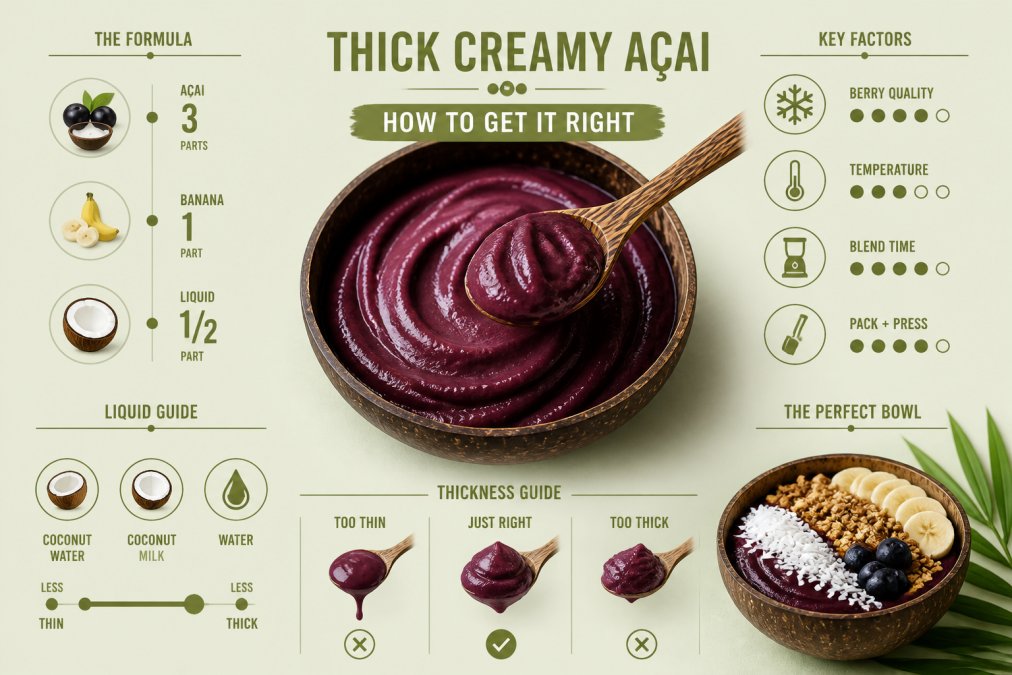
Thick Creamy Acai Texture: How to Get It Right
Table of Contents
- Why Thick Creamy Acai Texture Starts With the Right Ratio
- Acai Bowl Liquid to Fruit Ratio: The Definitive Guide
- Best Blenders for Thick Acai Bowls: Power and Blade Physics
- Step-by-Step Blending Technique for a Scoopable Bowl
- Troubleshooting Runny Acai Bowls: Common Causes and Fixes
- Temperature Management: Keeping Your Bowl Thick to the Last Bite
- Conclusion
- Frequently Asked Questions
Last Updated: September 13, 2026
Why Thick Creamy Acai Texture Starts With the Right Ratio
Most runny acai bowls aren't a blending failure, they're a measuring failure. Thick creamy acai texture comes down to one variable: how much liquid meets how much frozen fruit, by weight. This guide covers the ratios, equipment, and technique that separate a scoopable bowl from a smoothie.
The liquid-to-fruit ratio is the total liquid in your blender (plant-based milk, water, juice, or yogurt) versus the total weight of frozen fruit and acai base. Get it right and the rest becomes forgiving; get it wrong and no blending time will fix it.
Here's what most guides skip: acai from a frozen packet is already a semi-solid puree, not a dry fruit. It contributes its own moisture, so treating it like frozen banana leaves you with a thin, icy mess.
Acai Bowl Liquid to Fruit Ratio: The Definitive Guide
The working ratio for a thick, scoopable acai bowl is roughly 1 part liquid to 4 parts frozen fruit and acai by weight, with small adjustments depending on the fruit.
The 1:4 Liquid-to-Fruit Rule
Weigh your frozen ingredients first, then add liquid at about one-quarter of that weight. If your frozen acai and fruit total 400 grams, that's roughly 100 grams of liquid, close to 7 tablespoons of plant-based milk. Volume measuring fails because a "splash" of almond milk can easily be 80 grams. A kitchen scale removes the guesswork.
How to Adjust for Different Frozen Fruits
Not all frozen fruit behaves the same way in a blender. Water content, fiber, and pectin levels all change how thick the final bowl turns out.
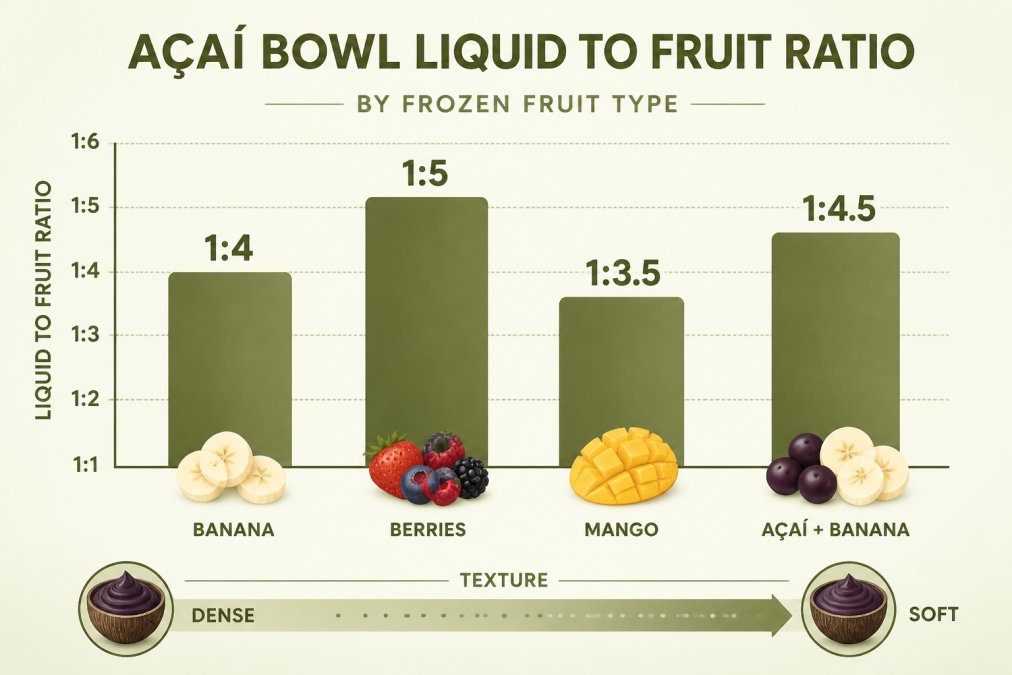
| Frozen Fruit | Suggested Ratio (Liquid:Fruit) | Texture Result |
|---|---|---|
| Frozen banana | 1:4 | Dense, ice-cream-like consistency |
| Frozen berries | 1:5 | Thicker, seedier mouthfeel |
| Frozen mango | 1:3.5 | Softer, needs less liquid |
| Acai packet + banana | 1:4.5 | Balanced, scoopable |
Frozen berries carry more water than banana, so they thin faster and need less liquid. Mango is softer and breaks down quickly, so a slightly higher ratio keeps it moving without turning runny. Acai packets add their own moisture, which is why the ratio nudges toward 1:4.5.
Measuring Your Ingredients by Weight vs. Volume
Weight wins for consistency. A cup of frozen berries varies wildly depending on how tightly they pack, while 140 grams is always 140 grams. If you only have cups, expect results to shift batch to batch.
Best Blenders for Thick Acai Bowls: Power and Blade Physics
The best blender for thick acai bowls has at least 1,000 watts of motor power and a tapered jar that pulls frozen fruit down into the blades rather than spinning it around the walls. Power and blade geometry matter more than speed settings.
The Vortex Problem: Why Thick Blends Stall
A thin smoothie forms a stable vortex, a cone-shaped whirlpool that feeds ingredients toward the blade tips. Thick acai blends don't. The frozen mass is too dense to circulate, so the blades carve a narrow channel through the center while outer material sits motionless against the jar walls. This is cavitation, the most common reason home blenders stall on frozen acai.
A blender that creates a proper vortex solves this. The vortex forms when blade pitch, the angle each blade is twisted, pushes ingredients downward and inward at once. Steep downward pitch (typically 30 to 45 degrees) generates stronger downward force; flat or shallow blades push material outward, which is why you stop every few seconds to scrape the sides.
Motor Power vs. Motor Torque: What Actually Matters
Wattage gets the marketing attention, but torque breaks down frozen fruit. Torque is rotational force, the ability to keep the blade spinning when it hits resistance. A 1,200-watt motor with low torque will still stall on a dense acai packet; a 1,000-watt motor with high torque powers through.
Blenders marketed for frozen desserts and nut butters tend to have higher torque than general-purpose blenders at the same wattage, thanks to gear reduction: some motors trade top speed for turning force, exactly the trade-off you want for thick acai.
Jar Shape and Taper: The Overlooked Variable
Jar geometry determines whether ingredients fall back into the blades or cling to the walls. A tapered jar, wider at the top, narrower at the bottom, uses gravity to funnel frozen fruit downward as it breaks apart; a straight-sided jar lets material pile up on the shoulders, out of reach. The sweet spot for a 400-gram acai blend is a jar between 48 and 64 ounces with a visible taper toward the blade assembly.
Blade Assembly: Count, Shape, and Material
Blade count matters less than blade mass and pitch. A two-blade assembly with heavy, downward-angled blades outperforms a six-blade assembly of thin, flat blades on frozen acai: heavy blades carry momentum through resistance, while thin blades deflect and lose contact.
Stainless steel holds its edge longer than coated blades, and a dull blade smears frozen fruit rather than shaving it. If your blender is over two years old and you blend frozen acai regularly, a replacement blade assembly is often the cheapest upgrade you can make.
Matching Blender Type to Your Workflow
| Blender Type | Typical Wattage | Best For | Limitation on Acai |
|---|---|---|---|
| Personal bullet blender | 250-600W | Single servings, soft fruit | Stalls on full acai packets; needs pre-crumbling |
| Standard countertop | 700-900W | Daily smoothies, some frozen fruit | Requires tampering and pulse technique |
| High-speed countertop | 1,000-1,500W | Frozen acai, nut butters, thick bases | Jar size may limit batch volume |
| High-torque frozen dessert | 1,000W+ with gear reduction | Dense acai, scoopable bowls | Higher cost; heavier base |
If you blend acai daily, a high-torque machine pays off in consistent results. If you blend occasionally, a standard countertop blender with a tapered jar and disciplined pulse technique gets you most of the way there, provided you don't overload the jar.
Step-by-Step Blending Technique for a Scoopable Bowl
Technique is where most people undo their good measuring. The goal: emulsify the frozen fruit and acai into a smooth, thick base without adding heat or extra liquid.
The Pulse-and-Tamper Method
- Add liquid first, then frozen fruit and acai on top. This keeps the blades from cavitating in an air pocket.
- Pulse in 3-second bursts, about 5 to 6 times, letting the fruit settle between pulses.
- Use a tamper tool to push ingredients down toward the blades. Never use a spoon or spatula while the blender runs.
- Switch to a low continuous speed for 15 to 20 seconds once the mixture starts moving.
- Stop the moment the texture turns uniform. Over-blending adds heat and thins the bowl.
The pulse-and-tamper approach keeps the frozen fruit cold while it breaks down. Continuous high-speed blending generates friction, the quiet enemy of a thick bowl.
Troubleshooting Runny Acai Bowls: Common Causes and Fixes
Runny acai bowls almost always trace back to one of four causes: too much liquid, warm ingredients, an underpowered blender, or over-blending. Identifying the cause is faster than guessing, and the fix depends on it.
Diagnosing the Problem Before You Fix It
Before adding anything, stop and identify the symptom. Each points to a different cause, and the wrong fix makes the bowl worse.
| Symptom | Likely Cause | Immediate Fix |
|---|---|---|
| Watery, pourable consistency | Too much liquid | Add 1/4 frozen banana or 1 tbsp chia seeds; re-pulse |
| Icy, gritty texture | Fruit too cold or under-blended | Pulse longer in short bursts; add 1 tbsp liquid only if blades stall |
| Thin after blending | Over-blending, heat buildup | Chill the bowl and base; blend in shorter bursts next time |
| Chunky, uneven | Weak motor, poor vortex | Tamper more; switch to a higher-torque blender |
| Thick at first, thin after 5 minutes | Warm bowl or warm toppings | Pre-chill bowl; use cold toppings only |
Specific Thickeners and How Much to Add
When a bowl is too thin, you have two options: add more frozen material or add a thickener that binds free water. Each has trade-offs.
Frozen banana is the most forgiving rescue ingredient. A quarter of a medium frozen banana adds roughly 30 grams of dense, low-water material and blends smoothly. It slightly sweetens the bowl.
Chia seeds absorb roughly 10 times their weight in liquid and form a gel that thickens without sweetness. One tablespoon per 400-gram batch is usually enough. Let the blend sit 2 to 3 minutes after pulsing so the seeds hydrate, then pulse once more. The trade-off: a slight seediness.
Protein powder, unflavored or vanilla whey or plant-based, acts as a mild thickener and adds body. One scoop per batch is typical. The trade-off is flavor shift and potential grittiness if not fully dispersed.
Nut butter adds fat, which emulsifies the mixture and improves mouthfeel. One tablespoon of almond or peanut butter per batch thickens slightly and adds richness. It won't rescue a truly watery bowl alone, but it improves a slightly thin one.
Coconut cream (the thick, solid portion from a chilled can) is the most effective fat-based thickener. One tablespoon per batch adds significant body and a subtle coconut flavor, and it emulsifies better than nut butter thanks to its higher saturated fat content.
The Order of Operations for Rescuing a Thin Bowl
Adding thickeners in the wrong order leaves a lumpy, uneven blend. Follow this sequence:
- Stop the blender. Don't keep blending and hoping. More blending adds heat and thins the bowl further.
- Check the temperature. If the bowl feels warm to the touch, transfer it to a chilled bowl and let it sit in the freezer for 5 minutes before proceeding.
- Add frozen material first. A quarter frozen banana or a few frozen berries will thicken without changing the flavor much.
- Add dry thickeners second. Chia seeds or protein powder go in after the frozen material, then pulse 3 to 4 times.
- Add fat-based thickeners last. Nut butter or coconut cream should be pulsed in gently to avoid over-blending.
- Let it rest. Give the bowl 2 to 3 minutes for chia or protein powder to hydrate before serving.
When to Start Over vs. When to Rescue
Not every thin bowl is worth saving. If the bowl is pourable, closer to a smoothie than a scoopable base, and you've already added liquid, the ratio is too far gone. Starting over with a fresh measurement is faster than trying to thicken a bowl that's already 30 percent liquid.
If the bowl is thick but slightly soft, a rescue works well. Rule of thumb: if a spoon stands up for 2 seconds before sinking, it's rescueable. If it sinks immediately, start over.
Preventing the Problem Next Time
The most reliable fix is prevention. Weigh your liquid in grams, not tablespoons. Keep frozen fruit at the back of the freezer, not the door. Chill your blender jar for 10 minutes before blending. And stop the moment the texture turns uniform, every extra second adds heat.
USDA food safety guidance on perishable food handling
Temperature Management: Keeping Your Bowl Thick to the Last Bite
Temperature is the variable almost no home guide addresses, and it decides whether your bowl stays thick after you sit down. Thick creamy acai depends on the frozen base staying frozen through blending.
Serve in a chilled bowl and keep it out of direct sun or a warm room. Toppings add their own temperature, so cold toppings like fresh berries, coconut flakes, and nut butter hold texture better than warm granola straight from a toasted pan. Nut butter also acts as a mild thickener, helping the base hold its shape.
The difference between a bowl that stays scoopable for 15 minutes and one that slumps in 5 usually comes down to how cold everything was going in. Work quickly, and don't let frozen ingredients sit on the counter while you gather toppings.
USDA food safety guidance on perishable food handling
Conclusion
Getting thick creamy acai texture right at home takes a scale, the right ratio, and a blender with enough torque to do the job without stalling. Most people get one of those three wrong and blame the recipe.
If you'd rather skip the trial and error, World Green Açai serves organic acai bowls crafted with the finest berries available. Order through our app to skip the line, or pick up a gift card for someone who'd appreciate a genuinely nutrient-dense treat. Our team is happy to talk through what goes into each bowl, and online ordering keeps the whole thing quick.
Frequently Asked Questions
How much liquid should I use for a thick acai bowl?
Start with 1/4 cup of liquid for every 1 cup of frozen fruit and acai packets. If your blender stalls, add more liquid 1 tablespoon at a time. The goal is to use the minimum liquid needed to get the blades moving. Plant-based milk, coconut water, or even a splash of nut butter can help emulsify without making the bowl runny.
Can I make a thick acai bowl without a high-speed blender?
Yes, but you'll need to adjust your technique. Let frozen fruit thaw for 5-10 minutes, cut large pieces into smaller chunks, and use the pulse setting frequently. Scrape down the sides often and add liquid sparingly. A lower-powered blender may require more patience, but a thick, creamy texture is still achievable with the right ratio.
Why does my acai bowl melt so quickly?
Your bowl melts fast when the base is too warm before blending or when you use too much liquid. Keep all ingredients frozen until the moment you blend, use chilled bowls, and avoid over-blending. Once blended, serve immediately. If you're meal-prepping, freeze the blended base in molds and re-blend briefly when ready to eat.
What are the best frozen fruits to add for a thicker texture?
Frozen banana is the gold standard for creaminess because of its natural pectin and low water content. Frozen berries like blueberries and strawberries add flavor but contain more water, so pair them with banana or mango. Avocado and nut butter are excellent thickeners that also boost healthy fats. Avoid watery fruits like melon or pineapple in high amounts.
Consistent texture is a process, not a lucky pour. World Green Açai makes that process easy with organic ingredients, convenient online ordering, and mobile app access so you can grab a properly thick bowl without the wait. Get started with World Green Açai and enjoy a bowl that holds its texture from the first scoop to the last.