 listicle
What Are the Benefits of Organic Acai Berries?
Table of Contents
- What Are Organic Acai Berries?
- Nutritional Profile of Organic Acai Berries
- How Organic Acai Supports Daily Energy and Stamina
- Acai Bowl Health Benefits: What to Expect from a Bowl
- Organic vs Conventional Acai: What the Label Doesn't Tell You
- Glycemic Index, Blood Sugar, and Metabolic Health
- Sourcing, Sustainability, and Quality: What to Look For
- Common Mistakes When Adding Acai to Your Routine
- A Quick Word on Getting It Right
- Frequently Asked Questions
Last Updated: September 16, 2026
What Are Organic Acai Berries?
Organic acai berries are the fruit of the Euterpe oleracea palm, grown without synthetic pesticides or fertilizers and harvested from the Amazon basin. What are the benefits of organic acai berries? They deliver a dense mix of antioxidants, healthy fats, and fiber in a single small fruit, which is why so many people now build a daily bowl around them.
This guide from World Green Açai breaks down what the research actually supports, how much to eat for steady energy, and which label claims are worth trusting. If you have ever wondered whether a purple bowl is genuine nutrition or dessert in disguise, the answer usually comes down to sourcing, not hype.
Nutritional Profile of Organic Acai Berries
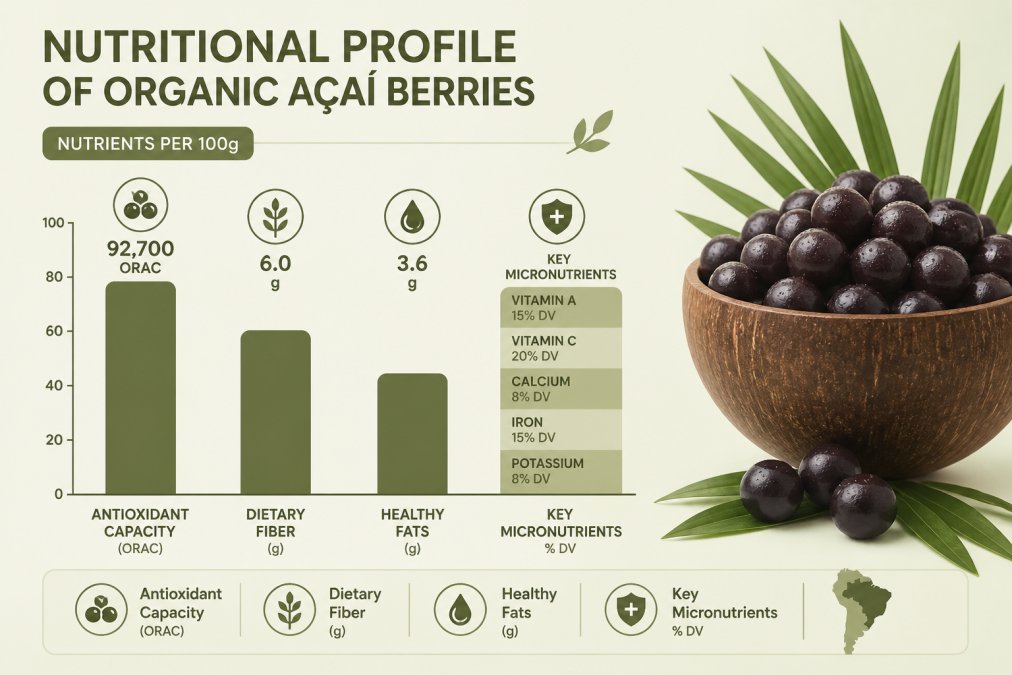
Acai earns its superfood reputation through nutrient density rather than any single miracle compound. Each berry carries antioxidants, healthy fats, and dietary fiber in proportions that few other fruits match.
The antioxidants belong to a class called polyphenols, and the most studied subgroup is anthocyanins, the pigments responsible for the deep purple color. These compounds help neutralize free radicals, the unstable molecules linked to oxidative stress and cellular damage.
Antioxidants and Anthocyanins
Anthocyanins give acai one of the higher antioxidant capacities among commonly eaten fruits. That matters because oxidative stress sits behind much of the inflammation researchers associate with aging and chronic disease.
A common mistake is assuming more antioxidants always means better results. In practice, absorption varies, and whole-food sources tend to outperform isolated powders.
Healthy Fats and Dietary Fiber
Acai contains healthy fats, including omega fatty acids, plus a meaningful dose of dietary fiber. That combination slows digestion and helps you feel full longer than a juice or smoothie made from sweeter fruit alone.
How Organic Acai Supports Daily Energy and Stamina
Acai supports sustained energy through a mechanism that has nothing to do with caffeine or added sugar. The fruit's fat and fiber content slows the rate at which its natural carbohydrates enter the bloodstream, which flattens the spike-and-crash pattern that follows a sugary breakfast. Instead of a rapid glucose rise and an equally rapid drop, the energy arrives gradually and holds through the next few hours.
The fat profile matters here. Acai contains oleic acid, the same monounsaturated fat found in olive oil, along with palmitic acid. Fat slows gastric emptying, meaning the stomach releases its contents into the small intestine more slowly. Fiber adds another layer by forming a gel-like matrix in the gut that further delays glucose absorption. Together, these two components turn a small fruit into a slow-release energy source rather than a quick sugar hit.
Busy professionals often reach for coffee and a pastry, then hit a wall by mid-morning. The pastry delivers simple carbohydrates with almost no fat or fiber to slow them down, so blood sugar rises fast, insulin responds, and the subsequent drop leaves you foggy and hungry. A bowl built on real acai pulp behaves differently because the energy arrives in a steady trickle rather than a flood.
Dosage Recommendations for Daily Energy
There is no official daily serving for acai, but a practical range works well for most people based on how the fruit is typically consumed:
- Light boost: one small bowl or smoothie, roughly 100g of pulp
- Sustained energy: 150-200g of pulp with protein or nuts added
- Post-workout recovery: 200g with fruit and a protein source
Start at the lower end and adjust based on how you feel. More is not automatically better. The goal is to find the amount that keeps you satisfied and steady without overloading your digestive system, which can happen when you eat a very large bowl in one sitting.
Synergistic Ingredients for Sustained Energy
Pairing acai with the right ingredients extends its effect. A common approach is combining it with:
- Nuts or nut butter for additional healthy fats and protein
- Banana or berries for natural sweetness and micronutrients
- Greek yogurt or a plant protein to slow digestion further
What most guides miss is that the toppings decide whether a bowl keeps you full or leaves you hungry an hour later. Sugary granola and sweetened juice undermine the whole point. A bowl with acai, almond butter, and a scoop of Greek yogurt delivers fat, fiber, and protein in a combination that can hold you for three to four hours. The same base with honey, juice, and candy toppings will not.
Acai Bowl Health Benefits: What to Expect from a Bowl
The acai bowl health benefits depend almost entirely on what else goes in the bowl. A well-built bowl delivers antioxidants, fiber, healthy fats, and micronutrients in one convenient meal. A poorly built one delivers sugar with a health halo.
At World Green Açai, we build bowls around real organic pulp rather than sweetened bases, which is the difference regular customers notice first. If you have tried bowls elsewhere that tasted like frozen yogurt, the base was likely diluted or heavily sweetened.
| Bowl Component | Best Choice | What to Avoid | Impact on Energy |
|---|---|---|---|
| Base | Frozen organic acai pulp | Sweetened sorbet base | Steady vs. spiking |
| Liquid | Small splash of water or milk | Fruit juice | Lower sugar load |
| Toppings | Nuts, seeds, fresh fruit | Candy, syrup, sweetened granola | Longer fullness |
| Protein | Greek yogurt or plant protein | None | Slower digestion |
For anyone grabbing a quick lunch, ordering ahead removes the guesswork. World Green Açai lets you order online and skip the line, so a nutrient-dense meal fits into a short break instead of eating into it.
Organic vs Conventional Acai: What the Label Doesn't Tell You
The organic vs conventional acai distinction matters most at the farming stage, not the nutrition label. Organic certification means the palms were grown without synthetic pesticides, which reduces residue exposure and supports cleaner agricultural practices.
Conventional acai can still be nutritious.
Here is what to check on a label:
- Does it name acai as the first ingredient, not sugar or syrup?
- Is there a USDA organic seal?
- Does it list added sweeteners you would not choose yourself?
- Is the pulp frozen rather than reconstituted from powder?
Glycemic Index, Blood Sugar, and Metabolic Health
Acai has a relatively low glycemic response on its own because its natural sugars come packaged with fiber and fat. The glycemic index measures how quickly a food raises blood sugar compared to a reference food, usually glucose or white bread. Foods with a low glycemic index release glucose slowly, while high-glycemic foods cause rapid spikes. Acai's combination of fiber and fat places it in the lower range, especially compared to refined carbohydrates.
Sourcing, Sustainability, and Quality: What to Look For
Sourcing determines both quality and environmental impact. Acai palms grow in Amazon floodplains, and well-managed harvests support local communities while keeping the forest standing, since the palms produce better when the surrounding ecosystem stays intact.
Common Mistakes When Adding Acai to Your Routine
The biggest mistake is treating acai as a dessert and expecting health results. Sweetened bases, syrups, and candy toppings turn a nutrient-dense fruit into a sugar delivery system.
Other frequent missteps:
- Skipping protein and fat. Without them, you will be hungry again quickly.
- Assuming powder equals fresh pulp. Processing and storage reduce antioxidant content.
- Drinking it instead of eating it. Chewing a bowl with whole toppings keeps you fuller.
- Ignoring portion size. A very large bowl still carries a lot of calories.
A Quick Word on Getting It Right
Building acai into your routine is less about willpower and more about removing friction. When a genuinely good bowl is easy to get, the healthy choice stops competing with the convenient one.
Frequently Asked Questions
Is it healthy to eat acai every day?
Yes, organic acai berries can be part of a daily routine. They provide antioxidants, healthy fats, and fiber that support sustained energy and overall wellness. A typical serving is 100 to 200 grams of frozen pulp or one bowl. If you are managing a health condition or taking medication, talk to your doctor about how acai fits your diet.
Does acai help with energy?
Organic acai berries contain healthy fats, fiber, and micronutrients that support sustained energy without a sugar crash. The combination of antioxidants and phytonutrients helps reduce oxidative stress, which can contribute to fatigue. For daily energy, a serving of 100 to 200 grams paired with protein or nuts can keep you going for hours.
What makes organic acai different from conventional acai?
Organic acai is grown without synthetic pesticides or fertilizers, which means fewer chemical residues and often higher levels of polyphenols and antioxidants. Organic vs conventional acai also differs in farming practices: organic operations focus on soil health and biodiversity. Look for USDA Organic certification on the label to confirm the berries meet federal standards.
Which is better for you, blueberries or acai?
Both are nutrient-dense, but organic acai berries have higher antioxidant levels, particularly anthocyanins, than blueberries. Acai also provides healthy fats and fiber that blueberries lack. However, blueberries are lower in calories and more widely available. For antioxidant support and sustained energy, acai has an edge; for a low-calorie snack, blueberries work well.
Getting consistent nutrition into a busy week is the hard part, and most people fail at it because the healthy option takes longer than the convenient one. World Green Açai closes that gap with online ordering, an easy mobile app, and bowls built from the finest organic acai berries available. Order online and have a nutrient-dense bowl ready when you walk in.