 comparison
Acai Sorbet vs Pulp: Key Differences Explained
Table of Contents
- Acai Sorbet vs Pulp: What's Actually in Your Bowl
- Side-by-Side Comparison: Ingredients, Nutrition, and Texture
- Acai Bowl Nutrition Facts: How Pulp and Sorbet Stack Up
- Organic Acai Benefits: What You Actually Get From Each Form
- Glycemic Impact and Cost: Two Things Most Comparisons Skip
- How to Choose High-Quality Acai: Reading Labels and Texture Cues
- Making the Right Choice for Your Bowl
- Conclusion
- Frequently Asked Questions
Last Updated: September 14, 2026
Acai Sorbet vs Pulp: What's Actually in Your Bowl
When it comes to acai sorbet vs pulp, the difference comes down to one thing: pulp is the raw, unsweetened berry puree, while sorbet is that same puree churned with sweeteners and emulsifiers into a ready-to-eat frozen dessert. That distinction changes everything about sugar content, texture, and use.
At World Green Açai, we field this question constantly from customers burned by bowls that tasted more like frozen yogurt than fruit. If your homemade bowl turned out icy or a store-bought one tasted suspiciously sweet, the answer usually sits in the ingredient list. Below, we break down how these two forms differ, what each does well, and how to pick the right one.
Acai pulp is the frozen, pasteurized puree of the acai berry, typically sold unsweetened and requiring blending before serving. Acai sorbet is a frozen dessert made by churning acai puree with added sweeteners, stabilizers, and sometimes emulsifiers to create a scoopable, dessert-like product.
Side-by-Side Comparison: Ingredients, Nutrition, and Texture
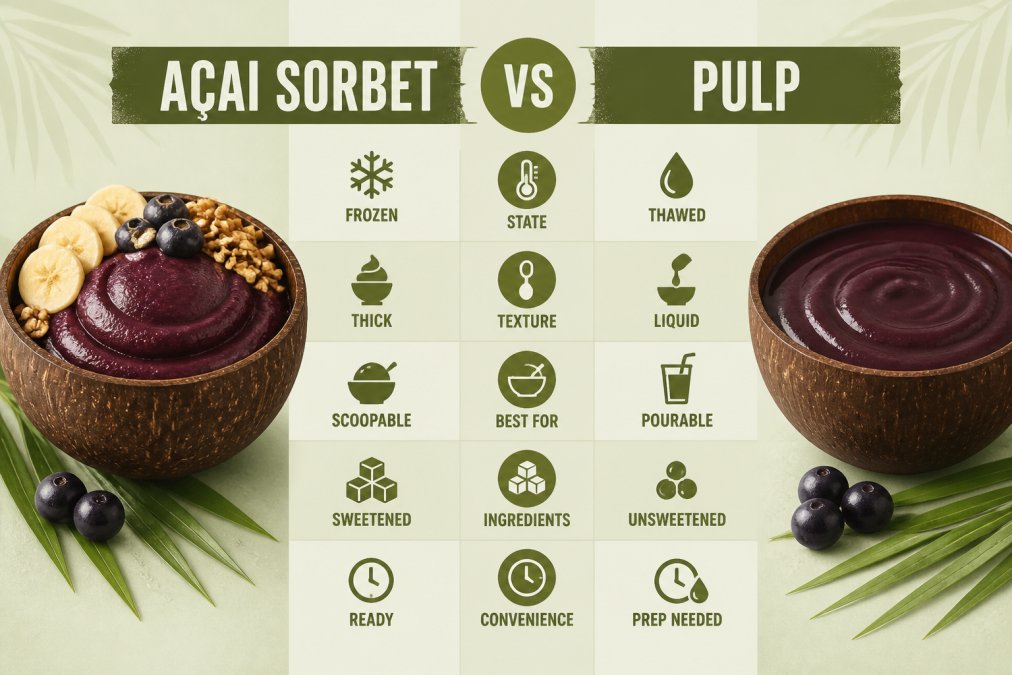
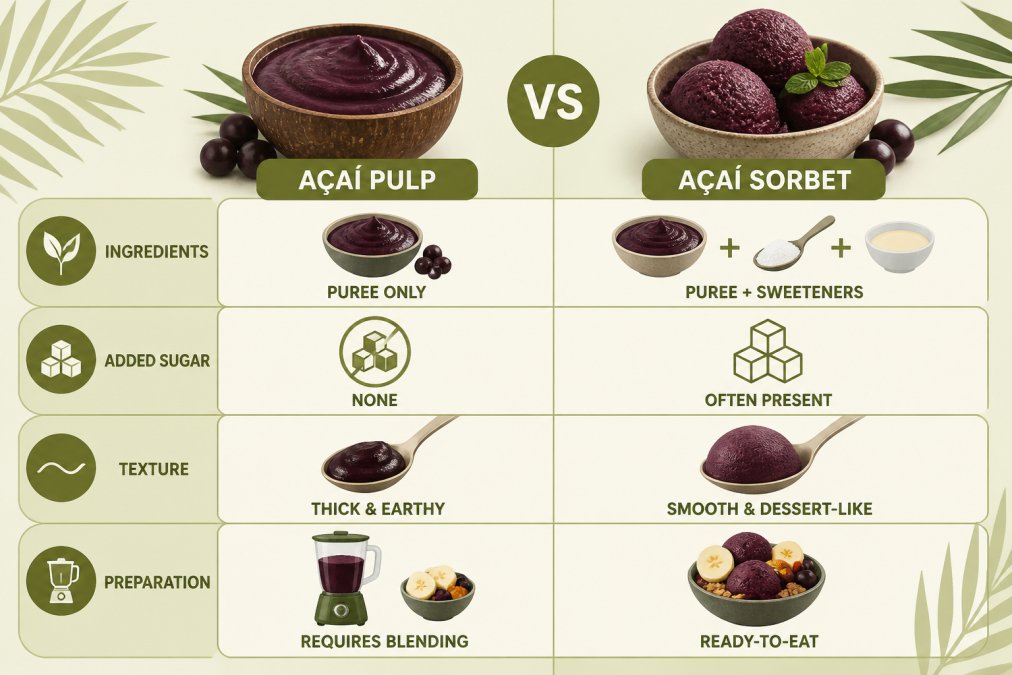
The clearest way to see the difference between acai sorbet and pulp is to compare them across the four dimensions that affect your bowl: ingredients, sugar, texture, and preparation.
| Dimension | Acai Pulp | Acai Sorbet |
|---|---|---|
| Ingredients | Puree only, often unsweetened | Puree plus sweeteners, stabilizers, emulsifiers |
| Added Sugar | None in pure form | Often present, varies by brand |
| Texture | Thick, earthy, slightly icy when blended | Smooth, creamy, dessert-like |
| Preparation | Requires blending and thawing | Ready to eat straight from the freezer |
| Flavor Profile | Bitter notes, earthy finish | Balanced, sweeter |
Pulp gives you full control over sweetness, pulp-to-liquid ratio, and add-ins. Sorbet gives you speed: open, scoop, eat. That trade-off is the whole story in miniature.
Acai Bowl Nutrition Facts: How Pulp and Sorbet Stack Up
Acai pulp wins on nutrition for one simple reason: nothing has been added. Unsweetened pulp delivers the berry's natural antioxidants, healthy fats, and omega fatty acids without the sugar load of most sorbets. The more useful question is why the two diverge nutritionally, because that explains almost every label you will read.
Three nutrient groups matter here. First, anthocyanins, the purple pigment family found in blueberries and blackberries, which act as antioxidants. Second, fats: acai is unusual among fruits because roughly half its dry weight is fat, mostly oleic acid (the monounsaturated fat in olive oil), plus smaller amounts of palmitic and linoleic acid. Third, fiber, which gives unsweetened pulp its thick, paste-like body. Together they are why acai behaves more like nut butter than juice when thawed.
Processing is where the two products separate:
- Flash-frozen pulp is pureed and frozen shortly after harvest. Because the berry is mostly fat and fiber, freezing needs no sugar or stabilizers to hold texture, so the nutrient matrix arrives largely intact.
- Pasteurized puree applies heat for safety and shelf stability. Some heat-sensitive anthocyanins degrade, but fat, fiber, and minerals survive essentially unchanged.
- Churned sorbet dilutes in two ways: churning whips in air, so a given volume holds less berry than dense pulp, and sweeteners, stabilizers, and emulsifiers displace berry solids. A half-cup of sorbet typically delivers less acai per serving than a half-cup of pulp, before counting added sugar.
Here is what that looks like in practice:
- Unsweetened pulp: anthocyanins, oleic acid and other healthy fats, fiber, no added sugar, dense berry concentration per serving
- Sweetened sorbet: the same base nutrients but at lower concentration per serving because of incorporated air and added ingredients, plus added sugar and stabilizers
- Frozen puree with guarana syrup: pulp plus a caffeine-containing sweetener, common in commercial bowl bases, which stacks stimulant effect on top of the sugar
One practical note: antioxidants are sensitive to oxygen and heat, not freezing. The biggest antioxidant loss in either product usually happens during home blending, not manufacturing. Over-blending whips in air and warms the mixture, another reason the pulse-and-scrape method matters for nutrition, not just texture.
If you are tracking sugar or managing dietary restrictions, read the label on any sorbet before assuming it is a health food. Some are genuinely light. Others are closer to ice cream than fruit. The ingredient list, not the front of the package, tells you which one you are holding.
Organic Acai Benefits: What You Actually Get From Each Form
Organic acai benefits depend far more on sourcing and processing than on whether the product is pulp or sorbet. A certified organic pulp and a certified organic sorbet start from the same wild-harvested berries; the difference is what happens after.
Organic certification matters because acai is a superfood category with heavy marketing and light regulation of claims. Look for third-party verification rather than trusting front-of-package language. USDA Organic certification standards require growers to avoid synthetic pesticides and maintain traceable supply chains, which is the closest thing to a guarantee that your berries came from a clean source.
Processing method shapes what survives the trip to your freezer:
- Flash-frozen pulp preserves more of the berry's raw-state compounds because the time between harvest and freezing is short
- Pasteurized puree trades a small amount of nutrient preservation for shelf stability and food safety
- Churned sorbet adds air and emulsifiers, which lowers the berry concentration per scoop
The harvest window is the variable most people never consider. Acai berries degrade quickly after picking, so quality depends on how fast the processor moved. That is why origin transparency matters more than the pulp-versus-sorbet decision itself.
Glycemic Impact and Cost: Two Things Most Comparisons Skip
Glycemic impact is where sorbet and pulp diverge most sharply, and almost no comparison addresses it. The mechanism explains why two products with similar calorie counts can behave very differently in the body.
Blood sugar response depends on how much sugar is present, how fast it is absorbed, and what slows that absorption. Unsweetened pulp has a low glycemic load because the berry's own fat and fiber act as speed bumps: fat slows gastric emptying, and fiber forms a viscous matrix that delays glucose release. The sugar that is naturally present arrives gradually.
Sorbet changes the equation on two fronts. Added sweeteners, whether cane sugar, agave, or fruit juice concentrate, are largely free sugars with little or no fiber, so they absorb quickly. And churning incorporates air, so a scoop can deliver its sugar in a smaller, denser package than the equivalent volume of pulp. The combination is a faster rise. For anyone managing blood sugar, a bowl of unsweetened pulp topped with nuts and seeds behaves very differently than pre-sweetened sorbet scooped straight from the container.
The practical rule: if you have dietary restrictions, pulp is the safer default because you control every gram of sugar that goes in. If you choose sorbet, look for one where added sugar is low or where the sweetener is paired with fat and fiber from the berry itself.
Cost-per-serving tells a similar story. Pulp usually costs less per serving because you are not paying for three things sorbet bundles in: added ingredients, packaging convenience, and churning. When you buy pulp, you buy berry. When you buy sorbet, you buy berry plus formulation plus a ready-to-eat format.
To compare without getting lost in brand pricing, divide the container price by the label's serving count, then adjust for how much of each serving is actual berry versus air and sweetener. Sorbet's incorporated air means a labeled serving often contains less fruit than the same weight of pulp. If you eat acai several times a week, that gap compounds. Buying pulp in bulk and blending at home shifts the per-serving math in your favor, at the cost of a few minutes of prep.
Neither is a bad deal. Sorbet's premium buys speed and consistency. Pulp's lower per-serving cost buys control. The right choice depends on which of those you value more on a given morning.
How to Choose High-Quality Acai: Reading Labels and Texture Cues
Choosing high-quality acai comes down to two skills: reading the ingredient list and judging texture. Both take about thirty seconds once you know what to look for.
Start with the label. A clean pulp lists one ingredient: acai. Anything else means you are buying a formulated product, which is fine as long as you know it. Watch for these markers:
- Acai listed first, not sugar or syrup
- No artificial colors or "natural flavors" doing heavy lifting
- Organic certification logo from a recognized certifier
- Country of origin stated, ideally with a specific region
- For sorbet: added sugar grams per serving clearly listed
Texture is the second tell. High-quality frozen pulp thaws into a thick, dense puree that holds its shape on a spoon; if it turns watery or grainy, the pulp-to-liquid ratio was off or the product was refrozen. Sorbet should look smooth and uniform, with no surface ice crystals, which signal temperature fluctuation in the supply chain and a compromised texture.
For a home preparation guide, the practical move is simple: thaw pulp slightly, blend it with a small amount of liquid and your choice of fruit, and serve immediately. Over-blending is the number one cause of thin, soupy bowls.
Making the Right Choice for Your Bowl
Choosing between acai sorbet and pulp is a question of priorities, not superiority. Pulp rewards anyone who wants control, lower sugar, and better per-serving value. Sorbet rewards anyone who wants speed, consistency, and a dessert-like texture without touching a blender.
Here is a quick decision framework:
| Your Priority | Best Choice | Why |
|---|---|---|
| Lowest sugar | Unsweetened pulp | No added sweeteners |
| Fastest prep | Sorbet | Ready to eat |
| Best value per serving | Bulk pulp | No convenience premium |
| Consistent texture | Sorbet | Formulated for creaminess |
| Full ingredient control | Pulp | You choose every addition |
| Vegan-friendly dessert | Either | Both are typically plant-based |
If your household eats acai a few times a week, keep both on hand: pulp for mornings you have five minutes, sorbet for the ones you do not. That is the honest answer most comparisons avoid because it does not fit a tidy verdict.
Conclusion
The difference between acai sorbet and pulp is not quality. It is what you are optimizing for: sugar control, convenience, texture, or cost.
At World Green Açai, we build our bowls from high-quality organic berries and let you order online so you skip the line entirely. If you want to taste the difference a clean, well-sourced acai base makes, our mobile app puts the full menu in your hand, and our online ordering gets your bowl ready before you arrive. Order online with World Green Açai and taste what real acai is supposed to be.
Frequently Asked Questions
Is acai sorbet actually healthy?
It depends on the formulation. Acai sorbet starts with real acai, so it carries some of the fruit's antioxidants and healthy fats. But many sorbets add sweeteners, emulsifiers, or guarana syrup, which raise the sugar content and dilute the nutritional profile. A sorbet with a short ingredient list, acai first and no added sugar, is a better choice than one loaded with syrups. Checking the label tells you more than the word sorbet on the package.
What is the best form of acai to use for bowls?
Unsweetened frozen acai pulp gives you the most control. You decide how much sweetener, fruit, or liquid goes in, so you can build a thick, creamy base without hidden sugar. Sorbet works when you want speed, since it is pre-sweetened and ready to eat. For a bowl you assemble at home, pulp plus a frozen banana and a splash of liquid produces a smooth consistency that holds toppings well.
Does acai sorbet contain added sugars?
Often, yes. Sorbet is formulated as a dessert, so many brands add cane sugar, agave, or guarana syrup to balance acai's natural bitterness. Some products also include emulsifiers for a smoother texture. Not every sorbet does this, so read the ingredient list. If sugar or syrup appears in the first few ingredients, the product is closer to a frozen treat than a pure fruit serving.
How can you tell the difference between pure acai pulp and sorbet?
Start with the ingredient list. Pure pulp lists acai and little else, while sorbet usually names sweeteners, stabilizers, or natural flavors. Texture is the second clue: pulp is dense and earthy with bitter notes, and sorbet is smoother and sweeter straight from the package. Color helps too, since pulp tends to look darker and less uniform than a churned sorbet.
Is an acai bowl made with sorbet less nutritious than one made with pulp?
It can be. Pulp preserves more of the berry's antioxidants, omega fatty acids, and fiber because it is flash-frozen in a raw state with nothing added. Sorbet goes through churning and often includes sweeteners, which raises sugar and lowers the acai concentration per serving. That does not make sorbet a bad choice, but if nutrient density is your goal, unsweetened pulp delivers more acai per spoonful.