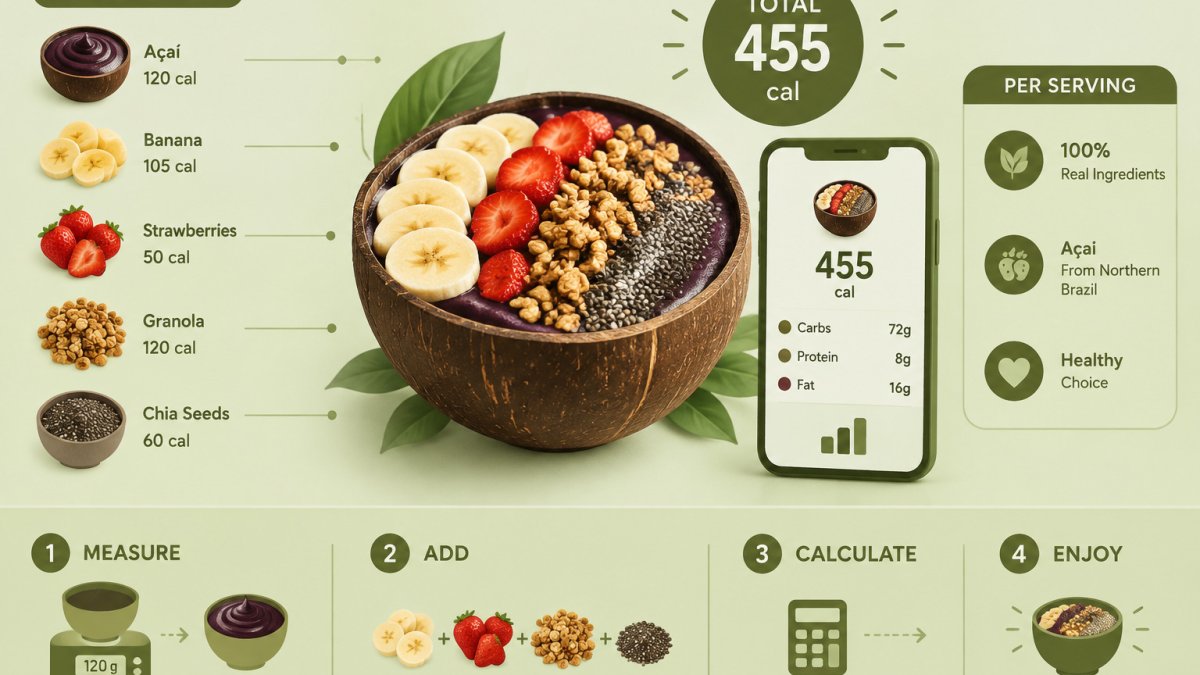
 How-to
How Do You Track Calories in a Homemade Açaí Bowl?
Last Updated: November 17, 2026
Quick Summary
To track calories in a homemade açaí bowl, weigh every ingredient on a digital scale, tare between additions, and log each topping separately. A typical bowl ranges from 200 to 500 calories, with toppings and sweeteners driving most of the difference.
- Tare the scale to zero before adding each ingredient so weights do not stack.
- Weigh frozen açaí against its package net weight, since a pack can read higher or lower.
- Log toppings like granola, nut butter, and honey separately to see which drives the total.
- Adding about 30 g granola, 16 g nut butter, and 10 g chia can add nearly 280 calories.
- Calculate batch totals first, then divide by the number of servings for per-bowl calories.
Table of Contents
- Why Homemade Açaí Bowl Calories Are Hard to Pin Down
- What You Need Before You Start Tracking
- Step-by-Step: Weighing Each Ingredient Accurately
- Calories in Açaí Bowl Toppings and How to Log Them Separately
- Calculating Calories for the Batch and Each Serving
- Setting a Standard açaí bowl Serving Size
- Handling Substitutions and Database Mismatches
- Booking Your Next Açaí Bowl at World Green Açai
- Frequently Asked Questions
Why Homemade Açaí Bowl Calories Are Hard to Pin Down
If you want to know how to track calories in homemade açaí bowls, start with the honest answer: it takes more work than most people expect, and a careful approach to how you track calories will pay off. A bowl that looks simple can hide a lot of energy in its toppings and sweeteners.
Published estimates vary widely. According to INTEGRIS Health's overview of açaí bowl calories, a typical bowl can range from 200 to 500 calories, and some reach 1,000. Portion size and add-ins drive most of that gap.
Why does the range stay so wide? Three things usually cause it:
- Portion size: A scoop of frozen açaí can vary a lot from one bowl to the next.
- Toppings: Granola, nut butter, and honey add calories fast.
- Sweeteners: Many blends include added sugar, even when the bowl tastes like fruit.
Here is the catch. Açaí itself is not always the main calorie source. Healthline's guide to açaí bowl nutrition notes that commercial bowls can reach 600 calories and 75 grams of sugar. Much of that comes from the other ingredients.
What You Need Before You Start Tracking
Before you log anything, gather the basics. You will get far better numbers with a few simple tools.
- A digital food scale that reads in grams
- A nutrition database or a label reader app
- A measuring spoon set for honey, nut butter, and granola
- A notebook or spreadsheet to record each ingredient
Use the same scale and the same units every time. Mixing cups and grams is the fastest way to create errors.
Step-by-Step: Weighing Each Ingredient Accurately
Weighing beats guessing, but the value comes from doing it the same way every time and watching a running total build. Here is the full sequence, with a worked example so you can see how the numbers accumulate.
- Tare the scale with the empty bowl on it. Press the tare or zero button so the display reads 0 g. Every weight you record from here on is the ingredient alone, not the bowl.
- Weigh the frozen açaí first. Frozen açaí packs are usually sold in fixed weights, so check the package net weight and confirm it against the scale. If a pack is labeled 100 g, the scale should read close to 100 g; a reading of 112 g means you are logging 112 g, not 100 g.
- Add the fruit base and weigh again. Tare back to zero, add banana or berries, and record the new grams. A medium banana is commonly around 118 g, but a large one can pass 140 g, the scale settles the difference.
- Add liquid and log it. Unsweetened almond milk is low in calories but not zero; tare, pour, and record the grams rather than eyeballing a splash.
- Measure sweeteners and nut butters by weight, not by spoonful. Tare, then spoon in honey or nut butter until the scale shows your target weight.
A worked example makes the running total concrete. Suppose you weigh 100 g frozen açaí, 120 g banana, 120 g unsweetened almond milk, 15 g honey, and 30 g granola. You now have five gram weights. Each one gets matched to a database entry or label value per 100 g, and you multiply: for a food at 350 calories per 100 g, 100 g is 350 calories; for one at 89 calories per 100 g, 120 g is about 107 calories. Add the five results and you have the bowl total before toppings.
Why grams instead of cups? Grams remove the ambiguity that comes with spoon and scoop measurements. Grams remove that ambiguity. The same logic applies to frozen fruit, where ice crystals and packing change how much fits in a cup.
Watch out: if you forget to tare between ingredients, every later weight includes the previous one and your total will be inflated by the sum of everything already in the bowl. Tare before each addition, not just at the start.
Keep a single column in your notebook or spreadsheet for grams and a second for the matched calorie value per 100 g. That two-column habit is what makes the next section, toppings, fast to log.
Calories in Açaí Bowl Toppings and How to Log Them Separately
Toppings are where homemade bowls quietly gain or lose a few hundred calories, so each one gets its own log line. Do not lump them into a single "toppings" estimate, you lose the ability to see which one is driving the total.
Here is how the common toppings behave when you weigh them, using typical label and database values per 100 g as a reference point:
- Granola: Often 400-500 calories per 100 g. A modest 30 g portion lands around 120-150 calories. Weigh it, a "handful" can easily be 50 g and push past 200 calories.
- Nut butter: Around 590-600 calories per 100 g. A level tablespoon is roughly 16 g, or about 95 calories; a heaped tablespoon can reach 25 g and 150 calories. Tare the jar on the scale and dip, or weigh the spoon.
- Honey and syrups: Roughly 300 calories per 100 g. A 15 g drizzle is about 45 calories; a free-pour over the bowl can double that without looking different.
- Seeds (chia, hemp, pumpkin): Commonly 480-560 calories per 100 g. A 10 g sprinkle is around 50 calories, small, but it adds up across a week.
- Coconut flakes: Often 600-660 calories per 100 g, so a 10 g pinch is roughly 60-65 calories.
- Fresh fruit: Lower density, generally 50-90 calories per 100 g depending on the fruit. Weigh it like everything else rather than counting "a few slices."
To see the swing, compare two versions of the same base. Base only: 100 g açaí, 120 g banana, 120 g almond milk, 15 g honey, roughly 350 + 107 + 20 + 45, or about 522 calories. Add 30 g granola (about 135), 16 g nut butter (about 95), and 10 g chia (about 50) and the bowl climbs to roughly 800 calories. Nothing about the bowl looks dramatically different, but the toppings added nearly 280 calories. That is the number most people underestimate.
Logging each topping separately also makes swaps visible. Replace the 30 g granola with 30 g of a lower-calorie cereal and you can see the exact change in your log instead of guessing. Replace honey with a zero-calorie sweetener and the 45-calorie line disappears.
Watch out: nut butter and honey are the two toppings most often logged by spoon rather than by weight, and they are also the two with the widest spoon-to-spoon variation. If you only fix one habit, weigh those two.
A practical pattern is to log toppings in the order you add them, top to bottom, so the log mirrors the bowl. When you review the week, sort by calorie contribution and you will quickly see which topping is worth adjusting first.
Calculating Calories for the Batch and Each Serving
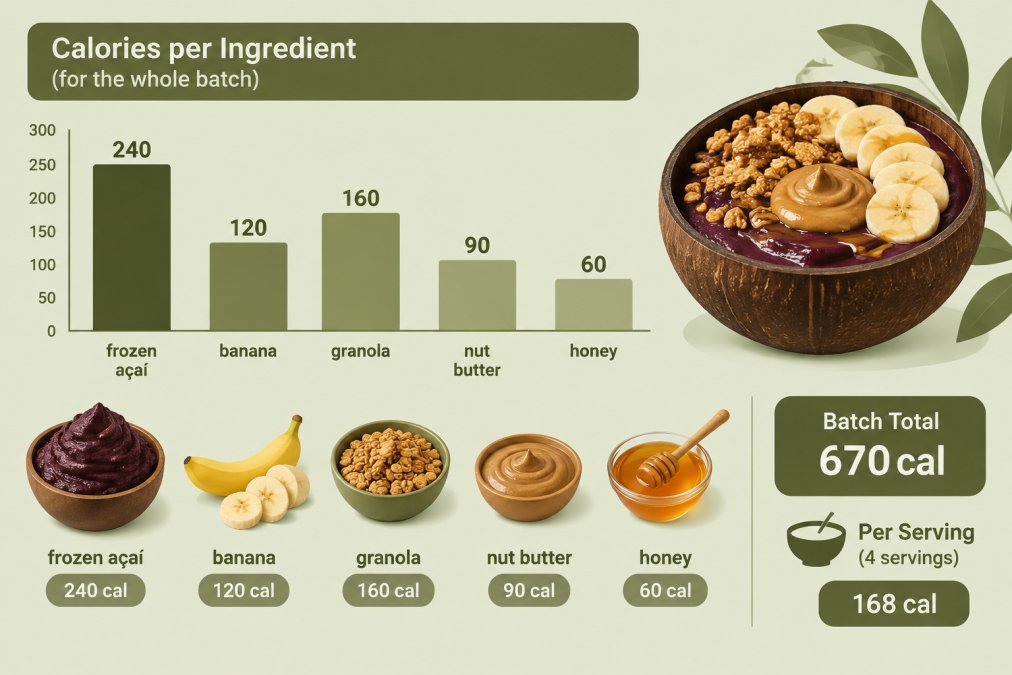
If you make a large batch, calculate totals first, then divide.
- Add up the calories for every ingredient in the batch.
- Divide by the number of servings you plan to make.
- Write the per-serving number on your log.
For example, if one batch totals 1,200 calories and makes 4 bowls, each bowl is about 300 calories. Check your math against your scale weights before you trust the result.
Setting a Standard açaí bowl Serving Size
Pick one standard serving size and stick to it. A standard bowl keeps your tracking consistent from week to week.
Start with a weight, such as 300 grams of finished bowl, and measure it once. Then record how many calories that weight contains. Use that number for every future bowl of the same size.
Handling Substitutions and Database Mismatches
Swaps happen. A different granola brand or a new fruit can change your totals.
- Check the label of any new product before you log it.
- Match the entry closely. If your database lists "raw banana" and you used a frozen one, note the difference.
- Write down substitutions so you can trace any sudden change in your numbers.
Database entries can disagree, too. When two sources give different numbers, choose the one that matches your product's label most closely and stick with it.
Booking Your Next Açaí Bowl at World Green Açai
Tracking your own bowl gives you control, but sometimes you want someone else to make it. A gift card from World Green Açai is an easy way to let a friend enjoy one of our bowls at our Larkspur shop. You can also order online from our menu, and our app makes repeat orders quick. For the latest prices, check our website or ask our team directly.
Frequently Asked Questions
How many calories are in a homemade açaí bowl?
A homemade açaí bowl depends almost entirely on its recipe and portions. Weigh each ingredient to get a number you can trust. Adding granola, nut butter, honey or extra fruit can push the total much higher. Weigh each ingredient on a food scale and calculate from the nutrition label or a food database rather than relying on a single generic figure.
How do you track calories in an açaí bowl?
Start by listing every ingredient, including toppings and drizzles. Weigh each one in grams, look up calories per gram from the nutrition label or a reliable food database, and multiply. Add the totals to get the batch calories, then divide by the number of servings. Log toppings as separate line items so you can see which additions drive the total. Keep a record of your method so you can repeat it consistently.
Why do açaí bowl calories vary so much?
Portion size, sweeteners, and toppings change the total far more than the açaí itself. Portion size and toppings can change a bowl's total considerably. Homemade bowls vary for the same reasons. Tracking each ingredient by weight, rather than by estimated scoops, reduces the gap between your logged total and what you actually eat.
Is an açaí bowl OK for weight loss?
An açaí bowl can fit a weight-loss plan when its total calories and added sugar match your daily targets. The unsweetened base is not the main problem; large portions of granola, honey, and nut butter are. Tracking the full bowl, including toppings, gives you an accurate number to compare against your goals. Check your overall daily intake rather than judging the bowl in isolation.