 How-to
7 Signs of Authentic Açaí Pulp You Can Check Yourself
Last Updated: November 20, 2026
Quick Summary
You can identify authentic açaí pulp by checking for deep purple color with brownish undertones, a thick slightly grainy texture, and an ingredient list that reads only açaí and water. Authentic açaí pulp tastes earthy and slightly tart, not like sweet frozen dessert, and it darkens toward brownish purple as it oxidizes without smelling sour or fermented.
- Bright fuchsia or neon violet shades usually come from added coloring, not the berry itself.
- Pure pulp should list açaí first, with water second and nothing else.
- Unsweetened pulp tastes earthy and slightly tart, closer to dark berries than candy.
- Thaw frozen pulp in the refrigerator overnight and use it within one to two days.
- Never refreeze thawed pulp, because freezing stops growth but does not sterilize.
Table of Contents
- Why Authentic Açaí Pulp Is Harder to Spot Than You Think
- Step 1: Check the Color of Real Açaí Pulp
- Step 2: Test Texture and Thickness
- Step 3: Read the Label for Pure Açaí Pulp Ingredients
- Step 4: Choose Unsweetened Açaí Pulp Over Sweetened Blends
- Step 5: Compare Fresh, Frozen, and Freeze-Dried Formats
- Step 6: How to Tell If Açaí Is Off
- Step 7: Ask Where the Pulp Comes From
- Frequently Asked Questions
Why Authentic Açaí Pulp Is Harder to Spot Than You Think
Açaí is big business. According to the USDA Foreign Agricultural Service's Global Acai Report, Brazilian açaí production is forecast at 2 million metric tons in 2026, up 11% from 2025. More supply means more products on shelves, and not all of them are what they claim.
Here's the uncomfortable truth: appearance alone can't confirm authenticity. A deep purple color and thick texture are useful clues, but they're easy to fake with dyes and thickeners. Many shoppers find this confusing when trying to buy real pulp. This guide walks you through seven checks you can do yourself, from label reading to a quick thaw test.
Below, we'll show you how to identify authentic açai pulp without a lab coat. Color is only one part of verification.
Step 1: Check the Color of Real Açaí Pulp
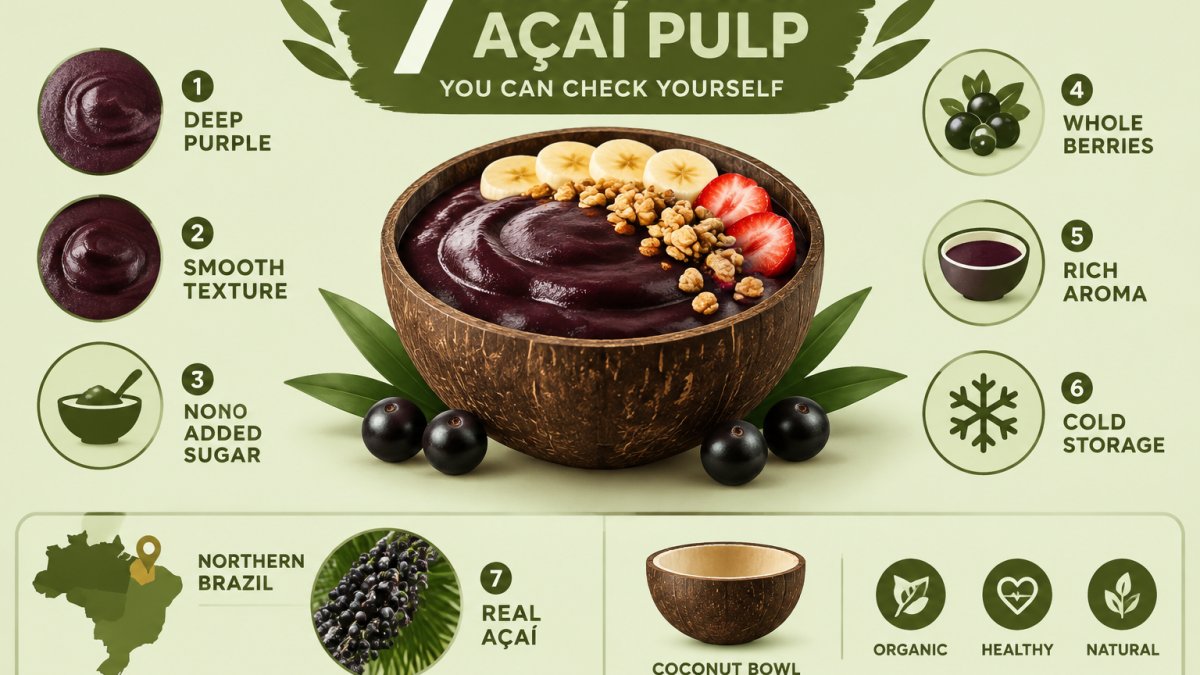
Authentic açaí pulp is deep purple, almost black in a thick pour, with brownish undertones at the edges. That brown tint matters. It signals real fruit, not dye.
Bright fuchsia or neon violet is a warning sign. Those shades usually come from added coloring, not the berry itself. Pure pulp also darkens as it oxidizes after opening. A product that stays cartoon-purple for days is suspicious.
Hold a spoonful against a white plate in daylight. Genuine pulp looks uneven, with slight variation across the surface. Flat, uniform color points to dilution or artificial dye.
Step 2: Test Texture and Thickness
Real açaí pulp is thick, smooth, and slightly grainy, like a dense sorbet before it melts. It should hold its shape on a spoon for a moment, then slide off slowly.
Thin, watery pulp has usually been diluted or stretched with water and thickeners. Icy, crystal-heavy pulp was likely frozen slowly or refrozen, which damages texture.
Try this quick test at home:
- Let a spoonful sit at room temperature for two minutes
- Watch how it melts: real pulp softens evenly
- Check for grit: a little grain is normal, sandy residue is not
Texture varies by format. Frozen pulp is chunkier than fresh, and freeze-dried powder is finer. Match the texture to the format before you judge.
Step 3: Read the Label for Pure Açaí Pulp Ingredients
The fastest way to judge a product is the ingredient list, but the front of the pack is written to sell, not to inform. Learn to read both panels and the claims stop being confusing.
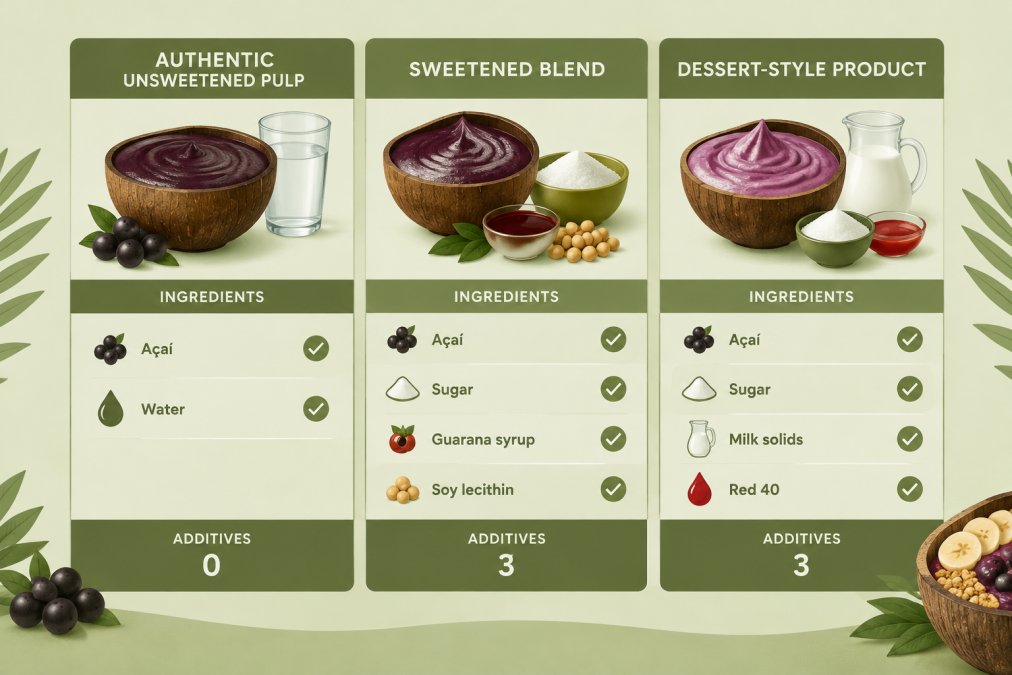
Start with the ingredient statement. Pure açaí pulp should read: açaí and water. That's it. Ingredients are listed by weight, so the first two or three entries tell you what you're mostly buying. If açaí is not first, or if water appears before açaí, you're looking at a diluted product.
Decode the Claims
Front-of-pack terms can be used loosely, so check the ingredient list before relying on them:
- "Pure", implies nothing added, but check the list. A product labeled pure that lists sugar, syrup, or gums is not pure pulp.
- "Unsweetened", means no added sugar, but it can still contain added fruit, fruit juice, or thickeners. Read the full list, not just the sugar line.
- "Organic", look for a USDA Organic seal and the name of the certifying agent on the package.
- "Pulp" vs. "puree", pulp is the fruit separated from the seed and frozen; puree may be blended, diluted, or sweetened. The terms are used loosely, so the ingredient list is the tiebreaker.
- "Blend", usually a signal that açaí is mixed with other fruit, juice, dairy, or sweeteners. A blend can be a fine product, but it is not pure pulp.
Additives That Signal a Diluted Product
Watch for these on the label:
- Sugar or cane syrup listed in the first three ingredients
- Guarana syrup, a common sweetener and filler in blends
- Soy lecithin or gums used to fake thickness
- Artificial dyes such as Red 40, or fruit-juice concentrates used for color
- Milk solids or yogurt powder, which turn pulp into dessert
- Added fruit such as banana, strawberry, or apple, which stretches volume and sweetness
None of these make a product unsafe. They make it something other than pure pulp. Watch out: a label that leads with sugar or lists açaí after water and sweetener is a sweetened blend, no matter what the front of the package says.
Check the Numbers and the Origin Line
Two more label details separate serious products from casual ones. First, look for a solids or pulp-content figure if the brand publishes one; a higher pulp concentration means less water and filler, though brands report this inconsistently. Second, check the country or region of origin. A label that names a specific region and a processor is easier to verify than one that says only "Amazon." If the origin line is vague, ask the seller directly before you buy.
Step 4: Choose Unsweetened Açaí Pulp Over Sweetened Blends
Unsweetened açaí pulp tastes earthy and slightly tart, closer to dark berries than candy. That flavor is the point. It tells you the fruit is doing the work.
Sweetened blends mask low pulp content with sugar. The result tastes like frozen dessert, and many buyers can't tell the difference at first bite. A good rule: if it tastes like ice cream, check the label before you trust it.
Buy unsweetened when you want control. You can always add banana or honey at home. You can't remove sugar once it's blended in.
Step 5: Compare Fresh, Frozen, and Freeze-Dried Formats
Frozen pulp is the closest thing to fresh for most buyers. Fresh pulp is excellent but has a short window and rarely travels well.
If you're weighing formats, this comparison of frozen açaí pulp vs powder breaks down the trade-offs. And if you're wondering whether a sorbet product counts as pulp, this guide to açaí sorbet vs pulp explains the difference.
| Format | Texture | Shelf Life | Best For |
|---|---|---|---|
| Fresh pulp | Thick, grainy | A few days, chilled | Immediate bowls |
| Frozen pulp | Dense, chunky | Months, frozen | Home bowls and smoothies |
| Freeze-dried powder | Fine, dry | Long, pantry-stable | Smoothies and travel |
Step 6: How to Tell If Açaí Is Off
Off açaí announces itself, but the trick is separating normal oxidation from actual spoilage. Both can change color and smell; only one makes the product unsafe. A practical inspection sequence, run in this order, catches most problems before you taste anything.
1. Inspect the packaging cold, before thawing. Frozen pulp should arrive rock-hard with no soft spots. Look for tears, loose seals, ice crystals or frost inside the bag, and liquid stains in the carton. A block that has partially thawed and refrozen often shows a thick ice crust or a collapsed, separated shape. Watch out: leaking or swollen packaging is a spoilage signal, not a shipping inconvenience, discard it rather than tasting to check.
2. Check the cold chain.
3. Thaw in the refrigerator, never on the counter. Move the pack to the fridge and let it thaw slowly, ideally overnight. Room-temperature thawing pushes the outer pulp warm while the center stays frozen, which is exactly the uneven condition that lets spoilage organisms multiply. Once thawed, keep it refrigerated and use it within one to two days.
4. Do not refreeze thawed pulp. Freezing stops growth; it does not sterilize. Refreezing a thawed pack preserves whatever multiplied during the thaw and wrecks texture with large ice crystals. If you only need part of a pack, portion it frozen and thaw only what you will use.
5. Run the sensory checks. Signs that point to spoilage rather than ordinary oxidation:
- Sour, fermented, or yeasty smell straight from the opened pack
- Mold anywhere on the surface, lid, or inside the bag
- Fizzing, bubbling, or a bulging package, which suggests gas-producing microbes
- Sharp sour or bitter taste that lingers, beyond the normal earthy tartness
- Slimy or stringy texture after thawing, rather than a smooth melt
Normal oxidation looks different. Authentic pulp darkens toward brownish purple after opening and may separate slightly into liquid and solids as it sits. That browning is chemistry, not contamination. The dividing line is smell and texture: oxidized pulp still smells like fruit, while spoiled pulp smells sour or fermented and may turn slimy.
6. Know when to throw it out. If any spoilage sign is present, discard the product. Do not try to salvage it by cooking or blending, and do not taste a suspect batch to confirm. Cold-chain handling matters more than most buyers realize: a product that sat warm in transit can look and smell fine and still be unsafe.
Step 7: Ask Where the Pulp Comes From
Origin questions separate serious sellers from casual ones. Brazilian açaí from the Amazon is a common benchmark for origin, and a seller should be able to tell you the region and processor.
Ask directly:
- Which country and region is the pulp from?
- Is it certified organic, and by whom?
- Can you share the supplier or processor name?
Vague answers are a red flag. So is a label that says "Amazon" with no other detail. For a broader framework on vetting products, this guide to choosing high-quality açaí products walks through the full checklist. Once you know what to look for, this 2026 buying guide to finding real açaí shows where to shop.
One more tool worth knowing: labs use near-infrared spectroscopy to screen freeze-dried pulp for adulterants like cornstarch, according to research indexed by the EPA's HERO database. You can't replicate that at home, but it confirms why visual checks alone aren't enough. Third-party testing exists for a reason.
Real açaí shouldn't be a guessing game. At World Green Açai, we build our bowls on organic berries and a simple promise: what you taste is what's in the cup. Order through our app to skip the line, or send a gift card to someone who deserves a better lunch. Get started with World Green Açai and taste the difference real pulp makes.
Frequently Asked Questions
What does real açaí look like?
Real açaí pulp is deep purple, close to dark violet, and looks thick rather than watery. It can carry a slight brown undertone because the pulp oxidizes quickly after processing, and small berry particles may be visible. A bright fuchsia or neon violet shade is a warning sign, since that color usually comes from dye rather than fruit. Color is a useful first clue but not proof: laboratory screening methods such as near-infrared spectroscopy are used specifically because appearance alone cannot confirm authenticity.
What ingredients should pure açai pulp ingredients contain?
A short list. Frozen or fresh pulp typically lists açaí and water, nothing else. Freeze-dried powder should list açaí alone. Anything beyond that, including sugar, guarana syrup, soy lecithin, milk solids, or color additives such as Red 40, tells you the product is a blend or a dessert base rather than pure pulp. Read the order of ingredients too: if sugar appears before açaí, the product is mostly sweetener.
How can you tell if açai pulp has gone bad?
Thaw a small amount and smell it. Fresh pulp smells faintly of berries and earth; spoiled pulp smells sour, fermented, or sharp. Look for separation into watery liquid and grainy solids, a dull gray-brown color, or visible mold. Taste a tiny amount: a fizzy or bitter edge means discard it. Check the package for ice crystals or a soft, refrozen block before buying.
Is frozen açai pulp better than açai powder?
For texture and flavor, frozen pulp is closer to fresh because it keeps the water content and the thick consistency that bowls depend on. Whichever format you buy, check that the ingredient list names only açaí, and source matters as much as format.