 How-to
How to Choose High Quality Açaí Products
Last Updated: November 12, 2026
Quick Summary
High quality açaí comes down to three things: how fresh the fruit is when processed, how much of the product is actually fruit, and whether anything has been added. Check the ingredient order, fruit percentage, serving size, and added sugars before you buy.
- Açaí should be the first ingredient, since ingredients are listed by weight.
- Look for a printed fruit percentage to compare products directly.
- Watch for added sugars hidden under names like fruit juice concentrate.
- Ask sellers when the fruit was processed after harvest.
- Confirm organic claims by checking a named certifying body.
Table of Contents
- What Makes Açaí High Quality
- Reading the Ingredient List: What Should Be There and What Should Not
- Frozen Açaí Purée Versus Açaí Powder: Choosing the Right Format
- Authentic Açaí: Telling Northern Brazilian Fruit From Blended Imitations
- Freshness, Processing Time, and Cold-Chain Storage
- How to Verify Quality Claims Before You Buy
- Using Açaí Powder Where It Fits Best
- Your Next Step: Ordering an Açaí Bowl You Can Trust
- Frequently Asked Questions
What Makes Açaí High Quality
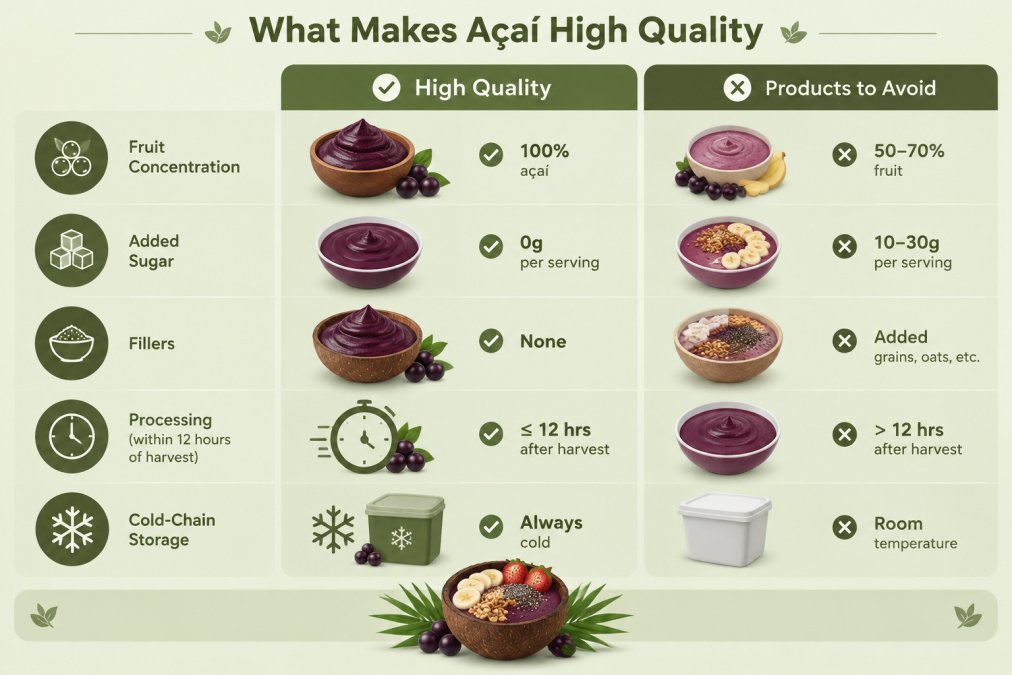
High quality açaí comes down to three things: how fresh the fruit is when it is processed, how much of the product is actually fruit, and whether anything has been added to it. Most of the difference between a good bowl and a disappointing one starts before the fruit reaches a freezer.
Açaí is highly perishable, and fruit that waits too long after harvest loses flavor and texture before anyone has a chance to freeze it.
Good purée tastes bright and tangy rather than sweet, and a thick, creamy texture is a useful sign of real fruit rather than thinners or fillers.
Reading the Ingredient List: What Should Be There and What Should Not
The ingredient list is the fastest way to judge a product, but only if you read it the same way every time. Most shoppers scan for the word "açaí" and stop. A consistent label-reading routine gets you much further, and it takes about a minute per product. To decode what goes into your bowl, see what açaí is made of and what's in your bowl.
Step 1: Read the order, not just the presence
Ingredients are listed by weight, from most to least. If açaí appears first, the product is mostly açaí by weight. If açaí appears after water, sugar, or a juice concentrate, the fruit is a supporting ingredient, not the base. A product can legally say "açaí" on the front and still list it third or fourth on the back.
Step 2: Find the fruit percentage
Many frozen purées and blends print a fruit percentage, for example, "60% açaí" or "açaí purée (40%)." This is the single most useful number on the package because it lets you compare two products directly. A 40% blend and a 90% purée are different ingredients for different jobs, and the percentage tells you which one you are holding. If no percentage is printed, use ingredient order as your fallback and treat the product as a blend until the seller confirms otherwise.
Step 3: Check the serving size against the fruit content
A label can look impressive until you check the serving size. A small serving with a high fruit percentage may deliver less actual fruit per bowl than a larger serving with a slightly lower percentage. Multiply the serving size by the fruit percentage to estimate how much açaí you get per serving, then compare that number across products rather than comparing the front-of-package claims.
Step 4: Hunt for added sugars under every name
Added sugar rarely appears as just "sugar." Look for cane sugar, evaporated cane juice, agave syrup, brown rice syrup, fruit juice concentrate, dextrose, and maltodextrin. Fruit juice concentrate is the most common hidden sweetener in açaí blends because it sounds natural while functioning as added sugar. If any of these appear before açaí, the product is a sweetened blend, not a fruit base.
Step 5: Identify fillers and texture agents
Fillers and thickeners stretch a small amount of fruit into a larger tub. Common ones include guar gum, xanthan gum, locust bean gum, modified food starch, and cellulose. A small amount of a stabilizer is normal in some frozen products, but a long list of gums and starches usually signals a low fruit percentage. Flavorings and colorings are a separate warning: real açaí is naturally dark purple and tastes tangy, so added flavor or color is often masking a weak base.
Step 6: Compare processing claims on the same footing
Claims like "flash-frozen," "cold-pressed," or "freeze-dried" describe how the fruit was handled, not how much fruit is inside. Put two products side by side and compare the same four fields: ingredient order, fruit percentage, serving size, and added sugars.
Watch out: a product can be labeled "organic" and still be a sweetened blend with a low fruit percentage, organic describes how the fruit was grown, not how much of it is in the tub.
A short, plain ingredient list remains the simplest signal of a producer doing the same work on their end. When the list is short and açaí leads it, the label-reading routine above usually confirms what the front of the package promises.
Frozen Açaí Purée Versus Açaí Powder: Choosing the Right Format
Frozen purée and powder are both legitimate formats, but they suit different uses. Frozen purée keeps the fruit's texture and flavor closest to fresh, which makes it the better choice for bowls and thick smoothies. Powder is shelf-stable and easy to store, which makes it useful for travel, pantry backups, and recipes where texture matters less. For a direct side-by-side comparison, read frozen açaí pulp versus powder for bowls and smoothies.
Format is a practical decision, not a ranking. A supplier's choice between formats such as sorbet, cubes, and purée should match what the product needs to do. Ask yourself whether you need a ready-to-blend base or a dry ingredient you can measure.
Authentic Açaí: Telling Northern Brazilian Fruit From Blended Imitations
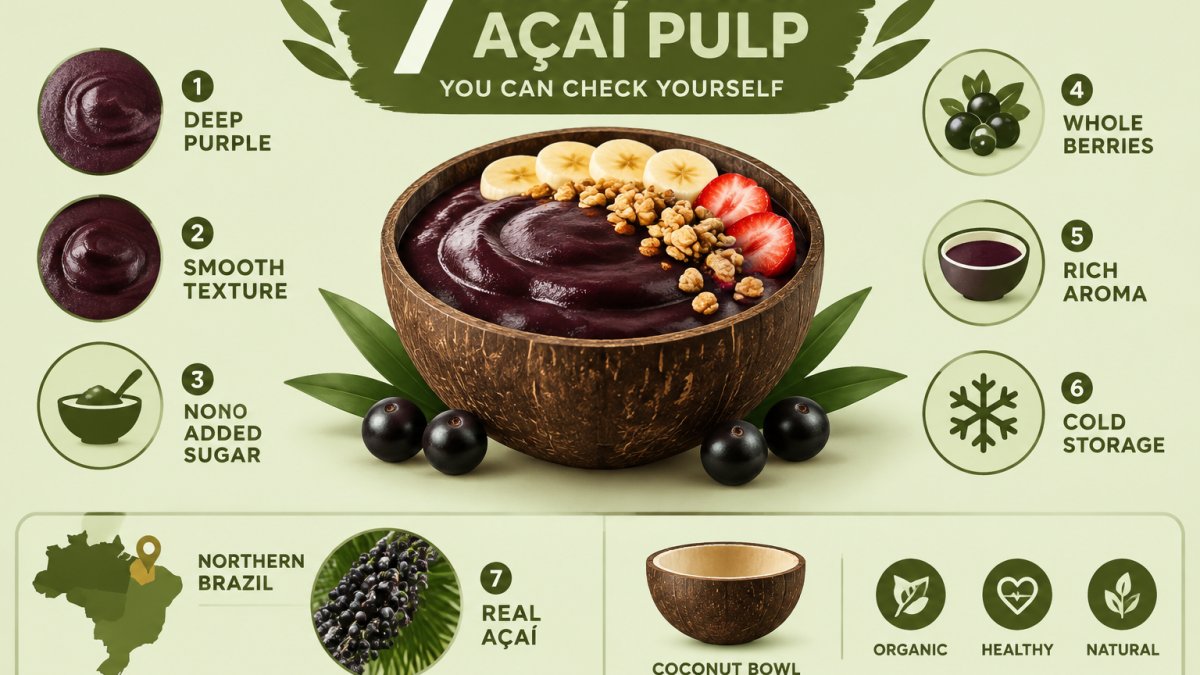
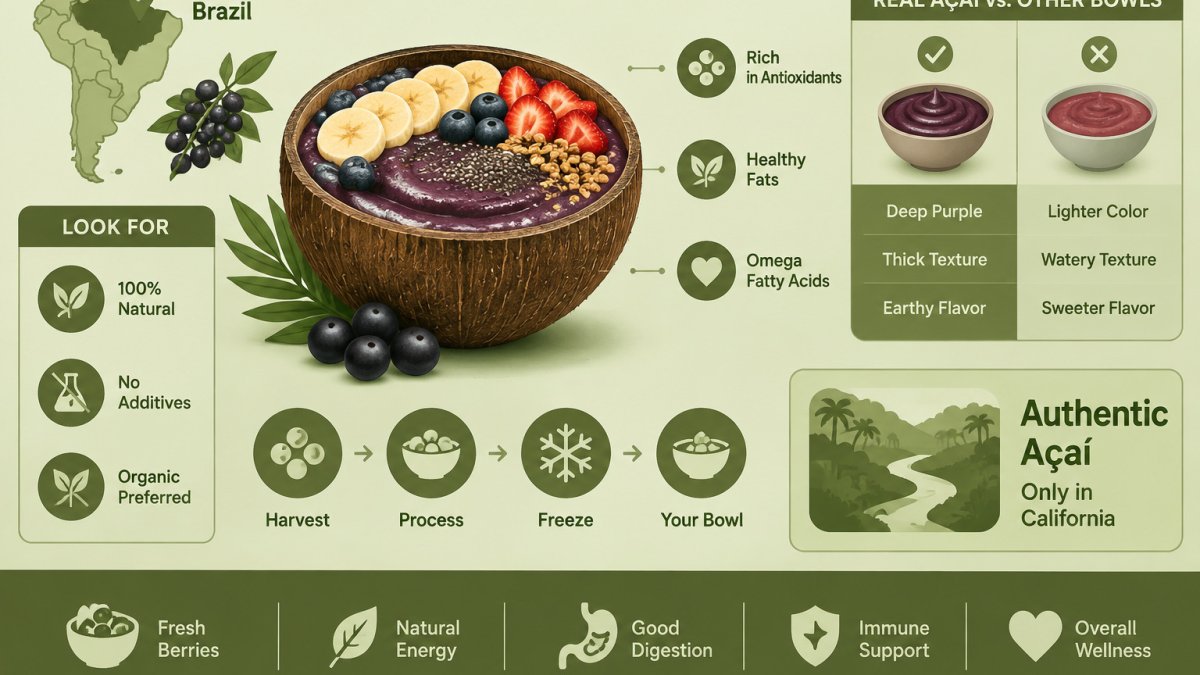
Authentic açaí traces back to the Northern Brazilian Amazon, where the fruit grows wild and is harvested by hand. Many products labeled "açaí" are blends where the fruit is a minor ingredient, so origin and purity are worth checking.
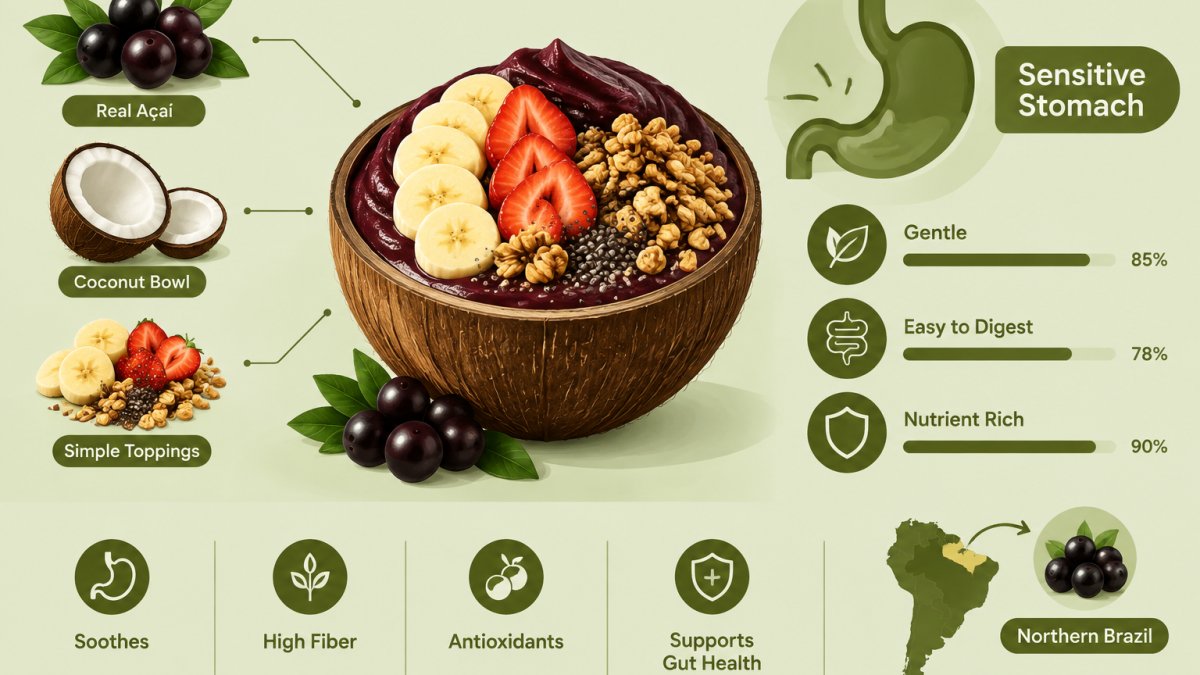
We serve authentic açaí from Northern Brazil in coconut bowls, and the point is that the fruit is real and the bowl tastes like the fruit itself.
Use these quick checks to tell authentic Northern Brazilian açaí from blended imitations.
| Check | What to look for | Why it matters |
|---|---|---|
| Origin | Traces back to the Northern Brazilian Amazon | Authentic fruit grows wild there |
| Harvest | Fruit harvested by hand | Marks traditional, wild-sourced açaí |
| Fruit content | Fruit is the main ingredient, not a minor one | Many "açaí" products are mostly blends |
| Purity | Check the label for added ingredients | Confirms the product is real fruit |
Freshness, Processing Time, and Cold-Chain Storage
Because açaí spoils quickly after harvest, the gap between picking and processing sets the ceiling on quality. Ask a seller when and how the fruit was processed. Vague answers are a warning sign.
After purchase, keep frozen products frozen until you use them. Repeated thawing and refreezing degrades texture and flavor. Store products at the temperature printed on the label, and use opened containers within the timeframe the label recommends.
How to Verify Quality Claims Before You Buy
Words like "organic," "pure," "premium," "natural," and "antioxidant-rich" are easy to print and hard to check. Treat every claim as a question to ask rather than proof of anything. The goal is to separate claims that are backed by a named, checkable process from claims that are purely descriptive. For a dedicated walkthrough, see how to identify genuinely organic açaí.
Sort claims into three buckets
Backed by a certifying body. An organic claim should name a certifying agent you can look up independently. In the United States, organic certification runs through the USDA National Organic Program, and certified operations are listed in the USDA Organic Integrity Database, which you can search by company name.
Backed by a test or a document. Some sellers can provide a certificate of analysis from a third-party lab, a specification sheet, or a supplier declaration describing fruit percentage and processing. These are meaningful because they are specific and traceable.
Descriptive only. "Natural," "premium," "superfood," "antioxidant-rich," and "authentic" have no defined legal standard in this context. They may be true, but they are not evidence. Do not let them substitute for a fruit percentage, an ingredient list, or a named certifier.
Ask the questions that produce checkable answers
A useful test is whether a question can be answered with a document or a number rather than an adjective. These questions tend to work:
- What percentage of the product is açaí fruit?
- When and where was the fruit processed after harvest?
- Which certifying body issued the organic certificate, and what is the operation's name in the certification record?
- Can you share a specification sheet or certificate of analysis?
- What is the recommended storage temperature, and what is the shelf life after opening?
Vague answers are a warning sign, but so are confident answers with nothing behind them. The strongest signal is a seller who can point to a specific record.
Use a verification checklist before you buy
- Açaí is the first ingredient on the label
- A fruit percentage is printed, or the seller can state one
- No added sugar, syrups, or juice concentrates appear before açaí
- No fillers, thickeners, or flavorings are listed
- The seller states when the fruit was processed after harvest
- Organic claims name a certifying body you can look up
- Storage instructions are clear and specific
- A specification sheet or certificate of analysis is available on request
Know the limits of nutrition claims
"Antioxidant-rich" on a package tells you nothing about how much fruit is inside or how it was handled. Nutrition claims and quality claims are separate questions. Verify the fruit content and processing first, then treat nutrition language as a bonus rather than a buying criterion.
Watch out: a certificate of analysis covers the specific lot it was issued for, so ask whether the document applies to the product you are actually buying.
Using Açaí Powder Where It Fits Best
Powder earns its place in a few situations. It works well for travel, for stocking a pantry, and for stirring into oatmeal or yogurt where a bowl's thick texture is not the goal. Measure it by the spoon, store it sealed and dry, and check the label for added ingredients, since some powders include sweeteners or fillers.
For a true açaí bowl, frozen purée gives the thick, spoonable texture that powder cannot match.
Your Next Step: Ordering an Açaí Bowl You Can Trust
Choosing good açaí comes down to fresh fruit, a short ingredient list, and clear sourcing. Use the checklist above on any product.
If you want to try it, you can visit World Green Açai in Larkspur or order online to skip the line.
Frequently Asked Questions
How can you tell if açaí is high quality?
Start with the ingredient list. A high-quality açaí product should list açaí as the first and main ingredient, with few or no added sugars, fillers, or additives. Check whether the product is kept frozen and whether the label names the format, such as frozen pulp or freeze-dried powder. Açaí fruit is highly perishable, so ask a seller how quickly its fruit is processed. Third-party testing or clear sourcing details are further signs of a reliable product.
What ingredients should I look for in açaí products?
Look for a short ingredient list led by açaí itself, such as açaí pulp or purée. Be cautious of products where sugar, syrups, juices, or fillers appear near the top, because these can dilute the fruit and change the taste. A product made from açaí alone is often the simplest choice. If a product includes granola, sweeteners, or other toppings, check each one separately so you know exactly what you are eating.
Is frozen açaí purée better than açaí powder?
It depends on how you plan to use it. Frozen açaí purée is closest to the fresh fruit in texture and flavor, which makes it a good choice for smoothies and açaí bowls. Açaí powder is shelf-stable, lighter to store, and easy to add to drinks or recipes, but it does not replicate the thick, creamy base of a bowl. Choose the format that matches your use and keep the storage needs of each in mind.
Where can I buy authentic açaí?
Look for sellers that name the origin of their fruit and explain how it is processed and kept frozen. Authentic açaí is typically sourced from the Amazon region of Brazil, and reputable sellers will describe their sourcing in plain terms. You can also ask World Green Açai about its ingredients and handling, and order online through its website or app.