 how-to
How to Identify Organic Açaí: A Complete Guide
Table of Contents
- How to Identify Organic Açaí: Start With the Label
- How to Read Açaí Ingredient Labels for Quality Markers
- Visual Inspection: What Real Organic Açaí Looks Like
- Verify Supply Chain Transparency and Traceability
- Common Adulterants and How to Spot Them
- Chemical Testing and Home Verification Methods
- Conclusion
Last Updated: August 10, 2026
How to Identify Organic Açaí: Start With the Label
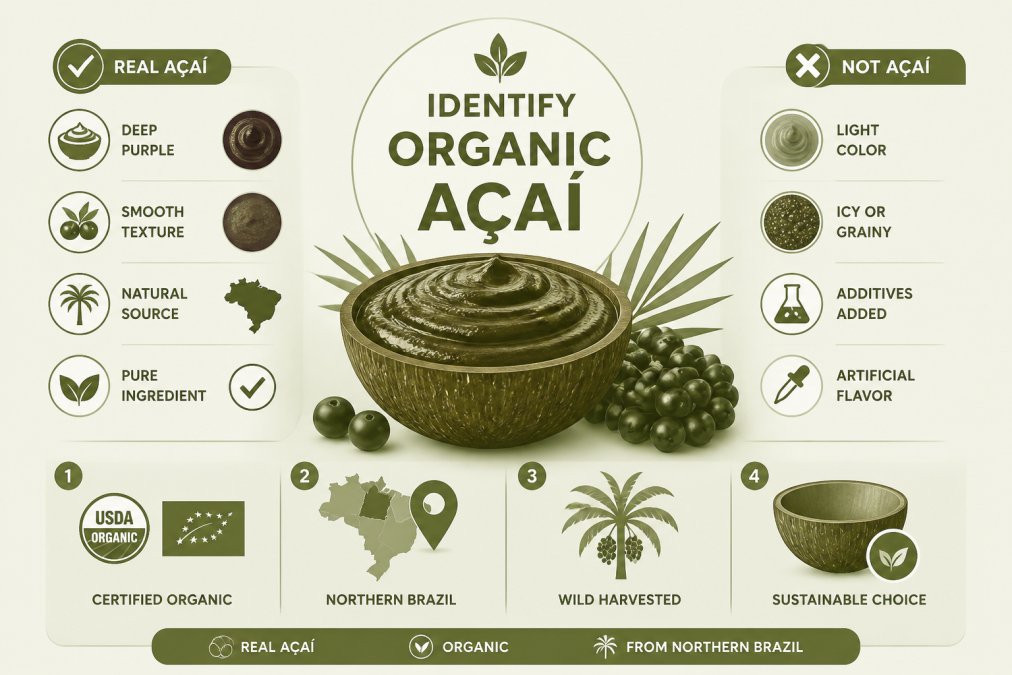
Real organic açaí tells a story on its label. Before you taste it, before you look at the color, the label is your first checkpoint. If you're learning how to identify organic acai, start here, because everything else follows from what the packaging promises.
The USDA organic seal is your gateway. When you see that seal, it means the product has been verified through a rigorous certification process. But the seal alone isn't enough. You need to read what's actually inside, understand what the words mean, and know which red flags signal trouble.
At World Green Açai in Larkspur, we've built our entire operation around transparency. Our açaí comes from Northern Brazil, authentic, single-origin berries processed to preserve their integrity. When you're evaluating any organic açaí product, you're asking the same questions we ask about our own supply: Is this real? Where did it come from? What's actually in the bowl?
What the USDA Organic Seal Actually Means
The USDA organic certification is not a marketing claim. It's a legal verification that the product meets federal standards for organic production. The seal means no synthetic pesticides, no artificial fertilizers, no GMOs, and no irradiation during processing.
But here's what matters most: certification is about how the açaí was grown and processed, not necessarily about quality or potency. An organic product can still be adulterated with fillers, frozen poorly, or harvested at the wrong time. The seal guarantees the farming method. It doesn't guarantee that what's in your bowl is pure, high-quality açaí.
When you see the USDA organic seal, you're looking at a verified supply chain. The producer has documentation tracing the berries from harvest through processing. This traceability is valuable, it's your proof that someone was watching the product from field to freezer.
Red Flags on Ingredient Lists
A single-ingredient açaí product should list only one thing: açaí. If you see "açaí puree" or "organic açaí puree," that's acceptable, puree is just the processed form of the berry. But anything beyond that deserves scrutiny.
Look for added sugars, syrups, or sweeteners. Real organic açaí doesn't need them. The berry has natural sweetness. If the label lists sugar, honey, agave, or any sweetening agent before or near the açaí, you're buying a blend, not pure açaí.
Preservatives are another signal. Sodium benzoate, potassium sorbate, or citric acid in large quantities suggest the product is fighting oxidation or spoilage. High-quality organic açaí, properly frozen or freeze-dried, requires minimal preservation.
Fillers are the hardest to spot because they hide behind innocent-sounding names. Acacia fiber, inulin, or other "natural" additives bulk up the product while cutting costs. These aren't necessarily harmful, but they're not açaí. If you're paying for açaí, you should get açaí.
How to Read Açaí Ingredient Labels for Quality Markers
The ingredient list is a hierarchy. The first ingredient listed is the most abundant by weight. Everything after that follows in descending order. This simple rule cuts through marketing language instantly.
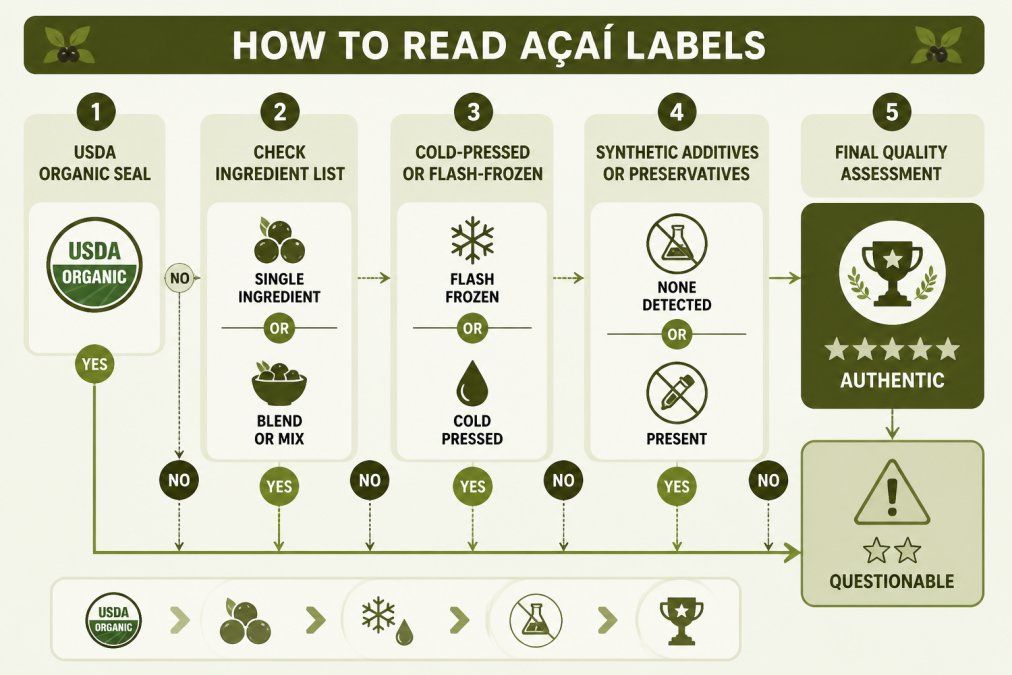
If "açaí" or "açaí puree" is not the first ingredient, you don't have a pure product. You have a blend. That's not inherently bad, blends can be delicious and nutritious, but you're not buying pure organic açaí. You're buying a fruit blend with açaí in it.
Spotting Pureed Berry Blends and Fillers
Pureed berry blends are common and often labeled misleadingly. A product might say "açaí blend" in large letters while listing açaí third or fourth on the ingredient list. The açaí is there, technically, but it's not the primary ingredient.
Look for the word "blend" explicitly. If the label says "açaí berry blend," you're getting a mixture. The açaí might be only 20 or 30 percent of what's in the container. Other berries, blueberry, raspberry, pomegranate, are cheaper and fill the product out.
Fillers like guarana, acacia fiber, or tapioca starch are added for texture, bulk, or claimed functional benefits. Some of these have their own nutritional profiles. Guarana adds caffeine. Acacia fiber adds prebiotic fiber. But they're not açaí, and they're not why you bought the product.
The texture of the final product often reveals the truth. Real, high-quality organic açaí has a dense, creamy texture when thawed. If your açaí bowl is icy, thin, or watery, the product likely contains fillers or was frozen improperly. Blended products tend to have a lighter, more granular texture because they contain less of the actual berry.
Understanding Cold-Pressed vs. Flash-Frozen
Cold-pressed açaí is extracted using pressure without heat. This method preserves heat-sensitive nutrients and maintains the berry's natural structure. Cold-pressed products are typically sold as pulp, thick, creamy, and concentrated.
Flash-frozen açaí is processed differently. The berries are frozen rapidly at very low temperatures, preserving cellular structure and preventing ice crystal formation that damages texture. Flash-frozen products are often sold as frozen bowls or frozen packets.
Both methods are legitimate for organic production. The difference is in the final product's texture and how you use it. Cold-pressed is richer and more concentrated. Flash-frozen is lighter and easier to portion.
The label should tell you which method was used. If it doesn't mention either, ask the vendor. A reputable producer knows their processing method and is proud to share it.
Visual Inspection: What Real Organic Açaí Looks Like
Before you eat it, look at it. Real organic açaí has a distinctive appearance that's hard to fake.
Color, Texture, and Pulp Consistency
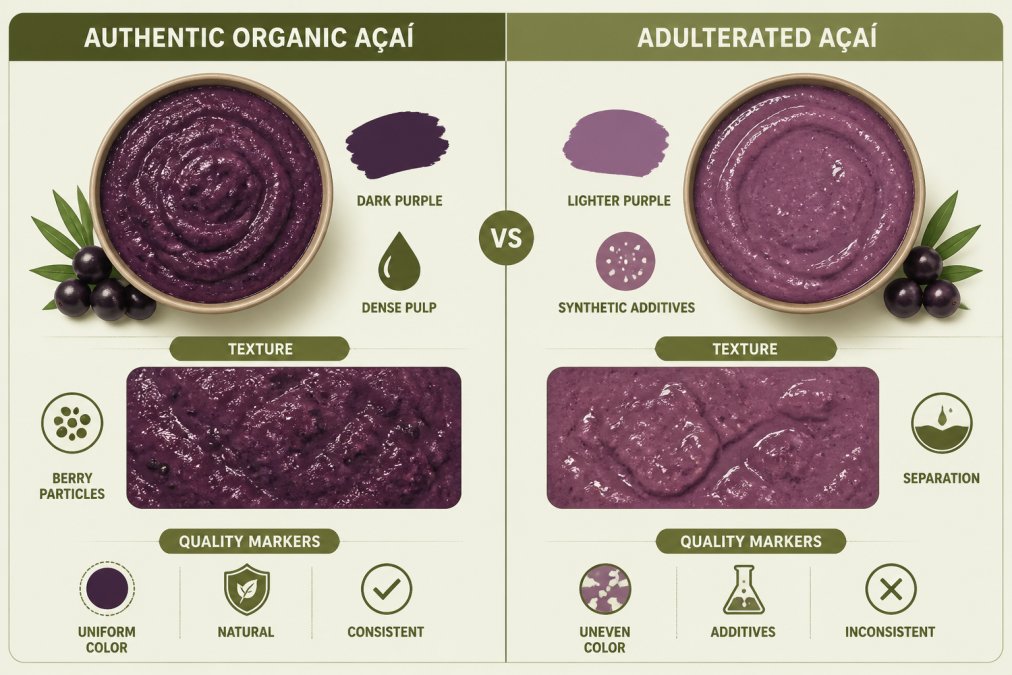
Authentic organic açaí is dark purple, almost black-purple. The color comes from anthocyanins, the antioxidant compounds that make the berry valuable. If your açaí is bright purple, light purple, or has any reddish tint, it's either adulterated or oxidized.
Oxidation happens over time. Exposure to air and light darkens the color and degrades nutrients. A product that's been sitting on a shelf for months will look darker than fresh product, but the darkness is loss, not quality.
The texture should be dense and creamy. When you scoop it, it should hold its shape briefly before softening. If it's icy or crystalline, the freezing process was too slow or the product thawed and refroze. If it's thin and pourable, it's likely a blend or heavily diluted.
Pulp consistency tells you about processing. Real açaí pulp has visible berry particles and a uniform texture. If you see large chunks of ice, separation between liquid and solid, or an unnaturally smooth, homogeneous texture, something's off.
Flavor Profile Analysis
Taste is the final verification. Real organic açaí has a distinct flavor profile that's hard to describe but easy to recognize once you know it.
The primary note is earthy. Not like dirt, but like concentrated berry with an underlying earthiness. There's a slight bitterness, not unpleasant, but noticeable. This bitterness comes from the berry's natural compounds and is a sign of authenticity.
Secondary notes vary by origin and processing. Some açaí has wine-like notes, almost like red wine or dark cherry. Others have subtle pomegranate undertones. These variations are normal and reflect the specific harvest region and berry ripeness.
What you should not taste is artificial sweetness. If your açaí tastes like candy or has a chemical aftertaste, it's been adulterated with sweeteners or flavorings.
If you're tasting an açaí bowl from a vendor, ask about the source. World Green Açai sources directly from Northern Brazil, where the best açaí grows. Knowing the origin helps you understand the expected flavor profile.
Verify Supply Chain Transparency and Traceability
Transparency is the mark of a producer with nothing to hide. When you can trace a product from harvest to your bowl, you have confidence in its authenticity.
Asking About Harvest Region and Sourcing
The best question you can ask is: "Where did this açaí come from?" A vague answer, "South America" or "tropical regions", is a red flag. A specific answer, "Northern Brazil, Pará region, harvested in June", is what you want to hear.
The harvest region matters because it affects growing conditions, berry ripeness, and flavor. Northern Brazil, particularly the Amazon region, produces the highest-quality açaí. The climate, soil, and traditional harvesting methods create berries with superior antioxidant content and flavor.
Ask whether the açaí is wild-harvested or cultivated. Wild-harvested açaí comes from native açaí palms in the Amazon. Cultivated açaí is grown on farms. Both can be organic, but wild-harvested has a different nutritional profile and is typically more expensive.
Ask about the supply chain. How many steps are there between the farmer and your bowl? Direct relationships, where the vendor works directly with growers, reduce the risk of adulteration and ensure better quality control.
Batch Verification and Quality Control
Reputable producers track batch numbers. Each batch of açaí has a unique identifier that connects it to a specific harvest, processing date, and quality check.
Ask if the product has a batch number. If it does, ask what that number tells you. A producer who can trace a batch back to its source, processing method, and quality verification is operating with full transparency.
Quality control should include testing for contaminants, verification of organic certification, and nutritional analysis. Not every producer publishes these results, but they should be willing to share them if asked.
World Green Açai maintains complete traceability on every product. We know the harvest date, the processing method, and the quality metrics for every batch we sell. This transparency is how we guarantee authenticity.
Common Adulterants and How to Spot Them
Adulteration is real. The açaí market has seen everything from synthetic dyes to completely fake products made from other berries.
The most common adulterant is other berry puree. Blueberry, raspberry, and blackberry are cheaper than açaí and have similar colors. A blend that's 50 percent blueberry and 50 percent açaí costs significantly less than pure açaí. The label might not make this obvious.
Synthetic dyes are less common in certified organic products, but they exist. If an açaí product is bright purple or has an unnaturally vivid color, it might contain artificial coloring. Real açaí, when exposed to light and air, darkens over time. Unnaturally consistent color across multiple batches is suspicious.
Fillers like guar gum, xanthan gum, or modified starch are added to create texture. These aren't harmful, but they're not açaí. They increase volume without adding nutritional value.
Added sugars are perhaps the most deceptive adulterant. A product labeled "organic açaí" might contain added organic sugar, which is still sugar. The label might not make this clear. Reading the ingredient list is the only way to catch this.
The worst adulterants are completely fake products, items made from other ingredients and marketed as açaí. These are rare in the US market because of FDA oversight, but they exist in unregulated markets. Buying from vendors with verifiable supply chains eliminates this risk.
Chemical Testing and Home Verification Methods
If you want certainty beyond visual inspection and label reading, chemical testing exists. It's not practical for individual consumers, but understanding what's testable helps you ask the right questions.
Third-party labs can test for anthocyanin content, the antioxidant compound that makes açaí valuable. High-quality organic açaí has specific anthocyanin levels. A product with unusually low levels might be adulterated or poorly processed.
Labs can also test for pesticide residues, heavy metals, and microbial contamination. Certified organic products should pass these tests, but verification through third-party testing adds another layer of confidence.
For home verification, you have limited options, but a few simple tests reveal basic information. The taste test is reliable, real açaí has that distinctive earthy, slightly bitter flavor that's hard to fake. The texture test shows whether the product was frozen properly. The color test, while imperfect, gives you a baseline.
One practical approach is to buy from vendors who offer transparency. Ask for test results, batch numbers, and sourcing documentation. Vendors who hesitate or refuse are worth avoiding.
Identifying authentic organic açaí requires attention to multiple details, the label, the appearance, the flavor, and the story behind the product. When you buy from World Green Açai, you're getting açaí sourced directly from Northern Brazil, processed to preserve its integrity, and backed by complete supply chain transparency. You can order online through our app for convenient ordering or visit us in Larkspur to experience the difference real, authentic organic açaí makes. Skip the lines, skip the guesswork, and get the quality you deserve.
Frequently Asked Questions
How can you tell if açaí is 100% organic?
Look for the USDA organic seal on the packaging, which certifies that the açaí meets federal organic standards. Check the ingredient label, authentic organic açaí should list only 'açaí' or 'açaí pulp' with no synthetic additives, preservatives, or fillers. Ask your supplier about their organic certification number and verify it through the USDA National Organic Program database. Real organic açaí from Northern Brazil sourced by authentic suppliers will have full supply chain transparency and batch verification documentation available upon request.
What does pure, high-quality organic açaí look like?
Authentic organic açaí has a deep, dark purple hue, almost black, with no artificial brightness. The texture should be thick and creamy when thawed, with visible pulp consistency rather than a watery or icy appearance. The flavor profile is distinctly earthy with subtle notes reminiscent of red wine and dark berries, never overly sweet or artificial-tasting. High-quality açaí maintains nutrient density and antioxidant content, with no visible separation of liquid or signs of oxidation. If it tastes like sugary frozen yogurt, it's likely a pureed berry blend or contains added sweeteners rather than real açaí.
What are common additives to avoid in non-organic açaí products?
Non-organic açaí often contains synthetic additives like high-fructose corn syrup, added sugars, and preservatives not found in authentic products. Watch for pureed berry blends that mix açaí with cheaper fruits like pomegranate, raspberry, or other berries to reduce costs. Some products include thickeners, gums, or stabilizers to mask poor pulp consistency. Avoid anything listing 'acai concentrate' or 'acai juice blend', these indicate adulteration. Always read the ingredient label carefully; genuine organic açaí should have minimal ingredients and no synthetic compounds. Batch verification and supply chain transparency help confirm you're getting the real thing.
How do I know if an açaí supplier is trustworthy?
Trustworthy suppliers openly share their USDA organic certification details and allow verification of their organic status. They provide information about harvest region, sourcing practices, and can explain their cold-pressed or flash-frozen processing methods. Ask about batch verification procedures and quality control standards, legitimate suppliers track every batch and can provide documentation. Look for suppliers who source directly from Northern Brazil's wild-harvested regions rather than generic sourcing. Check for label transparency that lists the harvest date and region. Authentic suppliers like World Green Açaí emphasize their commitment to genuine, high-quality organic açaí and welcome questions about their sourcing and certification.
This article was written using GrandRanker