 How-to
How to Choose Sustainable Packaging in Meal Delivery in 2026
Last Updated: November 11, 2026
Quick Summary
Sustainable packaging in meal delivery services means packaging that can be reused, recycled, or composted, and that causes less harm across its full life. For customers, it covers the box, liners, ice packs, and bags, and the key question is what happens to them after the food is gone.
- Sort meal kit packaging by material: cardboard, paper liners, film, gel packs, and rigid plastics each follow different disposal paths.
- Confirm your local program accepts each component before recycling, since acceptance varies widely by municipality.
- Treat compostable claims skeptically unless you have industrial composting access and clear disposal instructions.
- Reusable packaging only reduces waste when the company runs a working return and cleaning system.
- Ask providers for packaging weight per meal, recycled content by component, and actual recovery rates.
Table of Contents
- What Sustainable Packaging Means for Meal Delivery Services
- Which Packaging Materials Meal Kits Actually Use
- How to Recycle Meal Kit Packaging Component by Component
- Telling Compostable Food Packaging From Marketing Claims
- Reusable Food Packaging and Reverse Logistics
- Comparing Meal Delivery Services on Packaging Performance
- Choosing a Meal Delivery Service Based on Its Packaging
- Frequently Asked Questions
What Sustainable Packaging Means for Meal Delivery Services
Sustainable packaging in meal delivery services means packaging that can be reused, recycled, or composted, and that causes less harm across its full life. For a meal delivery customer, it is the box, the liners, the ice packs, and the bags that arrive at the door. The right question is not "is this box green?" but "what happens to it after the food is gone?"
Packaging is a bigger problem than it looks. The global eco-friendly food packaging market was estimated at USD 227.96 billion in 2024 and is projected to reach USD 353.78 billion by 2030, according to Grand View Research's food packaging market estimate. That growth reflects real demand, and it also tells you that many of the options on the market are still changing fast.
Packaging is only part of the picture. Meal delivery sustainability is a tradeoff between packaging and food waste. A customer who receives a meal they never cook sends more waste to the bin than packaging alone would suggest. Keep that in mind as you read the rest of this guide.
Which Packaging Materials Meal Kits Actually Use
Most meal kits rely on a small set of materials. Each one does a different job.
- Corrugated cardboard: The outer shipping box. It is usually the most recyclable part of the package.
- Insulated liners: Often paper-based or made from recycled fiber, depending on the service.
- Ice packs: Gel packs or frozen containers that keep food cold. These are often the hardest part to dispose of.
- Plastic film and bags: Used to hold individual ingredients. This is where most of the plastic usually sits.
Brands differ in how much plastic they use, and most providers do not publish a complete packaging breakdown.
The phrase "most" appears often in these claims. Ask what share of packaging is covered and which parts are left out.
How to Recycle Meal Kit Packaging Component by Component
A meal kit box is not one item. It is a stack of materials that each follow a different disposal path, and treating the whole box as "recyclable" is how contamination happens. The practical approach is to sort by material, identify what you are holding, and match it to what your local program actually accepts.
Corrugated cardboard box. Flatten it and place it in curbside recycling. Remove plastic tape, labels, and any glued-on plastic handles first, because those are the most common contaminants in the cardboard stream. Wax-coated or heavily greasy boxes usually belong in compost or trash rather than recycling.
Paper-based insulated liners. Many services now use paper liners made from recycled fiber. If the liner is clean and dry, recycle it with cardboard. If it is greasy, wet, or laminated to a plastic film, it usually belongs in compost or trash. Watch out: some paper liners look recyclable but have a thin plastic or foil layer bonded to them, and that mixed construction makes them unrecyclable in most curbside programs.
Plastic film and bags. The thin bags that hold individual ingredients are the largest plastic component in most kits. Most curbside programs do not accept them. Store drop-off bins at large retailers are the common recovery route, but acceptance varies, so confirm before you bag them up. Do not put film in curbside recycling, it tangles sorting equipment.
Gel ice packs. Check the label first. Some gel packs are drain-safe and can be emptied into the trash with the outer film discarded separately; others should be returned to the service if a return program exists. Never pour gel down a drain unless the label explicitly says it is drain-safe.
Rigid plastic containers and trays. Rinse them and check the resin code against your local accepted list. Many programs accept bottles and jugs but not clamshells or trays, even when both carry the same number.
Food scraps. Compost them if you have access. Otherwise, trash them. Scraps in the recycling bin contaminate the paper stream.
Mixed-material components. Insulated box liners with a plastic outer film and a paper inner layer, freezer packs with plastic covers, and boxes with glued-in foam are the hardest items. When a component cannot be separated by hand, it usually cannot be recovered.
The sorting steps above only work if your local program accepts the material. Municipal collection varies widely: some cities take mixed paper and cardboard together, some require separation, and some have no curbside program at all. Drop-off access is not equal either, a store drop-off bin that is a short walk away in one neighborhood may be a long drive in another.
Telling Compostable Food Packaging From Marketing Claims
"Compostable" and "biodegradable" are not the same thing, and they are not always backed by real-world conditions. Many compostable products need industrial composting facilities, which not every community has. A package that breaks down in a lab may still end up in landfill if no composting service collects it.
A 2024 review covers regulatory frameworks for paper-based and compostable packaging, and it shows that rules are still developing. California's SB 1335 aims to align food-service packaging with state recycling and composting systems, which is one example of how policy is shifting toward packaging that fits the local system, California Department of Resources Recycling and Recovery's SB 1335 page.
When you see a compostable claim, ask three questions:
- Is it certified, and by whom?
- Does my local program accept it?
- Does the company explain where and how it should be disposed of?
Vague claims without disposal instructions are a warning sign.
Reusable Food Packaging and Reverse Logistics
Reusable packaging can reduce waste, but only when a working system returns and cleans it. The U.S. Environmental Protection Agency states that reusable food service ware uses less energy and fewer resources over its lifespan, but only if an effective reuse system is in place, according to EPA guidance on sustainable food service ware.
That condition matters. A reusable container that is thrown away after one use has no advantage over a single-use box. Reverse logistics, meaning the process of getting packaging back from the customer, is the part that decides whether reuse works.
If you are evaluating a service, look for a clear return program, a deposit or incentive to return boxes, and details on how packaging is cleaned and reused.
Comparing Meal Delivery Services on Packaging Performance
The table below summarizes what the supplied research says about each service. It does not rank them, and it marks where a claim is not verified. The more useful comparison is not which service sounds greenest, but which one gives you enough information to measure.
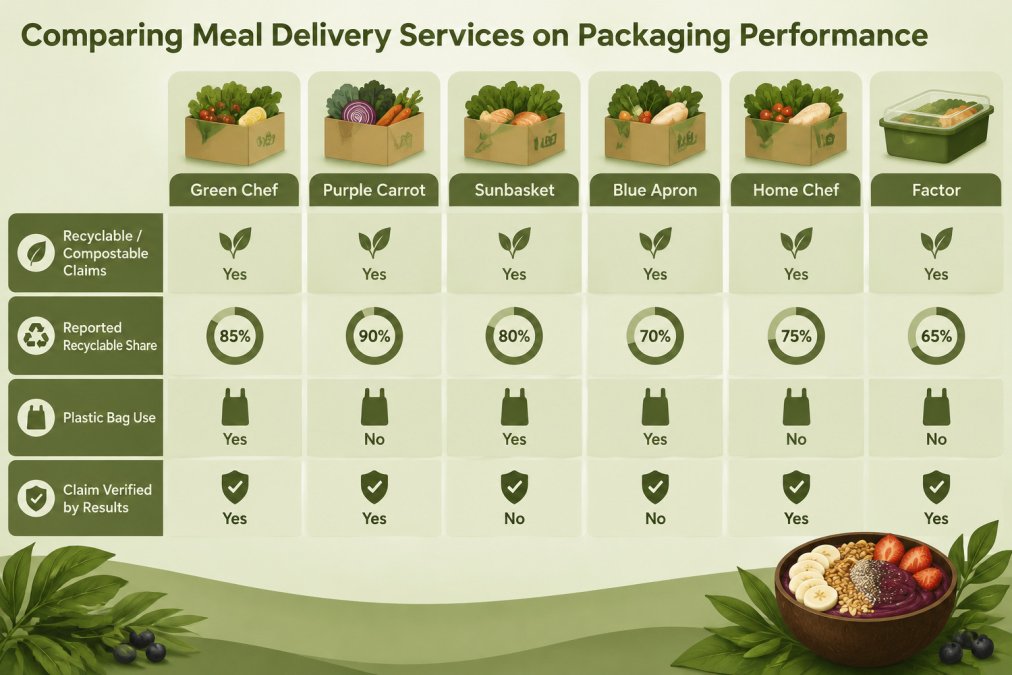
| Service | Packaging claim reported | Plastic use noted | Verified in supplied results |
|---|---|---|---|
| Green Chef | Almost all packaging recyclable, reusable, or compostable | Not specified | Partly; no component breakdown |
| Purple Carrot | Recyclable insulated boxes, nontoxic ice packs | Not specified | Partly; disposal not explained |
| Sunbasket | Mostly recyclable or compostable; recycled and virgin kraft paper | Not specified | Partly; "most," not all |
| Blue Apron | 50% of packaging recyclable, per a cited study | Not specified | Partly; study date not given |
| Home Chef | Individual plastic bags for ingredients | Yes, individual bags | Yes, as a packaging format |
| Factor | Customer concern about plastic packaging | Raised by a customer | No verified breakdown |
Pricing for each service is not stated in the supplied results, so check each company's website for current costs.
The most important finding is that almost no service gives a complete, verified packaging breakdown. That is the real comparison problem. "Most" and "almost all" are not metrics, and a claim that 50% of packaging is recyclable tells you nothing about which half.
A better approach is to ask each company for a small set of measurable benchmarks. Four measurable numbers can help separate a real program from a marketing one:
- Packaging weight per meal. Grams of packaging per serving, broken out by component. Lower is better, but only if food safety and insulation still hold.
- Recycled content. The share of post-consumer recycled material in the box, liner, and film, stated separately rather than as one blended figure.
- Recovery rate. The share of packaging that is actually recovered in practice, not just technically recyclable. A package that is recyclable in theory but not accepted locally has a low recovery rate.
- Emissions per delivery. A figure for the delivery itself, ideally including the insulation weight that has to be shipped and chilled.
These benchmarks matter because recyclability alone is a poor measure of sustainability. A heavier, fully recyclable liner can carry more embodied carbon than a lighter liner that ends up in landfill. A service that ships more insulation to protect food may reduce spoilage and food waste, which can outweigh the packaging impact. The honest comparison weighs packaging against spoilage, transport, and the grocery-shopping alternative the customer would otherwise use.
When you evaluate a service, ask for the material list for every component of the box, the recycled content by component, and the disposal instructions for each part. A company that can answer those questions is giving you something to measure. A company that answers with "most" is asking you to take its word for it.
Choosing a Meal Delivery Service Based on Its Packaging
Start with what you can verify. If a service names its materials and explains how to dispose of them, it gives you more to judge. If it uses "most" or "almost all" without specifics, ask for details before you commit.
Next, match the packaging to your local system. A service with compostable liners is only useful if you have composting access. A service with reusable boxes is only useful if the return program works where you live.
Finally, weigh packaging against food waste. Ordering only the meals you will cook can matter as much as the box itself. If you want a fast, healthy option with less packaging to sort, you can contact us to ask about our options, or read about our approach before you decide.
What's the simplest step you can take this week? Look at the packaging from your last delivery, sort it by material, and check your local rules. That single habit tells you more than any marketing claim.
Frequently Asked Questions
Which meal delivery service is most eco-friendly?
No single service leads on every measure, and the supplied research does not rank providers on a complete packaging scorecard. Providers vary in how much of their packaging is recyclable or compostable, and most do not publish a complete breakdown. Compare each provider's current packaging disclosures before deciding, and check whether the materials match your local recycling options.
Can meal kit packaging be recycled?
Often, but not all of it. Meal kits typically combine cardboard boxes, paper, plastic film, insulated liners and freezer packs, and each component follows different rules. Cardboard and paper are generally accepted in curbside recycling, while plastic film and some insulation often are not. Freezer packs may contain plastic and should be checked for the provider's return or disposal instructions. Recycling a box alone does not cover the whole kit.
How can meal delivery services reduce packaging waste?
Services can reduce waste by using recyclable or compostable materials, cutting the number of plastic bags, offering reusable insulated boxes with return programs, and right-sizing packaging to the order. Reusable food service ware can reduce resource use over its lifespan only when an effective reuse system is in place, so reuse programs need working return logistics to deliver the benefit. Packaging changes also need to be weighed against food waste, since spoiled food can outweigh packaging savings.
Is reusable packaging better than recyclable packaging for meal delivery?
It depends on whether the reuse system actually works. Reusable food service ware is preferable only if it is effectively reused, which requires customers to return boxes and the provider to collect, clean and redeploy them. Recyclable packaging avoids that logistics chain but still depends on local recycling access. For customers who can reliably return boxes, a reuse program is likely the stronger choice. For everyone else, a well-recycled single-use box is a reasonable alternative.