 ultimate-guide
Organic Açai Certification Standards 2026
Table of Contents
- What Makes Açai Truly Organic: USDA Organic Certification Requirements
- Organic Açai Supply Chain Transparency and Traceability
- Accredited Certification Bodies and Third-Party Verification
- Labeling Compliance and What You Can Claim
- Açai Berry Health Benefits and Safety Standards
- 2026 Regulatory Updates and What Changed
- The Application Workflow: Step-by-Step Certification Path
- Cost-Benefit Analysis: Is Certification Worth It?
Last Updated: August 29, 2026
What Makes Açai Truly Organic: USDA Organic Certification Requirements
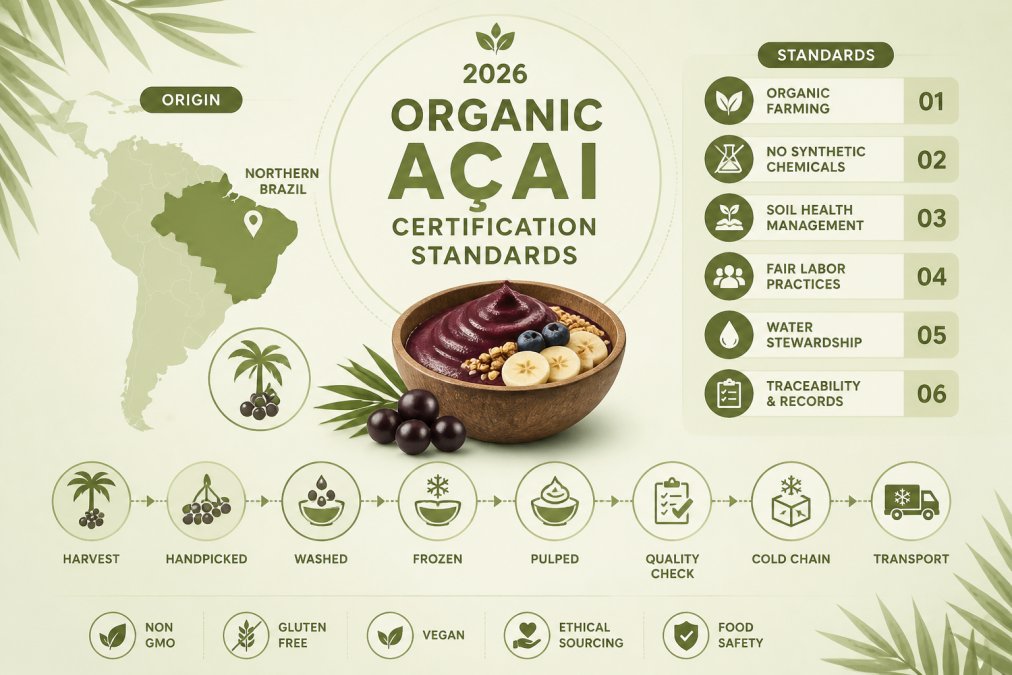
Organic açai certification standards represent a rigorous framework ensuring that açai berries meet strict agricultural and processing criteria. The USDA National Organic Program (NOP) establishes these standards, prohibiting synthetic pesticides, synthetic fertilizers, and genetically modified organisms (GMOs) throughout the entire production cycle. Farmers must maintain detailed records demonstrating compliance for a minimum of three years before their first harvest can be certified as organic, with third-party verification, annual inspections, and ongoing compliance monitoring.
The NOP Framework and Synthetic Pesticide Prohibitions
The National Organic Program is the federal regulatory standard governing all organic food production in the United States. Under NOP rules, synthetic pesticides are completely prohibited, meaning zero tolerance for residues from conventional agricultural chemicals. This applies to the açai berry from growth cycle through harvest and processing.
Açai grows in tropical climates where pest pressure is naturally high. Conventional growers rely on synthetic fungicides and insecticides, while organic producers must use approved alternatives: sulfur-based treatments, neem oil, beneficial insects, and careful crop rotation. This requires more labor-intensive farming practices, directly impacting both quality and certification timeline.
Synthetic pesticide prohibitions extend beyond the field. Post-harvest processing facilities must maintain organic integrity, with equipment thoroughly cleaned before processing organic açai. Facilities undergo separate certification for handling procedures, ensuring no cross-contamination occurs.
GMO-Free Requirements and Verification
GMO-free status is a core requirement of organic açai certification standards. Though açai has no commercially available genetically modified varieties, the GMO prohibition exists as a principle within the organic framework. Certification bodies verify that all inputs, seeds, soil amendments, and processing aids contain no genetically modified organisms.
For imported açai from Brazil, verification becomes more complex. Certifiers must trace the supply chain back to the original farming operation to confirm no GMO contamination occurred. This traceability requirement is one reason why authentic organic açai commands a higher price point than conventional alternatives.
Organic Açai Supply Chain Transparency and Traceability
Supply chain traceability is where organic açai certification standards become truly demanding. Every batch must be tracked from harvest through processing, packaging, and distribution, a legal requirement under the organic framework. This prevents fraud, enables rapid response to contamination issues, and provides documentation for annual audits.
From Harvest to Processing: The Timeline That Matters
Timing matters significantly in organic açai certification standards. Açai berries are highly perishable and must be frozen within 24 hours of harvest at certified facilities using approved methods. This rapid freezing preserves nutritional integrity and prevents mold development.
For imported açai, the timeline extends significantly. Shipment from Brazil typically takes two to four weeks by sea. During transit, temperature control is essential, frozen açai must remain frozen throughout transport. Any thawing or temperature fluctuation must be documented and can potentially invalidate the organic status of that batch.
Documentation and Audit Requirements
Documentation is the backbone of organic açai certification standards. Farmers must maintain records showing soil testing results, input records for all fertilizers and amendments, harvest dates and quantities, processing facility certifications, and distribution records. These records must be maintained for a minimum of five years and made available during annual inspections.
For processors and distributors, documentation requirements are equally stringent. Facilities must track every incoming shipment of organic açai, verify its certification status, and document how it was processed. If a facility handles both organic and non-organic products, separate documentation must prove that no cross-contamination occurred.
Accredited Certification Bodies and Third-Party Verification
Third-party certification bodies are the gatekeepers of organic açai certification standards. These USDA-accredited organizations conduct inspections, verify compliance, and issue organic certificates. Without this independent verification, the "organic" label would have no credibility.
The certification body conducts the initial inspection, visiting the farm or processing facility, reviewing documentation, and testing soil and water samples. For imported açai, the certification body must be accredited to work with international suppliers. ECOCERT, for example, is a major certifier for organic products globally, including Brazilian açai, with inspectors who understand the unique challenges of tropical fruit production.
The accreditation process for certification bodies is rigorous. They undergo their own audits to ensure consistent and correct application of standards, creating a chain of accountability: the USDA oversees certification bodies, which oversee producers and processors.
Labeling Compliance and What You Can Claim
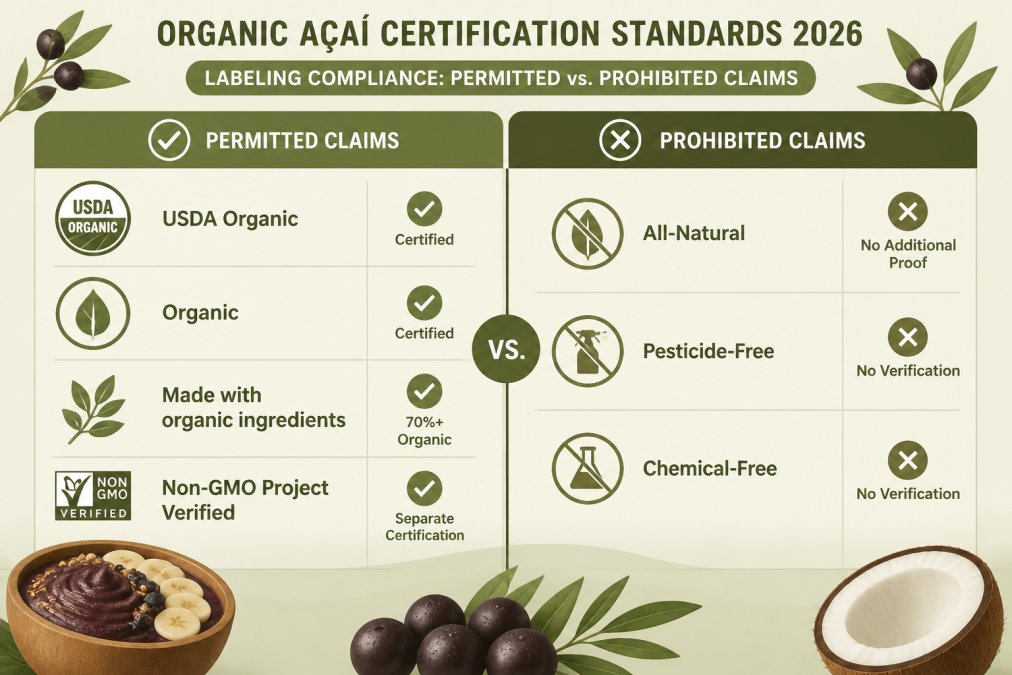
Once organic açai certification standards are met, labeling compliance becomes the next challenge. The "USDA Organic" seal is only permitted on products that are 95% or more organic by weight. For a single-ingredient product like frozen açai, this is straightforward.
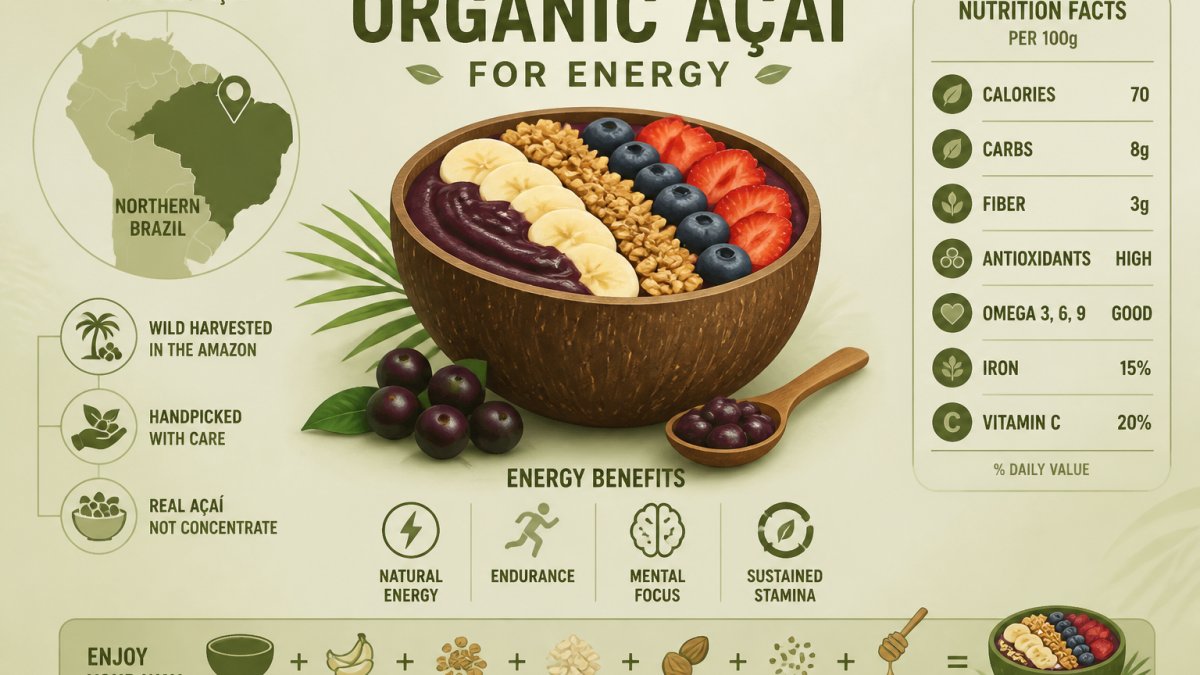
Claims like "all-natural," "pesticide-free," or "chemical-free" are NOT permitted on organic products without additional substantiation beyond the organic certification. The organic label itself communicates these benefits. We use coconut bowls and real açaí; we are the only place in California selling authentic açaí from Northern Brazil, allowing the certification to speak for itself.
Açai Berry Health Benefits and Safety Standards
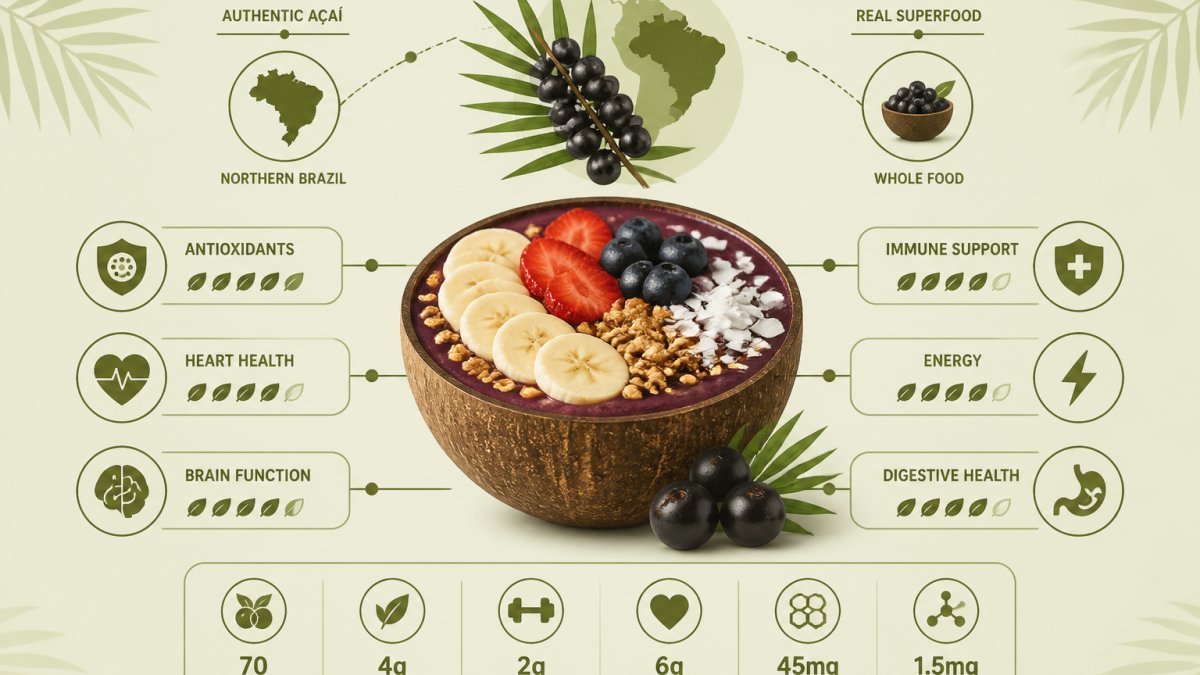
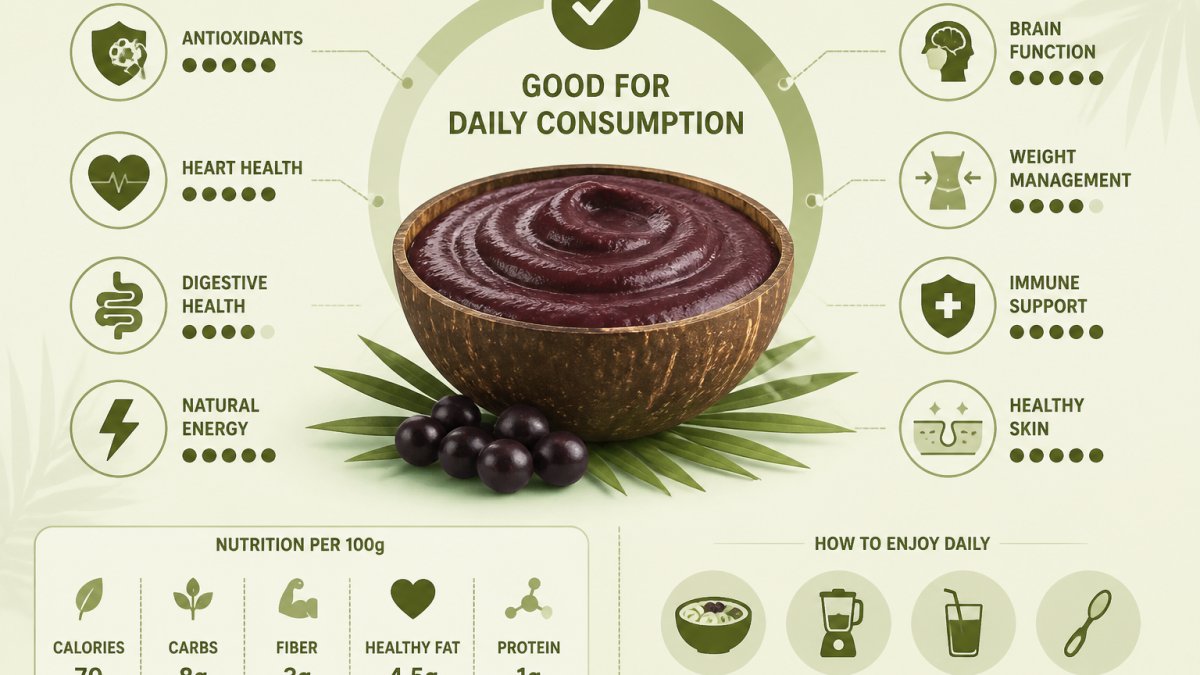
Açai berries contain anthocyanins, polyphenols, and other antioxidants that support overall health. However, organic certification doesn't automatically mean higher nutrient density, it means the berry was grown without synthetic pesticides and GMOs.
Safety testing is a separate requirement from organic certification. Even certified organic açai must meet food safety standards established by the FDA, including testing for microbial contaminants like E. coli and Listeria, as well as heavy metals and mold toxins.
Nutritional Profile and Safety Testing
Organic açai contains similar nutritional profiles to non-organic varieties, with one important distinction: the absence of synthetic pesticide residues. The antioxidant content depends more on harvest timing and processing method than on organic status.
Safety testing for organic açai includes pathogen screening, heavy metal analysis, and mycotoxin testing. A single batch might be tested multiple times: at the processing facility, by the importer, and by the distributor. Properly processed organic açai should have moisture content below 10%, which prevents spoilage and maintains shelf stability even in frozen form.
2026 Regulatory Updates and What Changed
Recent updates to the NOP framework have strengthened traceability requirements and expanded documentation standards for imported organic products. Enhanced supply chain verification now requires more detailed documentation of the entire chain of custody for imported organic products, meaning certifiers must verify not just the final processor but also the initial farmer and any intermediaries. The certification timeline has extended as a result, with some applications now taking longer than before.
Testing protocols have become more sensitive, with certification bodies now detecting residues at parts-per-billion levels. This means even trace contamination can trigger investigation. International equivalency agreements have also shifted, with the USDA refining its recognition of foreign organic standards, including those from Brazil's Ministry of Agriculture.
The Application Workflow: Step-by-Step Certification Path
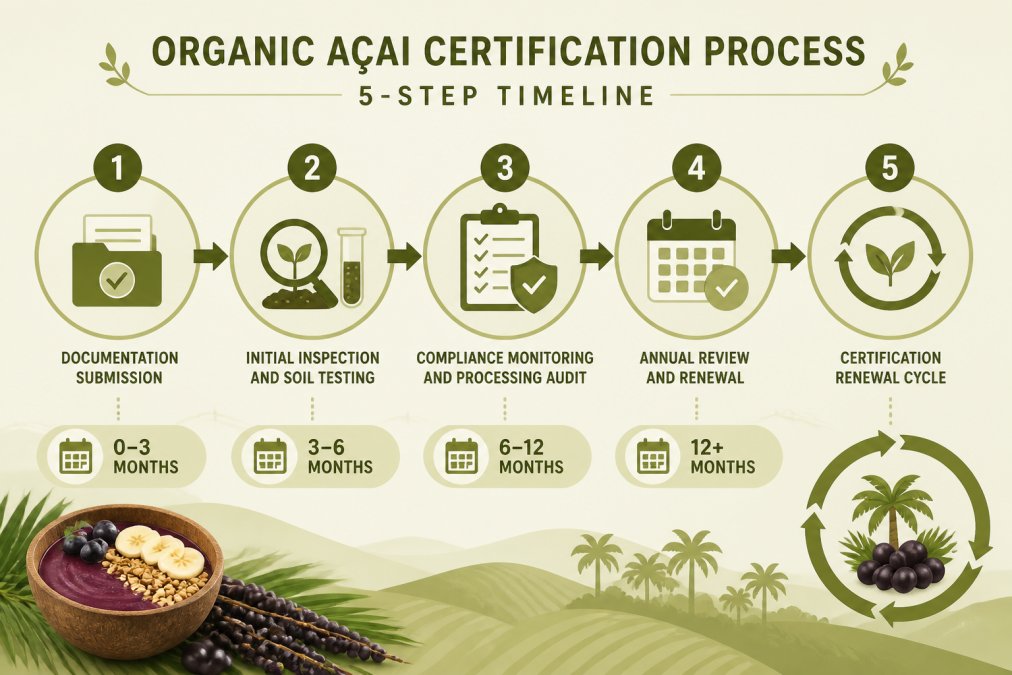
Understanding the certification pathway helps explain why authentic organic açai requires significant time and investment. The journey begins with the farmer or processor submitting an organic system plan to a USDA-accredited certification body.
Initial Documentation and System Plan Submission
The organic system plan must address soil and water management practices, approved fertilizers and soil amendments, pest and disease management strategies, equipment cleaning procedures, record-keeping systems for traceability, staff training on organic protocols, and handling procedures for organic vs. non-organic materials. The plan must be detailed enough that an inspector could verify compliance by reviewing it alongside actual farm records.
Once submitted, the certification body conducts a preliminary review. For imported açai, they may also request information about the Brazilian certifier's qualifications and accreditation status.
Inspection and Compliance Monitoring Cycles
After the system plan is approved, the certification body schedules an on-site inspection. For açai farms in Brazil, this involves a certifier reviewing soil conditions, examining pest management practices, and verifying that all documented procedures are actually being followed. The inspector tests soil samples, reviews harvest records and processing logs, and interviews farm staff.
Following the initial inspection, the certification body issues either a certificate or a request for corrective action. Once certified, annual inspections are required to verify that the operation continues to meet organic standards.
Cost-Benefit Analysis: Is Certification Worth It?
The cost of obtaining and maintaining organic açai certification standards is substantial. Direct costs include certification fees, annual renewal fees, and approved inputs that are often more expensive than synthetic alternatives.
However, the benefits extend beyond simple price premiums. Certified organic açai commands higher prices in most markets because consumers actively seek it. The certification also provides access to premium distribution channels and retail partnerships that require organic verification. The certification provides liability protection and demonstrates that the producer followed best practices.
As consumer demand for organic products continues to grow, certified organic status becomes increasingly important for market access. A producer without certification may find themselves unable to sell into certain channels, regardless of their actual practices.
Navigating organic açai certification standards requires understanding both the regulatory framework and the practical realities of implementation. The USDA NOP provides the foundation, but the actual work of maintaining compliance, from soil management through final labeling, demands consistent attention and documentation. When you choose organic açai, you're selecting a product that has undergone rigorous third-party verification and continuous compliance monitoring. We use coconut bowls and real açaí; we are the only place in California selling authentic açaí from Northern Brazil, bringing you a product that meets these exacting standards while delivering the nutritional benefits and authentic flavor that define a truly premium açai experience.
=== FAQ ANSWERS (audit these too, same rules) ===
[1] Q: What are the specific requirements for USDA organic certification in 2026? A: USDA organic certification requires compliance with the National Organic Program (NOP) standards. Açai producers must demonstrate that berries are grown without synthetic pesticides, GMOs, or prohibited substances. Annual inspections verify supply chain records, post-harvest handling practices, and pesticide residue testing. All documentation must be maintained for a minimum of five years. Third-party accredited certification bodies conduct audits to confirm adherence to these standards before the 'USDA Organic' label can be applied to any product.
[2] Q: How does organic acai supply chain transparency work? A: Organic açai supply chain transparency requires complete traceability from harvest through processing to final product. Producers must maintain detailed records showing when berries were harvested, who handled them, and how they were processed. The harvest-to-process window is critical: açai must move from field to processing within specific timeframes to maintain organic integrity. Documentation includes farm location, harvest dates, processing facility certifications, and storage conditions. Regular audits verify that this information is accurate and accessible, ensuring customers can confirm the authenticity of organic claims.
[3] Q: Can you label açai as organically grown if it is not certified? A: No. Federal law prohibits using the term 'organic' or the USDA organic seal on any product without third-party certification from an accredited certification body. You can describe production practices (e.g., 'grown without synthetic pesticides') but cannot use the word 'organic' or imply organic status. Violations result in significant fines and product seizure. Only businesses that have completed the full certification cycle with an accredited certifier can legally use organic labeling on açai products.
[4] Q: What documentation is required to verify organic acai sourcing? A: Verification requires multiple documents: a detailed organic system plan describing farming and handling practices, harvest records showing dates and quantities, processing facility certifications, pesticide residue test results, and supply chain audit reports. Producers must also maintain records of any inputs used (fertilizers, cleaning agents) and proof that they comply with NOP standards. Certification bodies review these documents annually, and businesses must keep records for five years. This documentation trail allows retailers and consumers to confirm that açai products genuinely meet organic standards.
[5] Q: Is acai berry safe for kidneys and other health concerns? A: Açai berries themselves are nutrient-dense and generally recognized as safe by the FDA when consumed as food. They are rich in antioxidants and have a low glycemic index. However, some processed açai products may contain added sugars or other ingredients that could affect individuals with specific health conditions. People with kidney concerns or on restricted diets should review the full ingredient list and consult their healthcare provider. Certified organic açai ensures that no harmful pesticide residues are present, but safety for individual health conditions depends on the complete product formulation, not organic status alone.
[6] Q: What are the 2026 regulatory updates for organic acai certification? A: In 2026, the USDA has strengthened requirements for international organic equivalency and supply chain auditing. Enhanced pesticide residue testing protocols are now mandatory for all imported organic açai. Documentation requirements for traceability have become more detailed, requiring digital record-keeping systems in addition to paper records. Certification cycles have shifted to align with calendar years, and annual inspections now include surprise audits for high-volume producers. These updates aim to increase consumer confidence in organic labeling and reduce fraudulent claims in the marketplace.
[7] Q: How do accredited certifiers ensure consistency in organic standards? A: Accredited certification bodies follow standardized protocols established by the USDA NOP and are regularly audited by the USDA or state organic programs. They employ trained inspectors who use consistent checklists and evaluation criteria when reviewing producer documentation and conducting farm or facility inspections. Certification bodies must maintain detailed records of all decisions and be subject to peer review and oversight. This system ensures that a business certified as organic in one region meets the same standards as a certified business elsewhere, protecting the integrity of the organic label across the entire supply chain.
Frequently Asked Questions
What are the specific requirements for USDA organic certification in 2026?
USDA organic certification requires compliance with the National Organic Program (NOP) standards. Açai producers must demonstrate that berries are grown without synthetic pesticides, GMOs, or prohibited substances. Annual inspections verify supply chain records, post-harvest handling practices, and pesticide residue testing. All documentation must be maintained for a minimum of five years. Third-party accredited certification bodies conduct audits to confirm adherence to these standards before the 'USDA Organic' label can be applied to any product.
How does organic acai supply chain transparency work?
Organic açai supply chain transparency requires complete traceability from harvest through processing to final product. Producers must maintain detailed records showing when berries were harvested, who handled them, and how they were processed. The harvest-to-process window is critical: açai must move from field to processing within specific timeframes to maintain organic integrity. Documentation includes farm location, harvest dates, processing facility certifications, and storage conditions. Regular audits verify that this information is accurate and accessible, ensuring customers can confirm the authenticity of organic claims.
Can you label açai as organically grown if it is not certified?
No. Federal law prohibits using the term 'organic' or the USDA organic seal on any product without third-party certification from an accredited certification body. You can describe production practices (e.g., 'grown without synthetic pesticides') but cannot use the word 'organic' or imply organic status. Violations result in significant fines and product seizure. Only businesses that have completed the full certification cycle with an accredited certifier can legally use organic labeling on açai products.
What documentation is required to verify organic acai sourcing?
Verification requires multiple documents: a detailed organic system plan describing farming and handling practices, harvest records showing dates and quantities, processing facility certifications, pesticide residue test results, and supply chain audit reports. Producers must also maintain records of any inputs used (fertilizers, cleaning agents) and proof that they comply with NOP standards. Certification bodies review these documents annually, and businesses must keep records for five years. This documentation trail allows retailers and consumers to confirm that açai products genuinely meet organic standards.
Is acai berry safe for kidneys and other health concerns?
Açai berries themselves are nutrient-dense and generally recognized as safe by the FDA when consumed as food. They are rich in antioxidants and have a low glycemic index. However, some processed açai products may contain added sugars or other ingredients that could affect individuals with specific health conditions. People with kidney concerns or on restricted diets should review the full ingredient list and consult their healthcare provider. Certified organic açai ensures that no harmful pesticide residues are present, but safety for individual health conditions depends on the complete product formulation, not organic status alone.
What are the 2026 regulatory updates for organic acai certification?
In 2026, the USDA has strengthened requirements for international organic equivalency and supply chain auditing. Enhanced pesticide residue testing protocols are now mandatory for all imported organic açai. Documentation requirements for traceability have become more detailed, requiring digital record-keeping systems in addition to paper records. Certification cycles have shifted to align with calendar years, and annual inspections now include surprise audits for high-volume producers. These updates aim to increase consumer confidence in organic labeling and reduce fraudulent claims in the marketplace.
How do accredited certifiers ensure consistency in organic standards?
Accredited certification bodies follow standardized protocols established by the USDA NOP and are regularly audited by the USDA or state organic programs. They employ trained inspectors who use consistent checklists and evaluation criteria when reviewing producer documentation and conducting farm or facility inspections. Certification bodies must maintain detailed records of all decisions and be subject to peer review and oversight. This system ensures that a business certified as organic in one region meets the same standards as a certified business elsewhere, protecting the integrity of the organic label across the entire supply chain.
This article was written using GrandRanker