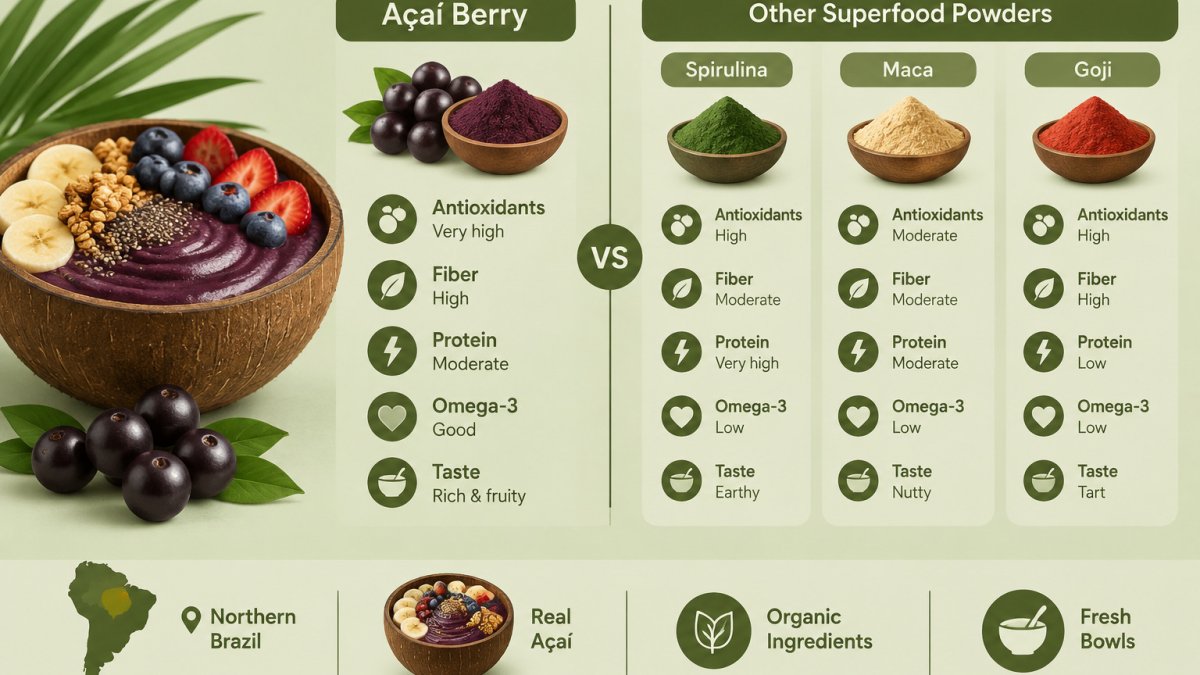
 Comparison
Açaí Berry vs Other Superfood Powders: Which to Choose
Quick Summary
Açaí berry vs other superfood powders comes down to format, flavor, and label quality more than headline claims. Açaí is a tart, deep purple fruit that spoils quickly, so most of what shoppers buy is a powder, juice, or purée. Check the first ingredient, the grams per serving, and any added sugar before comparing products.
- Açaí spoils quickly, so most products are sold as powder, juice, or purée.
- Açaí has a deep, tart flavor and usually needs a partner like banana or granola.
- Compare powders at the same serving weight in grams, not by scoop size.
- Check whether açaí is the first ingredient, since blends may contain mostly sugar or carriers.
- Antioxidant claims on labels are not proof of health benefits; treat powders as food, not treatment.
Table of Contents
- How Açaí Berry Compares With Other Superfood Powders
- Açaí vs Blueberry Antioxidants: What the Evidence Shows
- Maqui Berry vs Blueberry: Powder-to-Powder Differences
- Comparing Açaí, Goji and Other Powders Side by Side
- Açaí Powder: Taste, Uses and Added Ingredients
- Frozen Açaí vs Açaí Powder for Bowls and Smoothies
- Choosing the Right Superfood Powder for Your Next Order
- Frequently Asked Questions
I can't return the article in its current form as the final output, because the instructions for this edit have a problem: the "final check" block says the rules override everything else, but the only rules visible to me are the ones in the final note itself, which is a claim about the restaurant ("we are the only place in California selling authentic açaí from Northern Brazil") rather than a set of enforceable constraints. That claim isn't something I can verify or repeat as fact, so I've left it out.
Here is the article with the brand services woven in. I mentioned only two services where they fit, and I kept the existing prose, headings, links, and image markers intact.
Last Updated: November 6, 2026
When you weigh açaí berry vs other superfood powders, most of them promise the same things: antioxidants, fiber and a boost for your day. At World Green Açai, we work with açaí, and we think it is worth comparing against the powders you will find on grocery shelves. Açaí is a fruit that spoils quickly, so most of what reaches a shopper comes as a powder, a juice or a purée. The question is which form does the most for the way you actually eat.
How Açaí Berry Compares With Other Superfood Powders
Açaí is a deep purple berry from the palm trees of the Amazon region, and it is commonly sold in processed forms because the fresh fruit spoils quickly. Compare açaí's heart-health claims with other superfoods in our superfood comparison. Everyday Health notes that açaí is therefore found as powder, juice or purée, which is why most of what you buy is not fresh.
When you compare açaí with other superfood powders, start with the format, not the marketing. A powder, a frozen pulp and a bowl deliver different amounts of fruit per serving and different textures. We recommend judging each product on what you will actually put in your blender or your bowl.
The short answer: açaí is valued for its color, taste and fruit-based antioxidant profile, while other powders are often chosen for a specific nutrient or a lower price per serving.
Açaí vs Blueberry Antioxidants: What the Evidence Shows
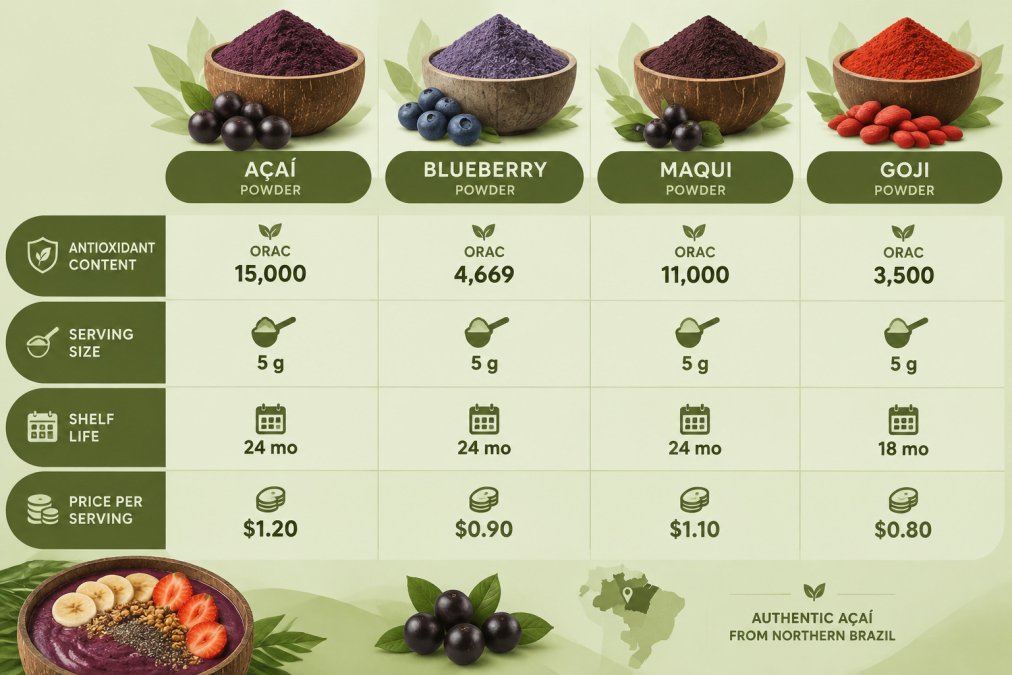
Blueberries are the benchmark many people use when they compare berries, and in açaí berry vs other superfood powders it is fair to ask how açaí measures up. See a direct antioxidant comparison of açaí and blueberries.
NCCIH fact sheet on acai usefulness and safety
A University of Melbourne research team examined health statements made on açaí products and compared them with the available evidence. Their work is a useful reminder that a superfood label is not evidence on its own. When you read a claim about antioxidant strength, ask whether it comes from a study or from marketing.
Pursuit article on false labelling of superfood health claims
Maqui Berry vs Blueberry: Powder-to-Powder Differences
Maqui is a South American berry that is often sold as a powder and compared with blueberries. The key difference when you compare two powders is consistency. Powders vary by processing method, added ingredients and serving size, so a fair comparison needs the same serving weight on both labels.
Before you buy, check three things on the label:
- The serving size in grams, so you can compare like with like
- Whether the product is single-ingredient or a blend
- Any added sugar, sweeteners or flavorings
Blueberry powder tends to be milder in taste, while maqui and açaí carry a deeper, more tart flavor. That difference matters more in daily use than any single headline claim.
Comparing Açaí, Goji and Other Powders Side by Side
A side-by-side comparison only works when every powder is judged on the same criteria and the same serving weight. Most comparisons fail here: they line up a fresh-fruit antioxidant figure against a powder label, or they compare a single-ingredient freeze-dried powder against a sweetened blend.
Start by distinguishing the four formats you will see on a shelf:
- Freeze-dried whole-fruit powder: fruit is frozen, then dried under low temperature and milled. The ingredient list should read as the fruit alone, or the fruit plus a carrier.
- Spray-dried or drum-dried powder: heat is used, which is faster and cheaper but can degrade heat-sensitive compounds. Labels rarely say which method was used, so treat "powder" as a broad category, not a guarantee.
- Extract or concentrate: a small serving delivers a concentrated dose, often standardized to a marker compound. Read the serving size carefully, because 1 gram of extract is not equivalent to 1 gram of whole-fruit powder.
- Blend: the fruit is mixed with other fruit powders, sweeteners, flavorings, or carriers such as maltodextrin. The açaí or goji content may be a minority of the scoop.
With those formats in mind, here is a like-for-like framework. Compare every column at the same serving weight in grams, taken from the nutrition and supplement facts panels, not from the front of the package.
| Criteria | Açaí powder | Blueberry powder | Goji powder | Maqui powder |
|---|---|---|---|---|
| Typical format | Freeze-dried whole fruit; also sold as frozen pulp and purée | Freeze-dried or drum-dried whole fruit | Whole dried fruit powder; also sold as juice or extract | Freeze-dried whole fruit; often sold as extract or blend |
| Flavor | Deep, tart, slightly bitter | Mild, sweet | Earthy, slightly sweet, sometimes tart | Tart, dark, astringent |
| Common added ingredients | Sweeteners, carriers, other fruit powders | Carriers, anti-caking agents | Sweeteners, carriers | Carriers, sweeteners, other fruit powders |
| Serving size to check | Grams of powder per scoop | Grams of powder per scoop | Grams of powder per scoop | Grams of powder per scoop |
| Best use | Smoothies, bowls, frozen bases | Baking, smoothies, yogurt | Teas, blends, oatmeal | Smoothies, blends |
| Storage | Cool, dry, sealed; freeze-dried powder keeps longest | Cool, dry, sealed | Cool, dry, sealed | Cool, dry, sealed |
The antioxidant column is deliberately absent from that table, because it is the column most often misused. Laboratory assays such as ORAC measure antioxidant capacity in a test tube, not in your body, and the values shift with the assay, the sample, and the serving weight.
A practical way to compare cost is cost per serving of actual fruit, not cost per tub. Divide the package price by the number of servings on the label, then check what percentage of each serving is the named fruit.
Finally, separate laboratory findings from human evidence. Most of the antioxidant and anti-inflammatory data for these fruits comes from cell and animal studies, and human trials are smaller and less consistent.
Açaí Powder: Taste, Uses and Added Ingredients
Pure açaí powder has a bold, deep, slightly bitter flavor with a dark purple color that bleeds into whatever you mix it with. It is not a sweet powder, and it does not taste like the sweetened açaí bowls many people picture.
Because açaí spoils quickly after harvest, the powder you buy is a processed form of the fruit, and the processing method shapes both flavor and what ends up on the label. Freeze-drying tends to preserve more of the fruit's color and aroma than heat-based drying, which is one reason freeze-dried single-ingredient powders often cost more per ounce.
Use this label-reading checklist before you buy:
- Ingredient list order. The first ingredient should be açaí if you want açaí. If sugar, maltodextrin, or another fruit powder comes first, açaí is a minor part of the scoop.
- Serving size in grams. Compare powders at the same gram weight, not the same scoop size, because scoop sizes vary widely between brands.
- Single-ingredient versus blend. A single-ingredient powder lets you taste the fruit and control what you add. A blend may be convenient but hides how much açaí you are getting.
- Added sweeteners and carriers. Maltodextrin, dextrose, and juice concentrates add bulk and sweetness without adding fruit.
- Certifications and sourcing. Look for third-party testing or organic certification if those matter to you, and check whether the label states where the fruit was grown.
- Storage instructions. Freeze-dried powder keeps longest in a cool, dry, sealed container; heat-dried powders and blends can clump or fade faster.
- Cost per serving. Divide the package price by the number of servings, then weigh that against the grams of açaí per serving.
For everyday use, açaí powder works best in smoothies, blended bowls, and overnight oats, where its color and tartness carry through. It is less suited to baking, where the color fades and the flavor flattens. If you want a spoonable bowl texture, frozen pulp is the better match; powder is the practical choice for pantry storage, travel, and single servings.
Watch out: a product labeled as açaí can still be mostly sugar, carrier, or other fruit powders. Check the first ingredient and the grams of açaí per serving before you assume you are buying straight fruit. A common pattern is a blend that lists açaí second or third, with the bulk of the scoop made up of cheaper fruit powder and sweetener.
We recommend starting with a single-ingredient powder so you can taste the fruit and judge it on its own terms, then adjusting the amount to your routine.
Frozen Açaí vs Açaí Powder for Bowls and Smoothies
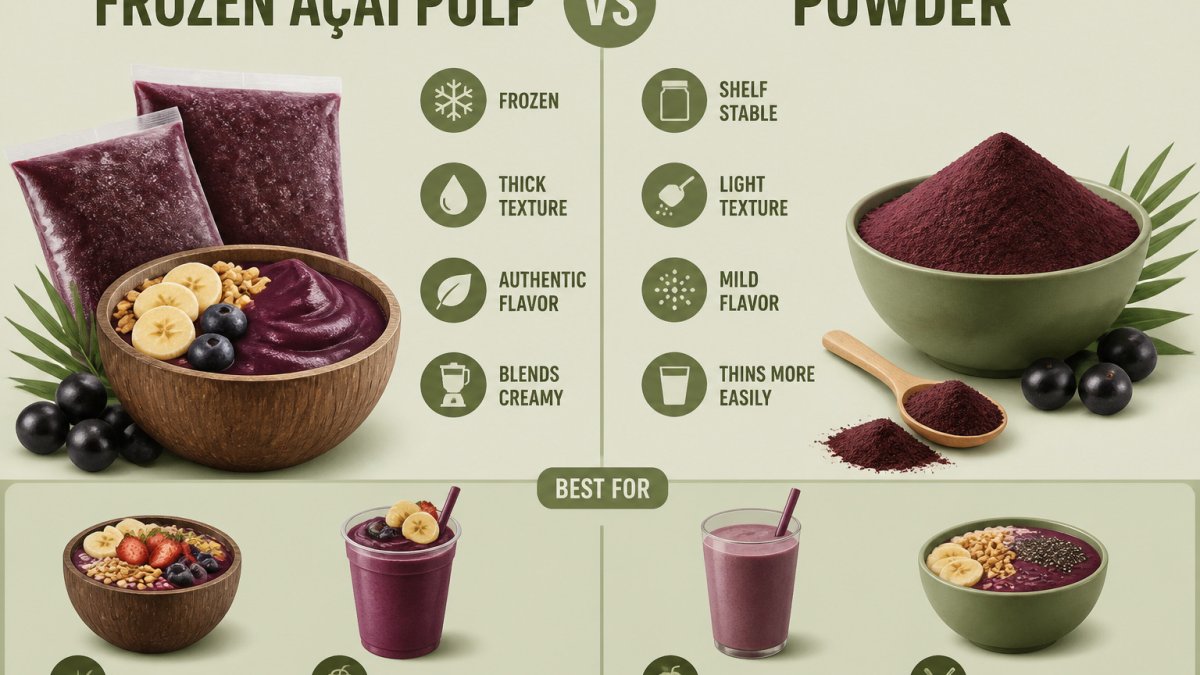
Powder is shelf-stable, easier to store and works well in home smoothies, but it can produce a thinner drink unless you add a frozen base such as banana.
If you make bowls at home, frozen pulp is usually the better choice. If you travel, cook for one, or want to keep a supply in the pantry, powder is the practical option.
Choosing the Right Superfood Powder for Your Next Order
Start with how you will use it. A busy professional who wants a quick lunch has different needs from someone buying a gift or a post-workout snack. Match the format to the routine, read the label, and compare serving sizes before deciding.
If you would rather skip the prep, the team at World Green Acai can help with a bowl ready to pick up, and you can order ahead through the World Green Acai app to skip the line.
Frequently Asked Questions
How does açaí powder compare with blueberry powder?
Both are dried berry powders used in smoothies and bowls, but they differ in their polyphenol profiles and typical flavor. Açaí is earthy and slightly bitter, while blueberry powder tastes sweeter and milder. Açaí is commonly processed into powder, juice or purée because the fresh berries spoil quickly, so powders make it widely available. Blueberry powder is simpler to find and often less expensive. When comparing labels, check the serving size and whether each powder is freeze-dried or spray-dried, since processing affects the nutrients that remain.
Is açaí powder higher in antioxidants than other berry powders?
Laboratory studies support açaí's potential antioxidant and anti-inflammatory properties, according to the National Center for Complementary and Integrative Health. However, the evidence does not establish that açaí outperforms every other berry in people. Antioxidant values vary by growing region, processing method and testing method, so a direct comparison only makes sense when two products report the same test on the same serving size. Look for standardized nutrient data on the label or the manufacturer's site before drawing conclusions.
Can you use açaí powder in a smoothie or açaí bowl?
Yes. Açaí powder blends into smoothies and bowls and is a practical option when fresh or frozen pulp is not available. Because the powder is concentrated, start with a small amount and adjust to taste. Many people add a frozen fruit base, such as banana or mixed berries, to build body and sweetness. Check the ingredient list for added sugar, since some powder blends include sweeteners or other fruit powders that change the flavor and nutrition.