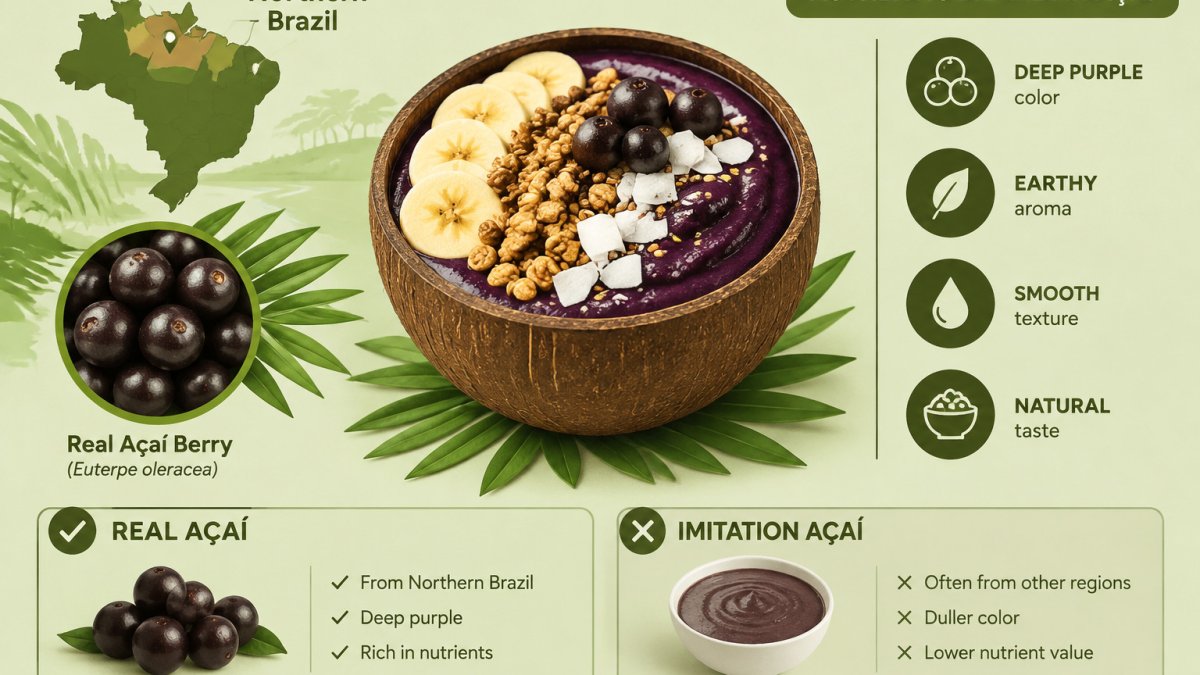
 How-to
How to Identify Authentic Brazilian Açaí Berries
Last Updated: November 27, 2026
Quick Summary
To identify authentic brazilian acai, check that the fruit is small, round and deep purple, and that any pulp or bowl lists açaí first with little else. Real açaí is a small dark purple fruit from the Amazon palm, sold as whole fruit, frozen pulp, or in a bowl.
- Whole açaí fruits measure about 1 to 2 cm across, round and deep purple to near black.
- Read the ingredient list from top to bottom; pure pulp should list açaí first with little else.
- Treat sugar, syrup, juice concentrate or artificial colors high on the list as caution signs.
- Ask sellers where the fruit was harvested and how it was processed, since a Brazilian label is only a claim.
- Frozen pulp should stay frozen until use, and thawed pulp should not be refrozen.
Table of Contents
- How Do You Identify Authentic Brazilian Açaí Berries?
- Açaí Berry Origin: Where Real Açaí Comes From
- What Does Real Açaí Look Like?
- Step-by-Step Checklist for Spotting Authentic Açaí
- Açaí Pulp Ingredients: What Authentic Pulp Should Contain
- Real Açaí vs. Açaí-Flavored Products: A Visual Comparison
- Booking Your Next Authentic Açaí Bowl at World Green Açaí
- Frequently Asked Questions
How Do You Identify Authentic Brazilian Açaí Berries?
To identify authentic Brazilian açaí berries, look at the fruit's size, color, and origin, then check the ingredient list on any pulp or bowl you buy, since authentic brazilian acai shows its origin and simplicity on the label. Real açaí is a small, dark purple fruit from the Amazon palm, and it is usually sold as whole fruit, frozen pulp, or pulp blended into a bowl. Appearance and taste are useful clues, but they do not prove where a product came from. The sections below explain which checks give you the most reliable answer.
Açaí Berry Origin: Where Real Açaí Comes From
Authentic açaí comes from the açaí palm (Euterpe oleracea), which grows mainly in the Brazilian Amazon. The fruit grows in large clusters on tall, slender palms, and local harvesters have gathered it for generations.
Brazil is the center of açaí production. The USDA Foreign Agricultural Service estimated Brazilian production at 2 million metric tons in 2026, an 11% increase from 2025 (USDA Foreign Agricultural Service, The Global Acai Report, 2026). That number describes national output, not whether any single product is genuine.
Origin is harder to confirm than size or color. A label that says "Brazilian" is a claim, so ask the seller where the fruit was harvested, how it was processed, and whether that information is written on the package.
What Does Real Açaí Look Like?
Whole açaí fruits are small and round. According to a 2023 critical review of açaí in health and disease, the fruits are spherical and measure 1.0 to 2.0 cm in diameter (Açaí (Euterpe oleracea Mart.) in Health and Disease: A Critical Review, 2023). The fruits grow in clusters of hundreds, so a single berry is tiny compared with a grape.
Look for these traits in whole fruit:
- Size: About 1 to 2 cm across, roughly the size of a large blueberry or small grape
- Shape: Round and even, not oblong or flattened
- Color: Deep purple to near black, with a dusty bloom on the skin
- Seed: A large seed takes up most of the fruit
Pulp is harder to judge by eye. Real pulp is usually thick, deep purple, and earthy in taste. It is not sweet on its own. If the pulp tastes mainly of sugar or fruit flavor, the product may contain added sweeteners or other ingredients.
Step-by-Step Checklist for Spotting Authentic Açaí
Work through these steps in order. Each one narrows the question.
- Check the form. Decide whether you are buying whole fruit, frozen pulp, powder, or a ready-made bowl. Each form has different things to check.
- Look at the color and size of whole fruit. Small, round, and deep purple points toward real açaí.
- Read the ingredient list. Pure pulp should list açaí and little else. See the next section for what to look for.
- Check for added sugar, fillers, and artificial colors. Long ingredient lists often signal a flavored product rather than real açaí.
- Ask about origin and processing. A reliable seller can tell you where the fruit was grown and how it was frozen or pulped.
- Taste before you commit to a large order. Real açaí has an earthy, slightly bitter taste. Heavy sweetness is a warning sign.
- Store it properly. Keep frozen pulp frozen until use, and do not refreeze thawed product.
Watch out: visual and taste checks cannot confirm origin or rule out adulteration. Analytical testing can. A Eurofins case study describes HPTLC fingerprinting, a lab method used to establish a characteristic profile for açaí and help detect adulteration (Eurofins, Case Study: Ensuring Authenticity and Efficacy of Acai-Based Products).
Reading the Ingredient List on Pulp and Bowls
Ingredient lists tell you more than the front of the package. Read them from top to bottom, since ingredients are listed by weight.
- Good sign: "Açaí pulp" or "Organic açaí" listed first, with nothing else or only water
- Caution: Sugar, syrup, juice concentrate, or "natural flavor" high on the list
- Red flag: Artificial colors, thickeners, or fillers such as starches or gums
For bowls, ask whether the base is made with pure pulp or a blend that includes sweeteners and fruit juice. A bowl described as "açaí" can still be mostly sugar.
Açaí Pulp Ingredients: What Authentic Pulp Should Contain
Authentic pulp is simple. It should contain açaí and, at most, a small amount of water used to aid blending. Pulp made from the fruit has a natural fat and fiber content and a dark, thick texture.
Sweeteners and additives are not automatically a problem, but they change what you are buying. A sweetened pulp or a bowl with granola and syrup is a treat, not plain açaí. Know which one you want before you compare products.
Authenticity means something different in each format, because most buyers cannot purchase fresh whole berries. Use this format-by-format guide to set the right expectation.
- Whole fruit: Small, round, deep purple, with a large seed and little edible pulp. Whole fruit is rarely sold fresh outside growing regions because it spoils quickly. If you see fresh whole açaí, ask how it was transported and how old it is.
- Frozen pulp: The most common authentic format. It should be thick, dark, and earthy, and it should stay frozen until use. Check the ingredient list for açaí first and little else.
- Powder: Dried and ground açaí. Powder is convenient but concentrated, and it can be blended with other fruit powders. Check the ingredient list and ask whether the powder is pure açaí or a blend.
- Ready-to-eat bowls: A prepared food, not a raw fruit product. The base may be pure pulp or a sweetened blend. Ask what the base contains before you judge the bowl by its color.
Freshness also matters. Frozen pulp should stay frozen until use. Thawed pulp should be used quickly or discarded, since it spoils faster than frozen product and can ferment if left warm. A common pattern is for quality to drop after repeated thawing and refreezing, so buy in portions you can use at once.
Watch out: dark color and earthy flavor are clues, not proof. A flavored product can be colored and flavored to taste earthy, and a pure pulp can vary in color with the harvest. Use the format, the ingredient list, and the seller's answers together before you decide.
Real Açaí vs. Açaí-Flavored Products: A Visual Comparison
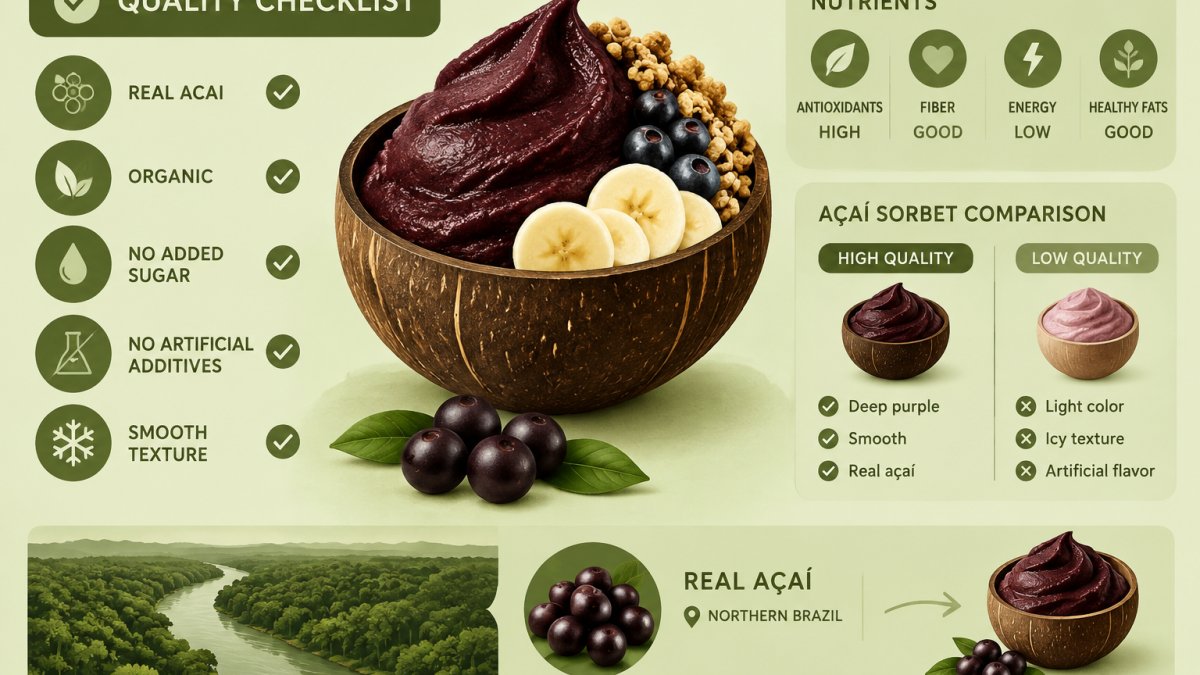
Use this comparison to tell real açaí from flavored products:
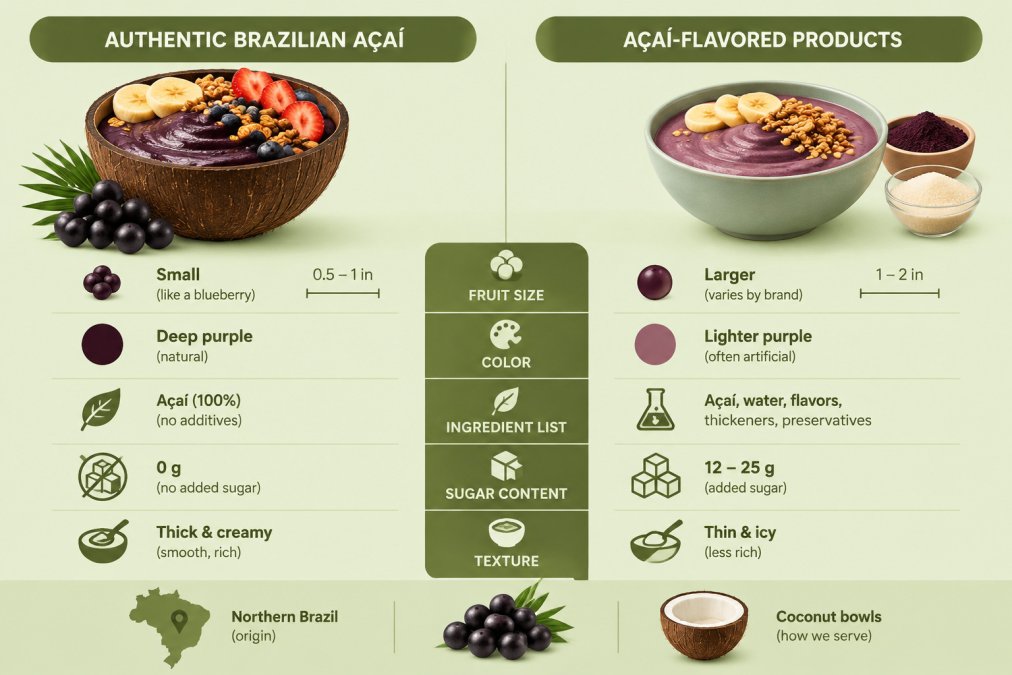
| Feature | Real açaí | Açaí-flavored product |
|---|---|---|
| Fruit size | About 1 to 2 cm | Not shown or not applicable |
| Color | Deep purple to near black | Often brighter purple or red |
| Ingredient list | Açaí first, few other items | Sugar, juice, or flavoring high on list |
| Sugar content | Naturally low | Often high |
| Texture | Thick and smooth | Can be thin, icy, or gummy |
| Taste | Earthy, slightly bitter | Mostly sweet, fruity |
A product that matches the left column is more likely to be real açaí. A product that matches the right column may be flavored, even if it is labeled "açaí."
Booking Your Next Authentic Açaí Bowl at World Green Açaí
If you want to try authentic açaí without doing the checks yourself, order an authentic açaí bowl from World Green Açaí in Larkspur for pickup. You can ask our team about how the açaí is sourced and prepared.
Before you visit, check our address, hours, and phone number on the contact page.
For a deeper self-check on açaí pulp, read our guide to spotting authentic açaí pulp yourself. If you are comparing products, our guide to choosing high-quality açaí products covers the same ground in more detail.
Ready to try the real thing? Visit World Green Açaí in Larkspur or order online for pickup.
Frequently Asked Questions
Is Brazilian açaí different from açaí grown elsewhere?
Brazilian açaí comes from the Euterpe oleracea palm, which grows across the Brazilian Amazon, and Brazil is the dominant producer. The USDA Foreign Agricultural Service estimated Brazilian production at 2 million metric tons in 2026, an 11% increase from 2025. Origin is a useful starting point, but it is not proof on its own. Ask for a product label that names the source and a supplier who can trace the pulp back to the harvest region.
What does real açaí look like?
Açaí fruits are spherical and measure about 1.0 to 2.0 cm in diameter, according to a 2023 critical review in PubMed Central. They grow in clusters of hundreds of fruits and have a dark purple to near-black skin. Whole fruit is rarely sold in the United States, so most shoppers see the fruit as frozen pulp or inside a bowl. Color and smell are clues, but they cannot confirm origin or rule out adulteration on their own.
What ingredients should authentic açaí pulp contain?
Authentic açaí pulp should list açaí as its main ingredient and little else. Watch for added sugar, sweeteners, fillers, artificial colors and juice blends that dilute the pulp. A short ingredient list is a good sign, while long lists or unexplained sweeteners suggest the product is an açaí-flavored item rather than real açaí. Check the label before buying, and ask the seller whether the product is unsweetened.
Does authentic açaí have a strong sweet taste?
Authentic açaí has an earthy, slightly tart flavor, closer to dark berries or unsweetened cocoa than to sweetened fruit. A very sweet taste often means added sugar or a flavored product. Taste alone does not verify origin, so combine it with label checks and questions about sourcing. Ask whether the bowl is made with unsweetened pulp before assuming the flavor reflects the fruit.