 How-to
How to Choose Healthy Cold Pressed Juices
Last Updated: November 24, 2026
Quick Summary
Choose healthy cold pressed juices by reading the ingredient list first: the first ingredient should be a vegetable, not a fruit. Check that added sugars read 0 g, total sugars per serving stay under 12 g, and the serving size matches what you will actually drink.
- Ingredients are listed by weight, so whatever appears first is what you are mostly drinking.
- A 16 fl oz bottle labeled as two servings at 12 g sugar each carries 24 g total.
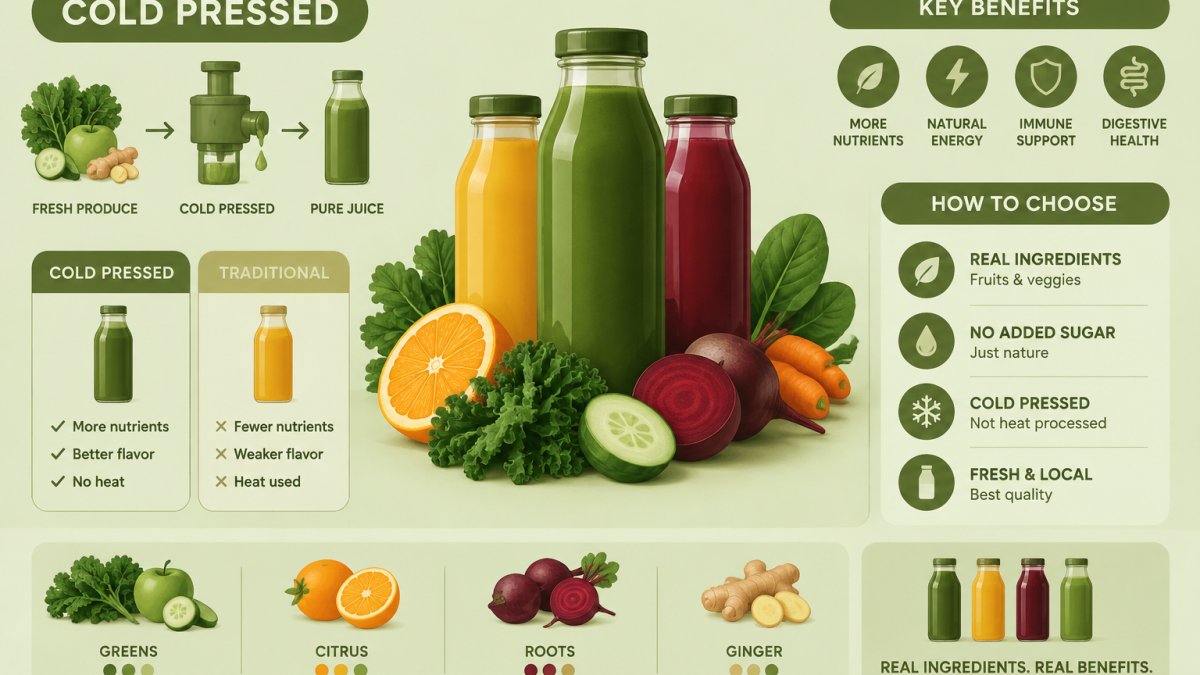
- Cold-press extraction crushes produce with a hydraulic press and no added heat.
- Treat juice as a snack or supplement to a meal, not a meal replacement.
- Keep a single serving to 8 fl oz or less if you are watching blood sugar.
Table of Contents
- How do you choose healthy cold pressed juices?
- How to read juice labels to find real nutrition
- Cold-pressed juice vs. regular juice: what the processing method changes
- Cold-pressed juice sugar content and serving size
- The healthiest cold-pressed juices are vegetable-forward
- Fiber, satiety, and whole produce
- Matching juice to your dietary needs and routine
- Building a better lunch routine with World Green Açai
- Frequently Asked Questions
How do you choose healthy cold pressed juices?
You choose healthy cold pressed juices by reading the label before the marketing copy: check the ingredient order, the serving size, the sugar per bottle, and whether the juice is mostly vegetables or mostly fruit. Cold-pressed processing is a method, not a health guarantee.
At World Green Açai, we sell bowls in Larkspur, and we get asked this constantly. The honest answer is that the bottle tells you more than the label on the front ever will.
The cold-pressed juice category is growing fast. Grand View Research's market estimate puts the global cold-pressed juice market at $897.4 million in 2025, rising to $953.0 million in 2026. Growth does not equal nutrition, though.
How to read juice labels to find real nutrition
Start with the ingredient list, not the front of the bottle. Ingredients are listed by weight, so whatever appears first is what you are mostly drinking. If apple or pineapple leads the list, you bought fruit juice with a green label.
Then check three numbers:
- Serving size. A bottle often holds two or more servings, so multiply everything.
- Added sugars. Zero is the target. Natural sugar from fruit still counts toward the total.
- Fiber. Most juice has little, because pressing removes the pulp.
Kaiser Permanente's guidance on cold-pressed juice recommends choosing a cold-pressed juice that includes mostly vegetables. That single rule filters out most of the shelf.
The label-reading checklist
Run this before anything goes in your basket:
- First ingredient is a vegetable, not a fruit
- Added sugars read 0 g
- Total sugars per serving are under 12 g
- Fiber is listed and above 1 g, or you accept it is low
- No artificial colors, sweeteners, or preservatives
- Serving size matches what you will actually drink
- A clear processing note: cold-pressed, HPP, or pasteurized
Do the serving-size math before you compare bottles
Most label mistakes happen because people compare the front of one bottle to the front of another. Compare the Nutrition Facts panel instead, and normalize everything to the amount you will actually drink.
A simple method:
- Note the serving size in fluid ounces and the servings per container.
- Decide how much of the bottle you will drink in one sitting (for example, 8 fl oz of a 16 fl oz bottle).
- Multiply calories, total sugars, added sugars, and fiber by that fraction.
- Compare that adjusted number to another bottle using the same method.
A common pattern is a 16 fl oz bottle labeled as two 8 fl oz servings. If each serving carries 12 g of total sugar, the whole bottle carries 24 g. Two bottles can look identical on the shelf and differ by 10 g or more of sugar once you adjust for serving size.
A transparent per-serving comparison
Use a table like this to compare any two bottles on equal footing. Fill in the numbers from each Nutrition Facts panel, adjusted to the amount you will drink.
| What to compare | Bottle A | Bottle B |
|---|---|---|
| Serving size (fl oz) | ||
| Servings you will drink | ||
| Calories (adjusted) | ||
| Total sugars (g, adjusted) | ||
| Added sugars (g, adjusted) | ||
| Fiber (g, adjusted) | ||
| First ingredient | ||
| Processing note (cold-pressed / HPP / pasteurized) |
The bottle with the lower adjusted sugar, the vegetable-first ingredient list, and a clear processing note is usually the better buy.
Watch out: "no added sugar" does not mean low sugar. A fruit-only blend can still carry 25 g or more of naturally occurring sugar per bottle, so always check total sugars, not just added sugars.
If you want to practice this skill on food labels more broadly, our organic açaí bowl ingredient label guide applies the same checklist to bowl ingredients.
Cold-pressed juice vs. regular juice: what the processing method changes
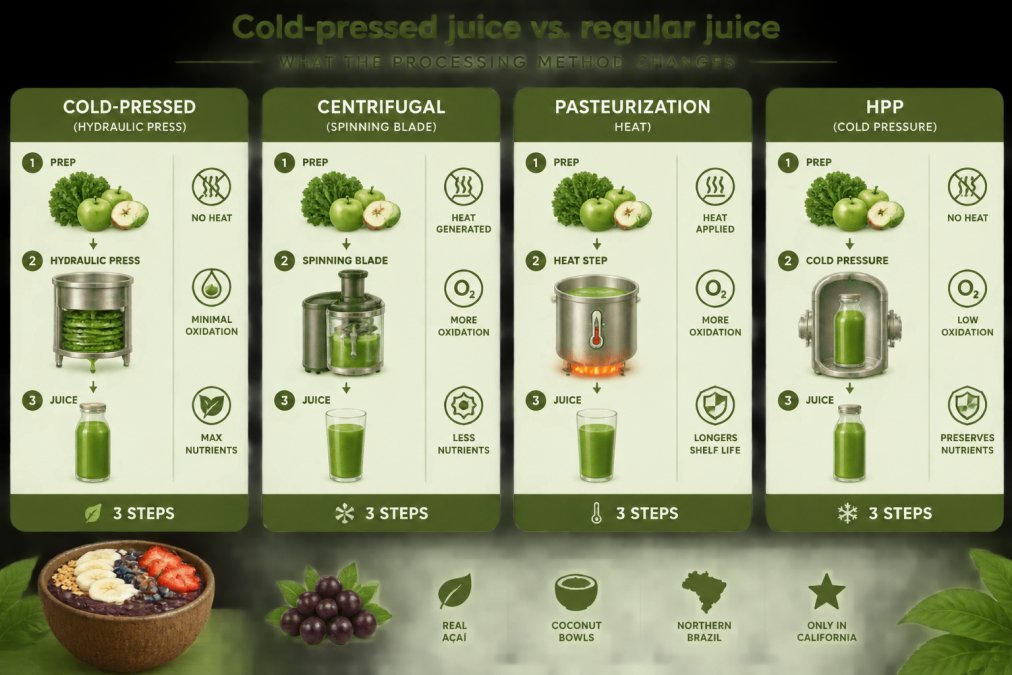
Cold-pressed juice and regular juice differ mainly in how the liquid leaves the produce. Cold-press extraction crushes produce with a hydraulic press and no added heat. Centrifugal juicing spins and shreds it with a fast blade, which introduces heat and air.
That difference matters for flavor and for some nutrients. A study in the Journal of Food Science and Technology compared cold-pressed and centrifugally extracted juices and noted the claim that cold-pressed juice retains higher levels of antioxidants and bioactive compounds.
How cold-press extraction and HPP work
Cold-press extraction is a hydraulic process that squeezes juice from produce without generating the heat of a spinning blade. High-pressure processing (HPP) is a separate, later step that uses high water pressure instead of heat.
Processing method affects how long a bottle keeps, so check the label. Traditional pasteurization uses heat, which extends shelf life but changes flavor. Neither method makes a sugary juice healthy. Processing protects the product; the recipe decides the nutrition.
Watch out: a "cold-pressed" claim says nothing about HPP or pasteurization. If food safety matters to you, look for the processing method stated on the label, and keep the bottle refrigerated as directed.
Cold-pressed juice sugar content and serving size
Sugar is where most cold-pressed juice buying goes wrong. A bottle of pure fruit blend can carry a substantial amount of sugar. Healthline's guide to choosing juice recommends picking juices that are nutrient-rich and lower in both natural and added sugars.
Practical rules we use:
- Treat a juice as a snack or a supplement to a meal, not a meal replacement
- Split a large bottle across two sittings
- Choose blends where vegetables outnumber fruit
- Drink it with food if you are watching your blood sugar response
If sugar is your main concern, our low-sugar açaí bowl ideas show how to build steady energy without leaning on sweet fruit.
The healthiest cold-pressed juices are vegetable-forward
The healthiest cold-pressed juices are the ones built on vegetables, with fruit used as seasoning rather than the base. Kale, cucumber, celery, beet, and carrot deliver flavor and color with far less sugar than an apple- or orange-heavy blend.
What most guides miss is that "green" on the label is a color, not a recipe. Green-labeled bottles can list apple first. Flip the bottle over.
A simple hierarchy for choosing:
- Vegetable-only or vegetable-dominant blends
- Vegetable blends with a small amount of fruit for palatability
- Fruit-forward blends, treated as an occasional treat
- Dessert-style juices with added sweeteners, skipped entirely
Fiber, satiety, and whole produce
Juice removes most of the fiber you would get from eating the same produce whole. Fiber generally helps you feel full and slows how quickly sugar is absorbed. A juice can be nutrient-dense and still leave you hungry twenty minutes later.
That does not make juice useless. It makes it a supplement. If satiety is the goal, eat produce or a bowl with texture, and use juice alongside it. Our superfood toppings guide lists additions that put fiber and staying power back into a meal.
Matching juice to your dietary needs and routine
There is no single best cold-pressed juice, because the right pick depends on your body, your medications, and your schedule. Anyone managing blood sugar, kidney function, blood pressure, or a medication interaction should ask their clinician before making juice a habit.
If you are watching blood sugar
Fruit-forward juice can raise blood sugar quickly because pressing removes most of the fiber. Practical steps:
- Choose vegetable-dominant blends where the first ingredient is a vegetable.
- Keep a single serving to 8 fl oz or less, and sip it with a meal that contains protein and fiber.
- Pair juice with whole produce or a bowl that has texture, rather than drinking it alone on an empty stomach.
- Check total sugars per serving, not just added sugars.
If you are watching sodium
Some vegetable juices, especially those with celery, beet, or added sea salt, can carry meaningful sodium per serving. Check the sodium line on the Nutrition Facts panel and compare it to your daily target. A vegetable juice with no added salt is usually the lower-sodium choice.
If you take medications
Some produce can interact with medications, so ask a pharmacist or clinician if you take prescriptions. If you take a prescription, ask your pharmacist whether any juice ingredient is a concern before making it a daily habit.
If you are watching calories or weight
Juice is easy to drink quickly and does not trigger the same fullness signals as whole produce. Treat it as a snack or a supplement, not a meal replacement, and measure your pour rather than drinking from the bottle.
Match the bottle to the moment
- Post-workout: vegetable-forward with a little fruit for glycogen
- Mid-afternoon slump: low-sugar green blend instead of a second coffee
- Meal side: small serving alongside protein and fiber
- Travel or busy days: a bottle you have already label-checked
Talk to a clinician before making juice a habit or trying a juice-only plan.
If sugar is your main concern, our low-sugar açaí bowl ideas show how to build steady energy without leaning on sweet fruit.
Building a better lunch routine with World Green Açai
A juice is one component of a lunch, not the whole thing.
At World Green Açai, we make organic açaí bowls in Larkspur and offer online ordering so you can skip the line. If you want quick healthy lunch ideas to build around a bowl, we have seven options for busy professionals.
Ready to try it? Find our address, hours, and pickup details and order online for pickup.
Lunch breaks are short, and the default options are rarely the good ones. World Green Açai makes the better choice the easy one, with organic açaí bowls, online ordering that skips the line, and mobile app access for repeat orders.
Frequently Asked Questions
What should I look for on a cold-pressed juice label?
Start with the ingredient list: it should read like a recipe, with vegetables first and no added sugars, artificial sweeteners, or artificial colors. Check the serving size, since one bottle often holds two or more servings, and multiply the sugar and calories accordingly. Look for a processing note such as HPP or cold-pressed, and confirm the bottle has been kept refrigerated. A short, recognizable ingredient list is the strongest signal that the cold pressed juices you are holding are nutrient-rich rather than a sugar bomb.
Are cold-pressed juices really healthier than regular juice?
The processing method is only one factor. Cold-pressed juice is often claimed to contain higher levels of antioxidants and bioactive compounds, but that is not established as categorically superior. What matters more is what is in the bottle: vegetable-forward recipes, no added sugars, and sensible serving sizes. A cold-pressed apple juice with 30 grams of natural sugar is still a high-sugar drink. Compare nutrition per serving rather than trusting the label on the front.
How much sugar should a healthy juice have?
There is no single threshold, but choosing juices that are nutrient-rich and lower in both natural and added sugars is a sensible approach. Read the nutrition label per serving, not per bottle, and favor blends where vegetables dominate. If a juice lists fruit first and delivers most of its calories from sugar, treat it as a treat rather than a daily staple. Picking cold-pressed juices that include mostly vegetables naturally lowers sugar content.
Can cold-pressed juice replace whole fruit or a meal?
Juicing removes most of the dietary fiber found in whole fruits and vegetables, so it is far less filling than eating the produce itself. That fiber loss matters for satiety and blood sugar response. Use cold pressed juices as a supplement to a balanced diet, not a replacement for whole vegetables or a full meal. If you want a lunch that holds you longer, pair a vegetable-forward juice with a fiber-rich food.