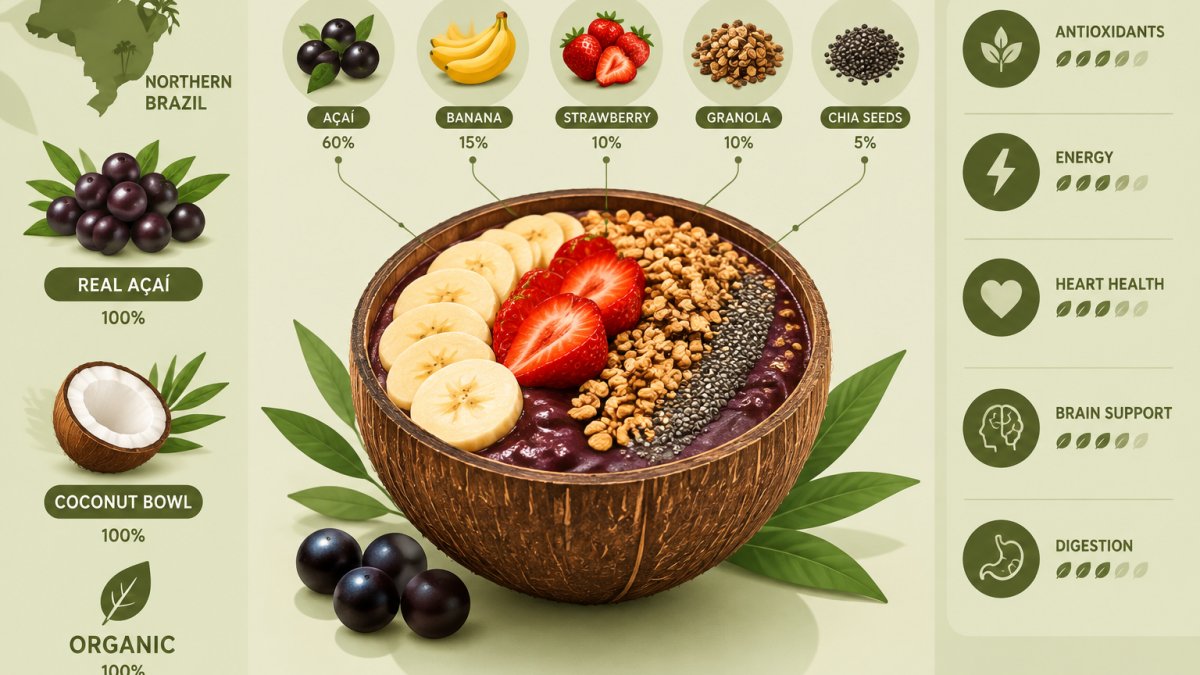
 How-to
Organic Açaí Bowl Ingredient Label Guide
Last Updated: November 21, 2026
Quick Summary
To read an açaí bowl label, check that açaí pulp is the first ingredient, since ingredients are listed by weight from heaviest to lightest. Choose products with three or fewer ingredients and no sweetener in the top three, and look for a USDA organic seal with a named certifier.
- Ingredients are listed by weight, so the first ingredient is what the product contains most of.
- If any sweetener lands in the top three ingredients, the bowl is built on sugar.
- Unsweetened açaí purée contains one ingredient: açaí.
- Açaí flavor" is a flavoring compound, not fruit.
- A home freezer set at 0°F keeps frozen açaí solid and stable.
Table of Contents
- How to Read a Food Label for Açaí Bowls
- Spotting Added Sugar in Açaí Bowls
- Unsweetened Açaí Purée vs. Sweetened Blends
- Organic Certification on Food Labels: What to Verify
- Texture, Color, and Oxidation: Sensory Checks Beyond the Label
- Cold-Chain Handling and Spoilage Signs
- Building Your At-Home Inspection Checklist
- Ordering a Bowl You Can Trust
- Frequently Asked Questions
How to Read a Food Label for Açaí Bowls
Many açaí bowls sold as "healthy" can contain a surprising amount of sugar. Reading the ingredient label is the best way to check. Customers often ask how to tell what is actually in an açaí bowl, so this breakdown explains how to read the label.
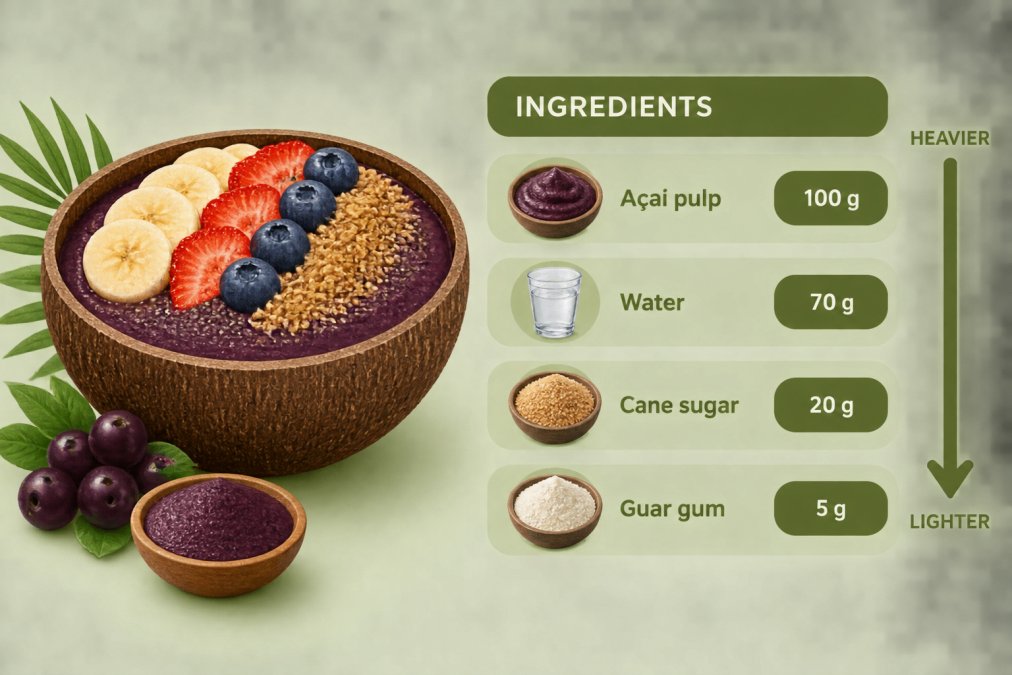
A food label is a legal document. It lists ingredients by weight, from heaviest to lightest. That single rule tells you more about a product than any front-of-pack claim ever will.
Ingredient Order: What Comes First Matters Most
The first ingredient is the one the product contains most of, by weight. That is the whole game.
If açaí appears first, you are buying an açaí product. If sugar, cane syrup, or apple juice concentrate comes first, you are buying a dessert with açaí in it.
Watch the order closely:
- Açaí pulp listed first: good sign
- Water or juice listed before açaí: diluted product
- Sugar, agave, or syrup in the top three: sweetened blend
- Guar gum, locust bean gum, or xanthan gum near the top: thickeners doing the work that real pulp should do
One more thing most guides miss. "Açaí flavor" or "natural açaí flavor" is not açaí. It is a flavoring compound. If the panel lists flavor instead of fruit, the purple color is coming from somewhere else.
Spotting Added Sugar in Açaí Bowls
Added sugar hides under dozens of names, and the nutrition panel will not always separate natural from added sugars clearly.
Açaí fruit carries its own modest sugar. Anything above that is added. Look for these on the ingredient list:
- Cane sugar, evaporated cane juice, brown rice syrup
- Agave nectar, honey, maple syrup
- Apple juice concentrate, grape juice concentrate
- Dextrose, maltodextrin, fruit juice sweeteners
The trick is position. If any sweetener lands in the top three ingredients, the bowl is built on sugar. For a deeper walkthrough of telling real fruit from sweetened imitations, see our guide on how to identify authentic organic açaí.
Unsweetened Açaí Purée vs. Sweetened Blends
Unsweetened açaí purée contains one ingredient: açaí. Sweetened blends contain açaí plus sugar, water, thickeners, or other fruits.
That difference changes everything about texture and taste. Real purée is thick, dark, and earthy. Sweetened blends taste like sorbet because, functionally, they often are sorbet.
Here is how the two compare:
| Feature | Unsweetened Purée | Sweetened Blend |
|---|---|---|
| Ingredient count | One: açaí | Three or more |
| First ingredient | Açaí pulp | Açaí, water, or sugar |
| Texture | Thick, slightly grainy | Smooth, icy, uniform |
| Sweetness | Low, earthy | High, dessert-like |
| Common format | Frozen packs | Tubs, sorbets, mixes |
Before comparing blends, it helps to understand how frozen pulp and powder forms differ. Our breakdown of frozen açaí pulp versus powder covers that directly.
Organic Certification on Food Labels: What to Verify
An "organic" claim on a food label is regulated, not decorative. In the U.S., the USDA National Organic Program sets the rules, and the USDA organic labeling standards define what each seal actually means. But organic is only one claim on the panel, and the others are where labels get slippery.
The Organic Tiers
Know the three levels:
- "100% Organic": all ingredients organic, USDA seal allowed
- "Organic": at least 95% organic ingredients by weight
- "Made with Organic": at least 70% organic, no seal allowed
The certifier name matters too. A legitimate label names the certifying agent. If you see "organic" with no certifier and no seal, treat it as marketing.
Decoding the Other Claims
Organic says nothing about whether the product is pure açaí. Read these words separately:
- "Pure" is not a regulated term. It usually means no added ingredients, but the ingredient list is the only proof.
- "Unsweetened" means no added sweetener, it does not mean low sugar, because fruit carries its own.
- "Pulp" generally means fruit separated from the seed with little else added; "purée" is often used interchangeably but can include water.
- "Açaí blend" signals a mixture, usually with other fruits, juice, or sweetener. The first ingredient tells you what dominates.
- "Açaí flavor" is a flavoring compound, not fruit. If it appears instead of açaí on the panel, the purple is coming from somewhere else.
Watch out: front-of-pack words like "superfood" or "antioxidant-rich" carry no legal definition and no verification requirement. They are not claims you can check.
Verifying Origin and Traceability
Country or region of origin is worth checking because açaí quality and handling vary by source. Look for a stated origin on the package, and note whether the label names a harvest or processing region rather than a vague "Amazon." Certifications beyond organic, such as fair-trade or sustainability marks, add a paper trail, but only if the certifier is named.
Supplier documentation is the deeper check. A shop or brand that can tell you where its pulp comes from, who processes it, and how it is frozen is demonstrating traceability. That is a stronger signal than any single seal.
For the specific seals and standards worth checking, our reference on organic açaí certification standards lays them out.
Texture, Color, and Oxidation: Sensory Checks Beyond the Label
Color and texture are useful clues, but they are not proof. That is the caveat most guides skip.
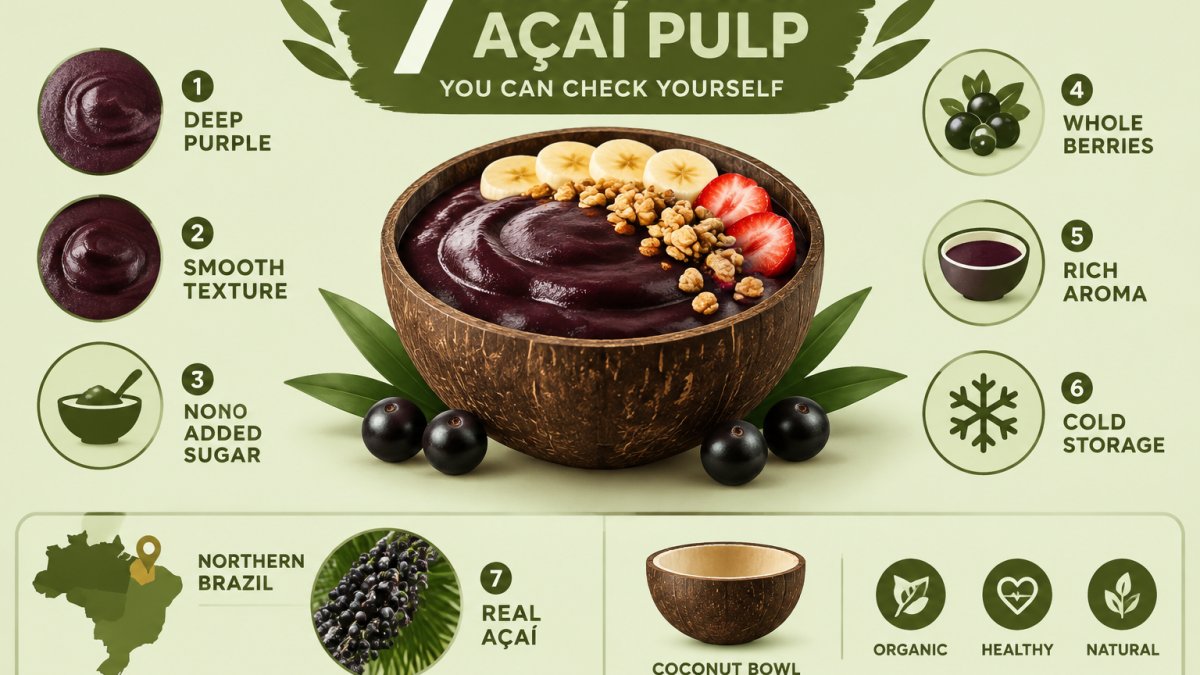
Authentic açaí pulp is deep purple, almost black in places, with a thick, spoonable body and a faint grain from the fruit's solids. It browns over time as it oxidizes. That color shift is normal, not a defect.
What should raise an eyebrow:
- Bright fuchsia or violet color that looks dyed
- Watery, thin consistency that runs off the spoon
- Icy crystals throughout, suggesting a diluted or refrozen product
- A uniform smoothness closer to soft-serve than fruit
If your bowl looks or feels off, our texture guide on why açaí turns icy helps you diagnose it.
Cold-Chain Handling and Spoilage Signs
Açaí is a frozen product from harvest to bowl. Break the cold chain and quality drops fast, and at the far end of that chain, safety does too. Most guides stop at "keep it frozen." The useful version explains what frozen actually means, how thawing works, and how to tell normal oxidation from a product you should throw out.
What "Keep Frozen" Actually Requires
A home freezer set at 0°F keeps frozen açaí solid and stable. A freezer that cycles above that, a frost-free unit during its defrost cycle, or a packed freezer door shelf, lets the surface soften and refreeze repeatedly. That cycling is what produces large ice crystals, freezer burn, and a grainy, watery thaw.
At the store, the check is simple: the pack should be hard as a brick, with no soft shoulders and no liquid pooling in the bag. A pack that yields to thumb pressure has been through a temperature swing somewhere.
Watch out: a resealed or bulging package, torn film, or ice crust inside the bag can mean the product thawed and refroze before it reached the shelf, treat packaging damage as a stop sign, not a cosmetic flaw.
Thawing and Refreezing Rules
The safest pattern is to thaw only what you will use. Move the pack to the refrigerator and let it thaw slowly, or run the sealed pack under cool water if you need it sooner. Once thawed, keep it refrigerated and use it within a short window rather than leaving it at room temperature.
Do not refreeze thawed purée. Refreezing does not restore quality, it wrecks texture and gives any bacteria that multiplied during the thaw a second chance to sit in the product. If you thawed too much, the honest move is to use it or discard it.
Spoilage vs. Normal Oxidation
This is where most people guess wrong. Açaí browns as it oxidizes; that color shift is normal and expected. Spoilage looks and smells different.
Normal oxidation:
- Color drifts from deep purple toward brownish purple
- Texture stays thick and spoonable
- Smell stays earthy and faint
Spoilage or mishandling:
- A sour, fermented, or yeasty smell
- Separation into watery and solid layers that do not recombine when stirred
- Visible mold, or a slimy surface
- A pack that was soft at purchase and stayed soft
Watch out: discoloration alone is not a reason to discard a pack, and a deep purple color is not a reason to trust one. Judge color together with smell, texture, and the pack's history.
Questions Worth Asking at the Shop
At the counter, ask how the açaí is stored and how long a thawed batch is kept. A shop that can answer plainly is telling you something about its handling. A shop that cannot is telling you something too.
Building Your At-Home Inspection Checklist
Use this checklist every time you buy açaí, whether in a store or from a menu.
- Is açaí pulp the first ingredient?
- Are there three or fewer ingredients total?
- Does any sweetener appear in the top three?
- Is a USDA organic seal present with a named certifier?
- Is the color deep purple rather than bright violet?
- Does the texture look thick, not watery or icy?
- Was the product stored frozen and solid?
- Does the label avoid "açaí flavor" in place of fruit?
Score it honestly. Three or more misses means you are likely looking at a sweetened blend, not real pulp.
Ordering a Bowl You Can Trust
Labels tell you a lot. A shop that welcomes questions tells you the rest.
At World Green Açai, we source organic açaí and build bowls around real fruit, not sugar. You can skip the line entirely by ordering through our app or online, and you can order an organic açaí bowl online when you are ready to taste the difference a clean label makes.
Reading labels takes about thirty seconds once you know what to look for. The harder part is finding a shop that meets the standard every single visit. That is the problem we set out to solve. World Green Açai offers organic açaí bowls with convenient online ordering and mobile app access, so a clean, honest bowl is ready when you are.
Frequently Asked Questions
What should you look for on an açaí bowl ingredient label?
Look for açaí pulp or unsweetened açaí purée listed first, with few added sugars or fillers. Check the ingredient order: items are listed by weight, so anything ahead of açaí means it makes up more of the product. Watch for syrups, juice concentrates, and artificial dyes like Red 40. A short list with recognizable ingredients is a better sign than a long one with stabilizers and flavorings.
What is the difference between unsweetened and sweetened açaí purée?
Unsweetened açaí purée contains only açaí fruit, sometimes with a small amount of water or citric acid. Sweetened purée has sugar, syrup, or juice added. Sweetened versions often taste milder and may include fillers. If you want to control sugar, choose unsweetened purée and add your own toppings. Check the nutrition facts for added sugars and compare the ingredient list length.
How can you tell if açaí is organic?
Look for the USDA Organic seal on the package or a certified organic claim from a recognized certifier. The seal means the product meets federal organic standards for growing and processing. Some brands list a certifier code or farm name. If the label says organic but lacks a seal or certification details, treat the claim with caution and ask the seller for verification.
Does açaí bowl granola contain added sugar?
Often yes. Many granolas include honey, maple syrup, or cane sugar to cluster the oats. Check the granola's own ingredient list and the added sugars line on the nutrition facts. If you want to limit sugar, ask for granola on the side or choose a bowl with fresh fruit and nuts instead. The same applies to other toppings like sweetened coconut or chocolate chips.