 blog
Ready to Heat vs Meal Kits: Which Fits Your Week in 2026
Last Updated: November 8, 2026
Quick Summary
Ready-to-heat meals arrive fully cooked and need only reheating, while meal kits arrive as portioned raw ingredients you cook yourself. Ready-to-heat suits busy weeks with almost no prep time, and meal kits suit people who enjoy cooking and want to control costs.
- Calculate cost per serving you actually eat, including shipping and add-ons, not the advertised headline price.
- Ready-to-heat meals often cost less per eaten serving for single-person households because every portion gets used.
- Meal kits usually cost less per serving on paper but can waste money in small households when ingredients go unused.
- Measure total time from delivery to eating, including prep and cleanup, since recipe-card times often leave those out.
- Test the format against your busiest night of the week, not your calmest, to see whether it fits.
Table of Contents
- What Ready to Heat and Meal Kits Actually Mean
- Cost Per Serving: A Like-for-Like Comparison
- Total Time From Delivery to Eating
- Meal Kits vs. Prepared Meals: Nutrition and Ingredient Quality
- How Long Do Ready-to-Heat Meals Last in Storage?
- Meal Kits for Singles: Portions, Waste and Effort
- Choosing the Best Heat and Eat Meal Delivery for Your Week
- Frequently Asked Questions
What Ready to Heat and Meal Kits Actually Mean
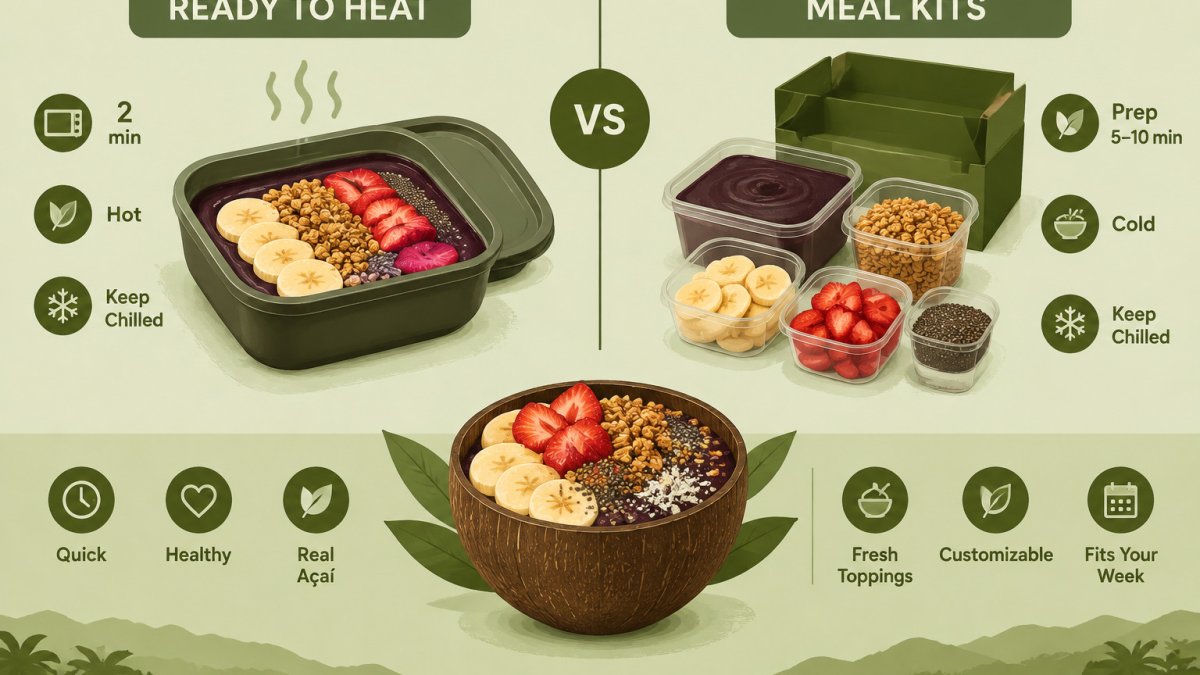
Ready-to-heat meals arrive fully cooked and need only reheating. Meal kits arrive as portioned raw ingredients with a recipe card, and you do the cooking. That single difference drives almost every other comparison from cost to time to effort.
Market researchers at Market.us project that the meal-kit delivery market could generate USD 30.00 billion in 2026. That estimate splits between "Cook & Eat" at USD 18.42 billion and "Heat & Eat" at USD 11.58 billion. The figures do not break out U.S.-only revenue, so treat them as directional rather than precise. For a quick overview of the difference, see Hungryroot's explanation of meal kits versus prepared meals.
Here is the short version. Meal kits ask for time and skill in exchange for lower cost per portion. Ready-to-heat meals ask for almost no time and usually cost more. Neither is better in general. The right pick depends on how much cooking you want to do in a given week.
Cost Per Serving: A Like-for-Like Comparison
Cost is where most people start, and it is where many comparisons go wrong. Prepared meals and meal kits are priced differently, so comparing sticker prices alone is misleading. The useful number is not the advertised per-serving price, it is the realistic total cost per serving you actually eat. For a closer look at whether premium organic açaí justifies its higher price, see whether organic açaí is worth the extra cost.
Build that number in four steps.
- Start with the box total, not the per-serving headline. Multiply the per-serving price by the number of servings in the smallest box you would realistically order. Many services advertise a low per-serving rate that only applies at the largest box size.
- Add shipping. Shipping terms vary by provider, so a smaller box can cost more per serving than a larger one even at the same per-meal rate.
- Add required add-ons or minimums. Some services require a minimum order or charge for certain proteins or premium meals. Fold those into the total before dividing.
- Divide by servings you actually eat, not servings shipped. If a kit ships four servings but one spoils before you cook it, your real cost per eaten serving is higher than the sticker.
A common pattern is that ready-to-heat meals carry a higher per-serving sticker but a lower effective cost for single-person households, because every portion is eaten. Meal kits carry a lower per-serving sticker but a higher effective cost for small households when unused ingredients are counted. The crossover usually happens around households of three or four, where kit portions get fully used.
Watch out: per-serving prices quoted in marketing often assume the largest box and a long commitment; recalculate at the box size and frequency you would actually choose before comparing formats.
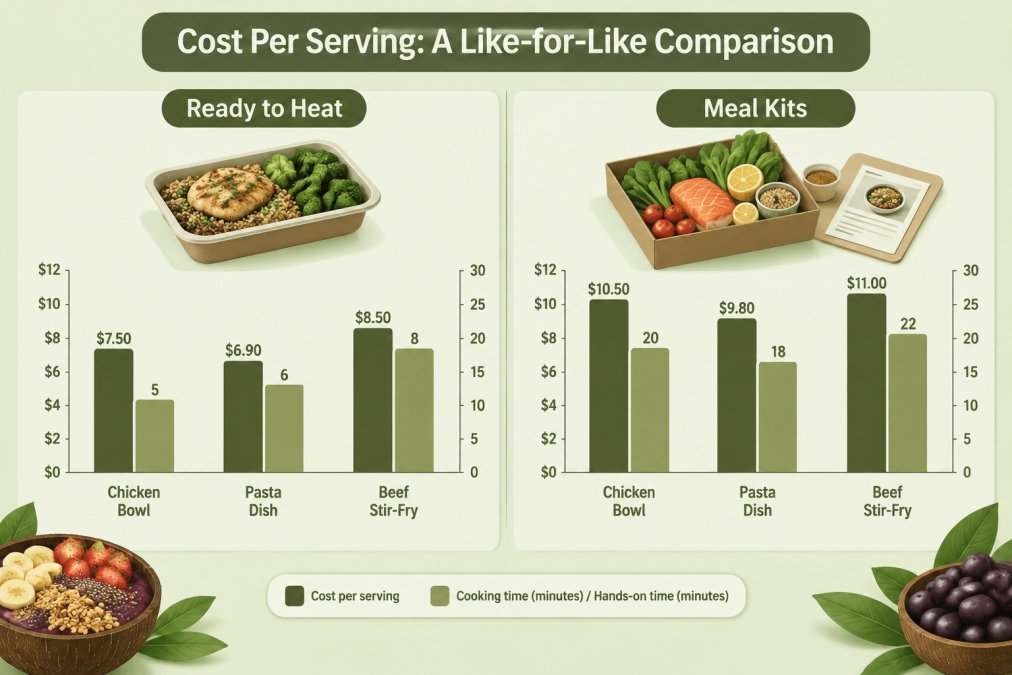
To compare fairly, put both formats on the same basis: total weekly cost including shipping and add-ons, divided by servings actually eaten. You can see a worked cost breakdown for an açaí bowl as a concrete example of this method. That single calculation exposes the cases where the cheaper sticker is the more expensive habit.
Total Time From Delivery to Eating
Cost per serving hides the second big variable: time. Total time runs from the moment the box reaches your door to the moment you sit down to eat, and it breaks into four parts that most comparisons lump together.
- Unpacking and storage: a few minutes to move items to the fridge or freezer. Kits with raw proteins need this done promptly.
- Active prep: chopping, measuring, and assembling. This is the hands-on time that determines whether a kit fits a busy weeknight.
- Cooking: the time on the stove, in the oven, or in the microwave. For ready-to-heat meals this is reheating; for kits it is the full cook.
- Cleanup: pans, bowls, and utensils. Kits typically generate more cleanup than a single reheated tray.
A ready-to-heat meal usually needs a few minutes of reheating and minimal cleanup. A meal kit needs prep, cooking, and cleanup, which can run well past 30 minutes on a busy night even when the recipe card says 30. The gap between advertised cook time and total time is where most of the convenience trade-off lives.
Our advice: track hands-on minutes per meal, not just the advertised cooking time. A kit listed at 30 minutes often needs more once chopping and cleaning are included. A ready-to-heat meal listed at five minutes usually needs about five, plus plating.
Watch out: recipe-card times often exclude prep and cleanup, so a "30-minute" kit can consume closer to 45 minutes of your evening once you count washing up.
For a household deciding between formats, the practical test is to compare total time on your busiest night, not your calmest. If the total time on a Tuesday exceeds what you have, the format does not fit that week regardless of price.
Meal Kits vs. Prepared Meals: Nutrition and Ingredient Quality
Nutrition is harder to judge than cost or time, and the research here is limited.
Nutrition depends heavily on the specific provider. Check the sodium, portion size and ingredient list on each meal rather than assuming a format is healthy. Meal kits give you more control over ingredients because you handle the cooking. Prepared meals give you less control but less effort.
How Long Do Ready-to-Heat Meals Last in Storage?
Storage affects waste, and waste affects real cost. Ready-to-heat meals are typically stored chilled or frozen until you reheat them. Follow the storage and use-by guidance printed on each package, since shelf life varies by product and provider.
Meal kits require you to refrigerate raw ingredients and cook them within the window the provider lists. Plan your cooking days around delivery so ingredients do not sit unused.
Meal Kits for Singles: Portions, Waste and Effort
Many meal kits are built for two or four people. A single person can end up with leftover ingredients, which raises the effective cost per serving and adds to food waste. Look for single-serving or smaller-portion options if you live alone.
Prepared meals often suit singles better because each meal is already portioned. The tradeoff is price and less control over what goes into each dish.
Choosing the Best Heat and Eat Meal Delivery for Your Week
Start with three questions: How much time can you spend cooking? What is your weekly budget per serving? How many people are you feeding? If you want the least effort, a heat-and-eat service fits best. Local ready-to-eat options are also worth comparing against delivery. If you enjoy cooking and want to control costs, a meal kit usually wins.
Compare providers on menu variety, dietary options, delivery coverage and minimum order requirements. For a broader framework, see Healthline's guide to choosing a healthy meal delivery service. You can also use our guide to how to choose the best healthy meal delivery service before committing to a plan.
Whatever you choose, track the actual time and money spent for two weeks, then adjust.
Frequently Asked Questions
What is the difference between ready-to-heat meals and meal kits?
Ready-to-heat meals arrive fully cooked or nearly so, and you only warm them in a microwave or oven. Meal kits include raw or prepped ingredients and a recipe card, so you do the cooking yourself. The practical gap is hands-on time: a ready-to-heat meal takes a few minutes, while a meal kit usually takes 30 to 45 minutes of active cooking. Prices and delivery terms vary by provider, so check current pricing on each company's website before you subscribe.
Are ready-to-heat meals cheaper than meal kits?
Usually not. Ready-to-heat meals typically cost more per serving because the provider handles the cooking and labor. Meal kits generally cost less per serving but require more time at the stove. Compare the total price per serving, including shipping fees and any minimum order, before deciding. Exact figures depend on plan size, delivery area and promotions, so confirm them directly with the provider.
Which is healthier: prepared meals or meal kits?
Neither format is automatically healthier. Nutritional value depends on the specific menu, portion sizes and sodium content. Read the nutrition labels and compare calories, protein and sodium per serving across the options you are considering.
How long do ready-to-heat meals last in the refrigerator?
Most ready-to-heat meals stay safe in the refrigerator for a limited window after delivery, and the exact date is printed on each package. Follow that date and the storage instructions on the label, and refrigerate them promptly on arrival. Once heated, eat the meal within the time the label specifies and do not refreeze it unless the packaging says it is safe to do so.