 Ultimate guide
Sustainable Açaí Harvesting: What It Means for the Amazon
Last Updated: November 16, 2026
Quick Summary
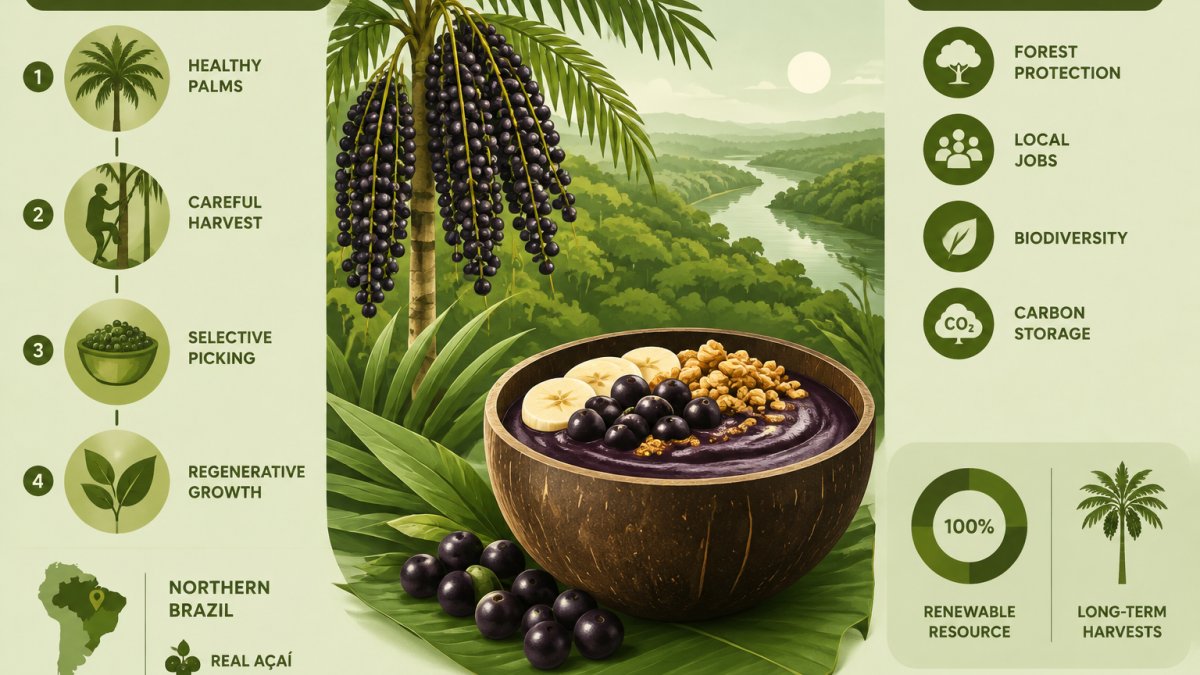
Sustainable açaí means harvesting fruit from managed floodplain forest at responsible intensity, leaving fruit for wildlife and regeneration, and keeping shade trees and companion species in place. Done this way, it gives communities a reason to keep standing forest standing, while cultivated monoculture expansion can drive habitat conversion and biodiversity loss.
- Brazil's açaí harvest is projected to reach 2 million metric tons in 2026, up 11% from 2025.
- A 2026 study links açaí's global market integration to deforestation, biodiversity loss, and heavier agrochemical use.
- Harvesters should climb palms rather than fell them and leave a share of fruit for wildlife.
- Downstream stages like transport, refrigeration, and packaging can dominate a finished product's total footprint.
- SAMBAZON reported diverting 96.3% of its waste from landfills in 2025, over 59 million pounds of açaí.
Table of Contents
- How Sustainable Açaí Harvesting Affects the Amazon
- Sustainable Açaí Production: What It Actually Requires
- Açaí and Deforestation: Separating Risk From Reality
- Amazon Agroforestry: The Case for Growing Açaí in the Forest
- Açaí Harvesting Practices That Protect or Harm Ecosystems
- Environmental Impacts vs. Traditional Harvesting: Summary Table
- What to Look For in a Bowl You Can Feel Good About
- Frequently Asked Questions
How Sustainable Açaí Harvesting Affects the Amazon
Brazil's açaí harvest is projected to hit 2 million metric tons in 2026, an 11% jump over 2025, per the USDA Foreign Agricultural Service's Global Acai Report. That scale is exactly why the environmental impact of sustainable acai harvesting matters: the same palm that feeds a booming global market can either protect standing forest or accelerate its conversion. At World Green Açai, we build our bowls around organic fruit, so we follow this debate closely. Below, we break down what sustainable açaí actually means, where deforestation risk is real, and how to judge a bowl or a supplier with confidence.
The two sides of a booming global demand
Açaí is a genuine economic engine for rural Amazon communities. It is also, at scale, a crop with documented environmental costs.
A 2026 study by J. Ardenghi and coauthors links açaí's integration into global markets with land-use change, deforestation, biodiversity loss, rising water demand, and heavier agrochemical use, according to the published research summary.
So the honest answer is uncomfortable: demand growth is not automatically good for the forest. Whether it helps or hurts depends almost entirely on how and where the fruit is grown and harvested.
Sustainable Açaí Production: What It Actually Requires
Sustainable açaí production is the practice of harvesting fruit from managed forest systems in ways that maintain biodiversity, soil, and water resources while sustaining community income over time. It is not a single certification or a marketing label; it is a set of land-management and harvesting decisions.
In practice, that means:
- Forest-based management rather than clearing for monoculture palm stands
- Managed harvest intensity that leaves enough fruit for wildlife and natural regeneration
- Agroforestry integration that keeps shade trees and companion species in place
- Waste handling that keeps pulp and seed waste out of waterways and landfills
- Traceable sourcing so buyers can verify where and how fruit was harvested
Voluntary sustainability standards are one tool for verifying these claims, though a 2024 paper on the açaí value chain notes the evidence on their outcomes is still being assessed. For a closer look at how certification is structured, see our breakdown of organic açaí certification standards.
Açaí and Deforestation: Separating Risk From Reality
Açaí and deforestation are connected, but not in the simplistic way many shoppers assume. Açaí palms grow naturally in floodplain forests; the deforestation risk comes from how production scales.
The distinction that matters is wild harvesting versus cultivated production. Wild harvesting, done at responsible intensity, works within existing forest. Cultivated expansion, especially monoculture, can drive habitat conversion, reduce biodiversity, and increase water demand and agrochemical reliance, as the 2026 Ardenghi study documents.
The nuance most coverage misses: a forest-associated crop is not automatically forest-friendly. Market expansion creates pressure, and that pressure lands on land use.
Amazon Agroforestry: The Case for Growing Açaí in the Forest
Amazon agroforestry is the practice of integrating açaí palms with other trees and crops in a managed forest system, rather than replacing forest with a single-species stand. It is the model most closely associated with positive conservation outcomes.
The United Nations Development Programme describes an initiative promoting agriculture that combines sustainable food production, income generation, and environmental aims. The UN Decade on Ecosystem Restoration highlights an açaí initiative where sustainable harvests reduce deforestation pressure and create incentives for conservation.
The logic is straightforward: when standing forest produces reliable income, communities have a reason to keep it standing. Agroforestry makes that income compatible with ecosystem health rather than in conflict with it.
Açaí Harvesting Practices That Protect or Harm Ecosystems
Açaí harvesting practices determine whether the supply chain protects or degrades the forest. The difference comes down to intensity, method, timing, and waste handling, and the mechanisms are more specific than most coverage admits.
How harvest intensity changes the forest
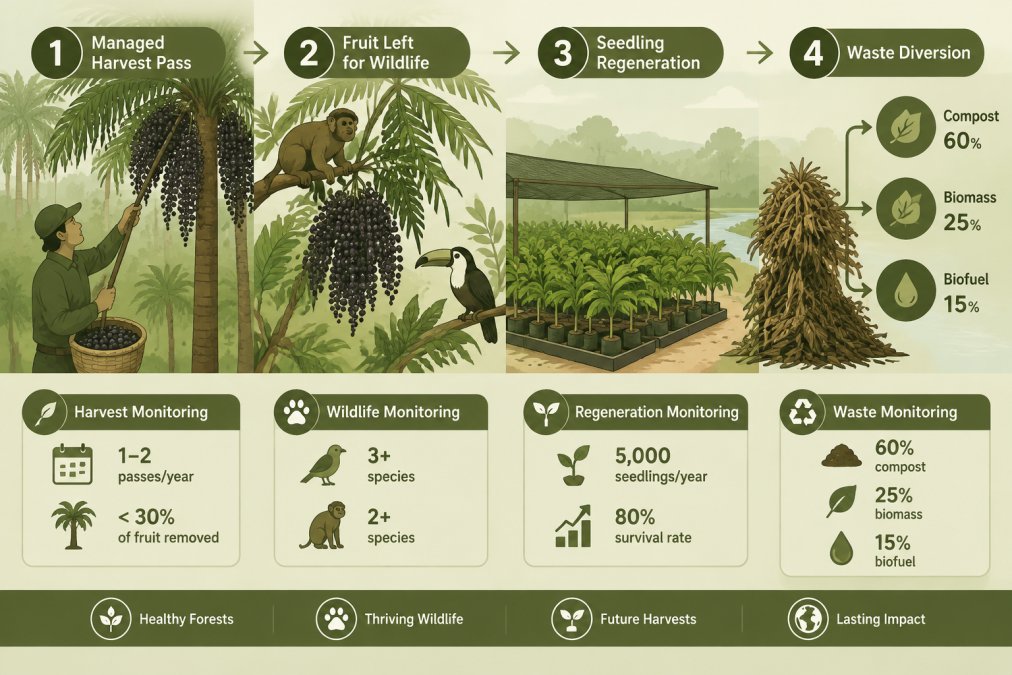
Açaí palms are managed in floodplain forest, and the fruit is a food source for fish, birds, and mammals. When harvesters remove too high a share of ripe fruit from a given palm or a given stand, three things happen: less fruit reaches wildlife, fewer seeds drop to regenerate the understory, and the palm puts more energy into the fruit that remains. Leaving a meaningful share of fruit on each palm, and rotating which stands are harvested, is generally discussed as a way to support regeneration and wildlife food availability. The exact threshold varies by site, so the practical answer is monitoring rather than a single universal number.
Practical ecological indicators to watch
- Fruit removal rate per palm: the share of ripe fruit taken in a harvest pass; track it per stand, not per region.
- Regeneration counts: seedling and young-palm density in harvested versus unharvested plots.
- Canopy and understory structure: whether shade trees and companion species remain after harvest cycles.
- Wildlife food availability: whether fruit remains on palms and on the ground after harvest.
- Waterway condition: whether pulp and seed waste are entering streams and floodplain channels.
Protective practices:
- Harvesting fruit by climbing rather than felling palms
- Leaving a share of fruit for wildlife and regeneration
- Rotating harvest areas to allow recovery
- Composting or repurposing seed and pulp waste
- Keeping harvest records so intensity can be checked over time
Harmful practices:
- Clear-cutting forest to plant açaí monoculture
- Over-harvesting that starves wildlife and blocks regeneration
- Dumping processing waste into waterways
- Expanding cultivation into intact habitat
- Harvesting without records, which makes intensity impossible to verify
SAMBAZON reported diverting 96.3% of its waste from landfills in 2025, involving more than 59 million pounds of açaí, according to PR Newswire's coverage of its 2025 Impact Report. That is the circular-economy standard the industry should be measured against, and it is one of the few publicly reported waste figures a buyer can actually compare against.
Environmental Impacts vs. Traditional Harvesting: Summary Table
Most comparisons stop at the farm gate. The angle this table takes is different: it separates impacts by lifecycle stage and adds a verification column, so a buyer can see not just which production system looks better but what evidence would actually confirm the claim.
| Lifecycle Stage | Wild / Forest Harvesting | Cultivated / Monoculture | What to Verify |
|---|---|---|---|
| Land-use change | Lower: works within standing forest | Higher: can drive habitat conversion | Land-use history and origin records for the stand |
| Biodiversity | Lower risk when harvest intensity is managed | Higher risk from single-species stands | Harvest-intensity records and regeneration counts |
| Water demand | Lower, rain-fed floodplain systems | Higher with irrigation and scale | Irrigation source and water-use records |
| Agrochemical use | Minimal | Can increase with intensive cultivation | Organic certification and input records |
| Harvest and transport | Labor-intensive climbing; transport distance varies | Mechanized harvest; transport distance varies | Worker safety training and transport distance |
| Processing and pulp extraction | Energy use depends on facility scale | Energy use depends on facility scale | Processing energy source and facility audits |
| Packaging and refrigeration | Cold chain and packaging dominate downstream emissions | Cold chain and packaging dominate downstream emissions | Cold-chain length and packaging material |
| Waste stream | Manageable with circular handling | Higher volume of pulp and seed waste | Waste diversion rate and disposal method |
| Community income | Supports forest-dependent livelihoods | Can concentrate production and value | Price paid to harvesters and contract terms |
Reading the table honestly
The farm-stage rows favor forest-based harvesting, but the downstream rows, transport, processing energy, refrigeration, packaging, and waste, can dominate the total footprint of a finished product. A forest-sourced fruit shipped long distances in a heavy cold chain is not automatically lower-impact than a locally processed one. The practical takeaway is that sustainability claims should be judged across the full lifecycle, not just at the point of harvest.
A practical verification checklist
- Origin and land-use history for the specific stand, not just the region
- Harvest-intensity and rotation records
- Organic or sustainability certification with a certificate number you can check
- Labor conditions, including climbing safety training and equipment
- Processing facility audits and energy source
- Waste diversion figures with a stated baseline
Watch out: a certification logo on packaging is not the same as a verifiable audit trail, ask for the certificate number and the scope it covers before treating it as proof of sustainable sourcing.
What to Look For in a Bowl You Can Feel Good About
For a shopper, the environmental impact of sustainable acai harvesting comes down to a few practical checks. You cannot audit a supply chain from a menu, but you can look for the signals that separate real sourcing from marketing.
- Does the shop describe its fruit as organic and forest-sourced?
- Is the açaí thick and dark rather than sweet and pale, a sign of real fruit over filler?
- Does the business talk openly about sourcing and waste?
- Are there certifications or standards you can verify?
If you want the deeper context on whether the fruit itself is sustainable, read is açaí actually sustainable. For help judging quality before you buy, our guide on how to choose high quality açaí products walks through what to look for. And if you want eco-friendly ways to build your bowl, see our list of eco-friendly acai bowl toppings.
At World Green Açai, we keep it simple: organic fruit, handcrafted bowls, and a story you can read for yourself in our story.
The environmental case for açaí is real, but it depends on sourcing you can trust. World Green Açai makes that easier with organic fruit, handcrafted bowls, and online ordering through our app so you can skip the line and get a nutrient-packed lunch fast. Order ahead and taste the difference real açaí makes.
Frequently Asked Questions
How does açaí harvesting affect the Amazon rainforest?
It depends on how the fruit is harvested. Wild harvesting in managed floodplain forests can keep trees standing and support forest-dependent livelihoods, while clearing forest for cultivated açaí or other crops drives land-use change and biodiversity loss. Sustainable açaí sourcing depends on harvest intensity, forest management, and traceability across the supply chain.
Is açaí harvesting sustainable?
Sustainable açaí harvesting is possible but not automatic. It requires managed wild stands or Amazon agroforestry systems, harvest levels that leave enough fruit for wildlife and regeneration, and verification that fruit comes from forest-friendly sources.
What are the environmental downsides of açaí production?
The main risks are land-use change and deforestation when forest is converted to açaí palms or other crops, biodiversity loss from habitat conversion and monoculture, higher water demand, and waste from pulp extraction and seed disposal.
How can consumers identify sustainably harvested açaí?
Look for brands that disclose where their fruit comes from, whether it is wild-harvested or cultivated, and how they handle waste and forest management. Certifications and voluntary sustainability standards can help, but they vary in rigor, so pair them with published impact reports. Ask about harvest intensity and Amazon agroforestry practices, and favor shops that can trace their pulp back to specific communities or cooperatives.